
All news
April 12, 2026
Study Abroad 101
Weighted vs Unweighted GPA: What International Students Need to Know
Weighted vs unweighted GPA explained for international students: how each is calculated, how US universities use GPA, and the Top 100 Guarantee requirement.

Weighted vs Unweighted GPA: What International Students Need to Know
Last Updated: April 2026
Weighted vs unweighted GPA is the distinction between two methods US high schools use to calculate grade point averages. An unweighted GPA (Grade Point Average) scales grades on a 4.0 system regardless of course difficulty, while a weighted GPA assigns extra points for advanced courses such as AP (Advanced Placement) and Honors classes - typically on a 5.0 scale. According to NACAC (2024), grades in college preparatory courses remain the most heavily weighted factor in US university admission decisions, and understanding how GPA is reported affects how international students plan their course selection.
Amerigo Education partners with 40 Niche A+/A rated schools across the US, Canada, and the UK, supporting 3,500+ students from 55+ countries. The Class of 2025 achieved 97% admission to Top 100 US universities. Amerigo's Top 100 Guarantee uses cumulative GPA as one of its four eligibility conditions, and academic planning at US Signature Schools is structured to maximize students' GPA trajectory over two years.
This guide explains how weighted and unweighted GPA systems work, how each type is reported to US universities, what GPA thresholds matter for Top 100 admission, and how Amerigo helps international students build a GPA that supports their university goals.
Key Takeaways
- Unweighted GPA Is the Standard Benchmark: Most US universities normalize GPA to a 4.0 unweighted scale for comparison - even when applicants submit weighted GPAs from their transcripts.
- Weighted GPA Signals Course Rigor: A weighted GPA above 4.0 tells admissions officers that a student completed AP and Honors courses - course rigor is evaluated alongside the GPA number.
- Top 100 Guarantee Uses Cumulative GPA: Amerigo's Top 100 Guarantee requires a cumulative GPA of 3.2 or above at an Amerigo US Signature School - calculated from coursework completed during the enrollment period.
- AP Access at Signature Schools: Amerigo Signature School partnerships include 20+ AP courses, giving students access to the weighted credit opportunities that strengthen both GPA and admission profiles.
- GPA Alone Is Not Sufficient: US universities evaluate GPA alongside English proficiency scores, course rigor, counselor letters, and extracurricular activity - the full academic profile matters, not GPA in isolation.
What Is the Difference Between Weighted and Unweighted GPA?
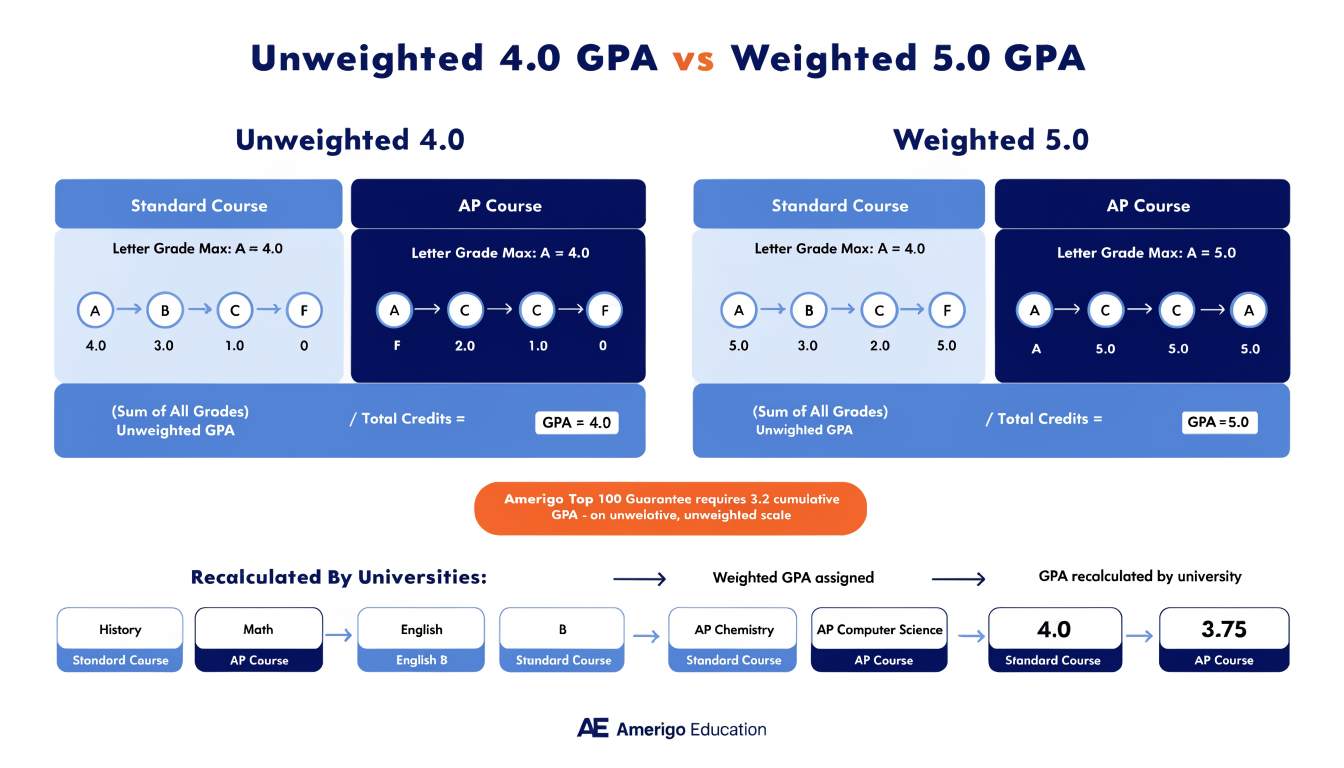
An unweighted GPA measures academic performance on a fixed 4.0 scale: A = 4.0, B = 3.0, C = 2.0, D = 1.0, regardless of whether the course is standard, Honors, or AP level. A weighted GPA adds grade points for advanced coursework - typically 0.5 for Honors and 1.0 for AP - so an A in an AP course earns 5.0 on a weighted scale. According to College Board (2024), most US high schools report both GPA types on the transcript alongside a school profile that contextualizes which courses were weighted.
For international students, understanding which GPA a US university uses for comparison matters because admissions offices normalize reported GPAs to an internal scale for ranking purposes. A weighted 4.3 GPA from a school with many AP courses may be recalculated differently from a weighted 4.3 at a school with fewer options.
- Unweighted GPA (4.0 scale): Treats all courses equally; measures raw grade performance without accounting for course difficulty.
- Weighted GPA (typically 5.0 scale): Adds bonus points for AP and Honors courses; reflects both grade performance and academic challenge level.
- School profile context: Admissions officers read the school profile alongside the transcript to understand which courses were available - this context matters for GPA interpretation.
How Do US Universities Use GPA in Admission?
US universities typically recalculate applicant GPAs internally using their own formula. This means a weighted GPA submitted on a transcript may be adjusted to an unweighted 4.0 equivalent for comparison across applicants from different schools. According to NCES (2024), US colleges and universities serve a highly diverse applicant pool using many different grading systems, which makes internal GPA recalculation standard practice at selective institutions.
For international students at Amerigo US Signature Schools, the transcript submitted to universities includes the GPA on the school's standard scale, accompanied by a school profile and counselor letter that contextualizes course availability, Niche A+/A school quality, and the student's standing in the class.
- Top 30 universities: Typically expect unweighted GPA of 3.7 or above alongside strong AP and Honors course rigor and extracurricular depth.
- Top 50 universities: Generally look for 3.5+ GPA; strong essays and counselor recommendations support applications at this tier.
- Top 100 universities: Most accessible at 3.2-3.5 unweighted GPA with at least one advanced course - the Amerigo Top 100 Guarantee threshold.
How Does AP Course Access Affect GPA?
Completing AP and Honors courses provides two distinct benefits: the weighted GPA bonus on the transcript and the signal of academic rigor to admissions officers. According to College Board (2024), students who complete AP courses and exams demonstrate college-level academic readiness, a factor that US admissions officers actively evaluate. Failing an AP exam does not remove the weighted GPA credit earned during the course - it simply means the student does not receive college credit at the university for that subject.
At Amerigo Signature School partnerships, students have access to 20+ AP courses. Amerigo's academic planning team identifies prerequisite courses needed before AP enrollment, ensuring international students start the course progression that maximizes weighted GPA opportunity during their two-year enrollment period.
- Weighted GPA bonus: An A in an AP course earns 5.0 on a weighted scale vs 4.0 on an unweighted scale - one AP A lifts the weighted cumulative GPA above 4.0.
- Course rigor signal: Admissions officers note how many AP and Honors courses appear on the transcript, not just the GPA number.
- Prerequisite planning: Amerigo's team maps the two-year course plan from the first pre-departure call, identifying which courses qualify a student for AP access in senior year.
What GPA Do International Students Need for US Universities?
The GPA threshold for US university admission varies by institution tier, but the consistent benchmark for Top 100 universities is a cumulative unweighted GPA of 3.2 or above. For Top 30 institutions, the effective threshold rises to 3.7 or higher alongside AP and Honors course rigor. Amerigo's Top 100 Guarantee sets 3.2 as the GPA floor for guarantee eligibility - not the ceiling for university admission ambitions.
The four conditions for the Top 100 Guarantee are: two consecutive years of enrollment at an Amerigo US Signature School, cumulative GPA of 3.2 or above, TOEFL 85 or above, and completion of at least one AP, IB, or Honors course during the enrollment period. Students who meet all four conditions at eligible US Signature Schools receive guaranteed Top 100 placement or a refund of up to $50,000 USD in senior year tuition.
How Does Amerigo Help International Students Build GPA?
Amerigo's approach to GPA development starts before arrival. Each student completes a 1:1 pre-departure call with an Amerigo academic director to review transcripts, set a course plan that targets GPA 3.2+, and confirm course registration for the first semester. Students at US Signature Schools also receive support from the on-campus international department, including in-residence homework help, academic tracking, and structured study hours with campus staff available.
Families receive monthly progress reports, school activity calendars and event announcements throughout the year, with real-time outreach when academic performance needs immediate attention. Amerigo also hosts its own social events for students and their friends separate from school-organized activities, supporting the balanced engagement that prevents academic burnout during the GPA-building period.
- Pre-departure transcript review: Academic director assesses the student's prior record and sets a realistic GPA target and course plan for the first semester.
- In-school ELL (English Language Learning) support: For students still developing English, in-school ELL courses are built into the schedule without displacing core GPA-eligible coursework.
- Academic counseling: Students can schedule meetings with Amerigo academic counselors throughout the year to address grade concerns before they affect the cumulative GPA.
- Subject tutoring: Subject-specific tutoring is available (additional costs may apply) for courses where extra support is needed to protect GPA performance.
- Monthly Progress Reports: Families receive monthly progress reports throughout the academic year, allowing parents and counselors to track GPA trends and identify early where additional academic support may be needed.
Frequently Asked Questions
How is weighted GPA calculated compared to unweighted GPA?
Unweighted GPA scores all courses on a 4.0 scale regardless of difficulty: an A is always 4.0. Weighted GPA adds bonus points for AP and Honors courses, typically 0.5 for Honors and 1.0 for AP, so an A in an AP course earns 5.0 on a weighted scale. Most US universities recalculate submitted GPAs to an internal standard for comparison, so both types are part of the application evaluation process.
Which GPA type do US universities prefer?
US universities typically recalculate all submitted GPAs to an internal standard for comparison, which means neither type gives an automatic advantage. What matters most is the combination of GPA score and course rigor: a 3.8 unweighted GPA with several AP courses is evaluated differently from a 3.8 with standard-level courses only. Admissions officers read the school profile alongside the transcript to understand the academic context.
What GPA do I need for the Amerigo Top 100 Guarantee?
The Top 100 Guarantee requires a cumulative GPA of 3.2 or above at an Amerigo US Signature School, alongside three other conditions: two consecutive years of enrollment, TOEFL 85 or above, and at least one AP, IB, or Honors course. The 3.2 threshold is the minimum for guarantee eligibility - students aiming for Top 50 or Top 30 universities should target 3.5 or higher with stronger course rigor.
Can a B1 English student achieve a 3.2 GPA in US high school?
Yes. Amerigo's Class of 2025 data shows 83% of low-B1 English entrants achieving Top 100 university admission, which requires meeting the 3.2 GPA threshold. In-school ELL support is built into the program, and Amerigo's academic planning ensures students are not placed in courses beyond their current English level in the first semester. GPA builds progressively as English and academic confidence develop over two years.
Does an AP exam failure affect the GPA from the course?
No. The weighted GPA credit earned during an AP course is based on the grade received in the class throughout the year, not on the end-of-year AP exam result. A student who earns an A in AP Chemistry all year receives the weighted GPA credit even if they score a 2 on the AP exam. The exam result affects whether the student earns college credit at a US university - it does not change the high school GPA.
How does the on-campus team monitor student GPA progress?
Students at US Signature Schools receive support from the on-campus international department, which monitors academic performance and issues monthly progress reports, school activity calendars and event announcements to families throughout the year. For grade concerns that arise between monthly reports, the on-campus team reaches out immediately. Students can also schedule meetings with Amerigo academic counselors to review their GPA trajectory and adjust their course plan.
What are the top AP courses for GPA and university admission?
AP courses in STEM subjects (AP Calculus, AP Chemistry, AP Biology, AP Physics) are particularly valued at research-oriented Top 100 universities. AP English Language and AP History courses strengthen writing-intensive applications. The right AP course choice depends on the student's academic strengths and target universities - Amerigo's academic counselors help identify which AP courses align with each student's university shortlist.
How many AP courses should an international student take?
Most Top 100 universities expect at least one AP course for the Amerigo Top 100 Guarantee, but Top 50 and Top 30 applicants typically take 2-4 AP courses across junior and senior year. The number depends on the student's English proficiency, subject strengths, and GPA risk tolerance. Taking too many AP courses can lower the GPA if grades suffer - Amerigo's academic team calibrates the AP load to protect the cumulative GPA while meeting admission targets.
Can homestay students maintain the same GPA support as residential students?
Yes. Homestay students receive academic support at the on-campus international department office, access to structured study hours, and the option to schedule meetings with Amerigo academic counselors. Residential students receive in-residence homework help in addition to the same on-campus support. The academic tracking and monthly progress reports, school activity calendars and event announcements are provided to all students regardless of accommodation type.
Conclusion
Weighted and unweighted GPA are two measures of academic performance that US universities interpret alongside course rigor, English proficiency scores, and counselor context. International students at Amerigo US Signature Schools receive structured academic planning from pre-departure through senior year to build the GPA and course record that Top 100 universities evaluate most favorably.
Start Building Your US Academic Record
To explore which Amerigo partner school fits your student's academic profile, use find your school or contact us to speak with an enrollment advisor about course planning and GPA strategy. To begin the enrollment process, apply now - applications are open year-round at most Signature Schools.
People Also Read
- What GPA Do International Students Need for Top US Universities? Strategic Guide 2026
- Why US High School Transcripts Give International Students a University Admission Advantage
- 97% Top 100, 60% Top 50, 25% Top 30: Which University Tier Should You Target?
About the Author
This guide was written by the Amerigo Education content team, drawing on program data from staff operating the on-campus international department at 40 Niche A+/A rated US, Canadian, and UK partner schools. Learn more about Amerigo Education.
Disclaimer: This article provides general information for educational purposes only. Families should conduct independent research, request current program data from providers, and consult with program representatives regarding specific circumstances. Contact us with questions.