All news
March 5, 2026
Study Abroad 101
US High School Pathway vs International School Outcomes
US high school pathway vs home country international school: compare curriculum, university outcomes, cost, and English immersion for families in 2026.

US High School Pathway vs International School Outcomes
Last Updated: March 2026
A US high school pathway is a full-enrollment program at an accredited American high school where an international student completes Grade 9 through 12 on an F-1 visa (student visa for academic programs), earning the same diploma as domestic students. According to IIE Open Doors (2024), the United States hosts over 1 million international students across all levels. This guide compares that pathway against completing high school at an international school in the student's home country.
Amerigo Education operates one of the most structured US high school pathway programs available, supporting 3,500+ students from 55+ countries through 40 Niche A+/A rated partner schools in the US, Canada, and the UK. The Class of 2025 achieved a 97% Top 100 university admission rate. This guide compares both pathways across curriculum, outcomes, cost, and English development.
Key Takeaways
- US pathway students earn a diploma evaluated without credential conversion: Admissions officers read US transcripts on the same 4.0 GPA (Grade Point Average) scale used for domestic applicants, removing the interpretive step required for IB or A-Level credentials.
- Full English immersion accelerates proficiency faster than classroom-only instruction: Students in a US high school use English in every class, activity, and social interaction from day one.
- AP (Advanced Placement) exams are scored 1-5 on a standardized national scale: According to College Board (2024), AP courses are offered in more than 38 subjects, and scores integrate directly into the US transcript format.
- 97% of the Class of 2025 gained admission to Top 100 US universities: Amerigo Education's results span 3,500+ students from 55+ countries, including students who entered with B1 English proficiency.
- US pathway programs cost $40,000 to $110,000 or more per year: This includes tuition, accommodation, on-campus international department support, and university counseling.
How Do US Universities Evaluate Each Pathway?
US university admissions offices evaluate applications through comprehensive review, which includes GPA, course rigor, standardized test scores, extracurriculars, recommendation letters, and essays. For students from a US high school, every component is produced within the same system admissions officers use daily. The credential requires no conversion.
For students from a home country international school, the admissions office must interpret the overseas credential. An IB (International Baccalaureate) diploma converts to a GPA equivalent, while A-Level grades require more interpretation. According to the National Association for College Admission Counseling (2024), selective US universities have frameworks for evaluating international transcripts, but the interpretive step adds uncertainty.
How Do AP Courses Compare to IB and A-Levels?
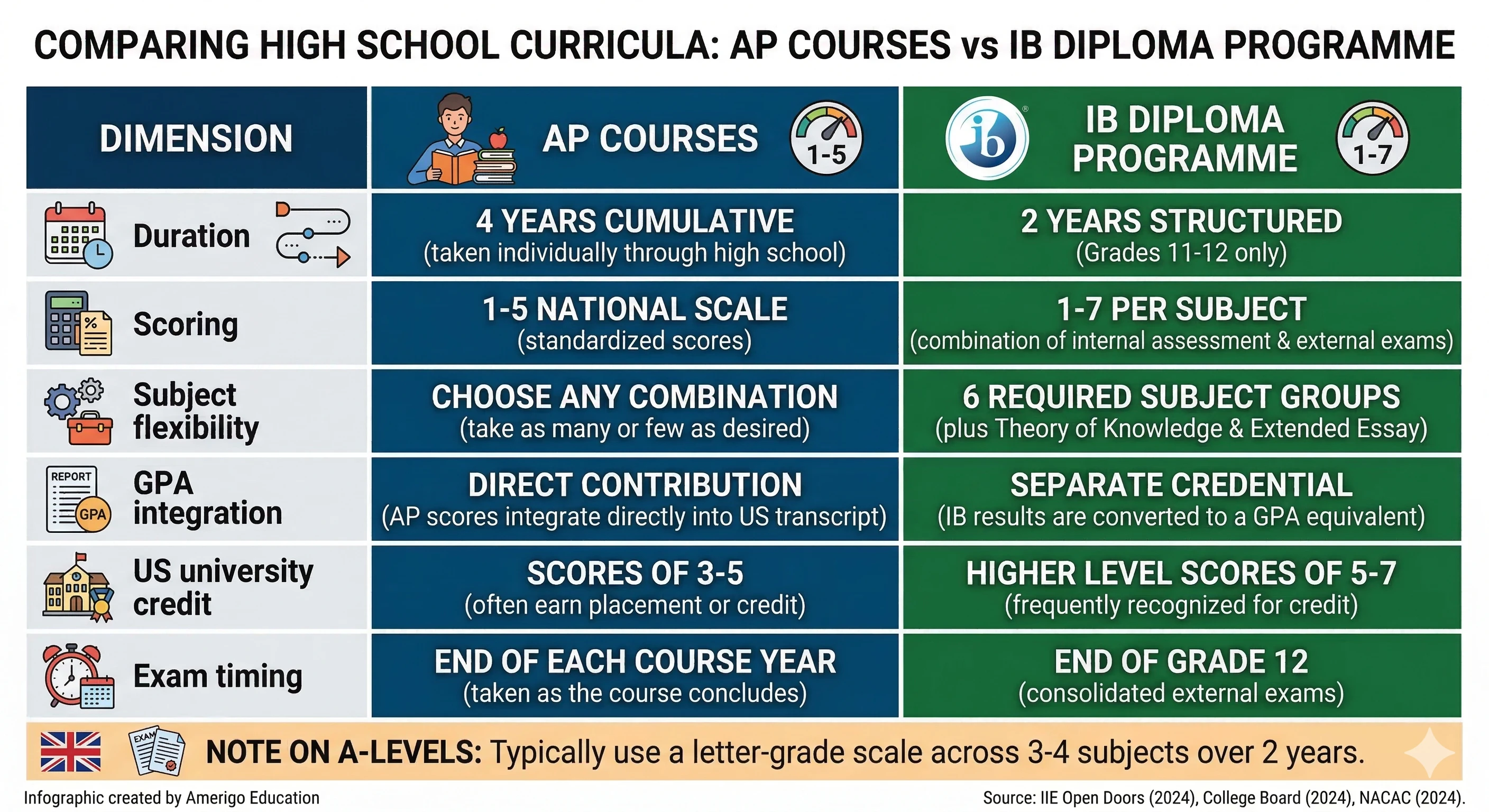
AP courses are individual college-level subjects taken within the standard US high school schedule, with national exams scored 1 to 5. Students can take anywhere from 1 to 10 or more AP courses depending on the school's offerings. The IB Diploma Programme is a two-year structured curriculum completed in Grades 11 and 12, while A-Levels are a UK curriculum with external exams over two years.
The key difference is how each credential integrates into the US application. AP scores contribute directly to the GPA and are taken across multiple years. IB and A-Level exams are concentrated at program end. US universities accept all three, but AP scores require no translation because they exist within the US academic framework. At Amerigo Education's partner schools, students access 20 or more AP courses alongside domestic classmates with support from the on-campus international department.
Which Pathway Produces Better University Outcomes?
University admission outcomes depend on the quality of each individual school, the student's academic effort, and the university counseling available. A top-tier home country international school with experienced US-trained counselors and strong IB results can produce strong US university outcomes. The pathway matters less than the specific program quality.
When comparing structured US pathway programs to equivalent home country options, the US pathway tends to produce stronger US university outcomes. The Class of 2025 at Amerigo Education's Signature Schools achieved 97% Top 100 and 60% Top 50 university admission.
- Credential format - US diploma requires no conversion for US admissions
- Extracurricular context - activities documented through the Common Application
- English immersion depth - full daily immersion vs classroom-only exposure
- University counseling integration - daily access vs scheduled appointments
- Recommendation letter format - US teachers write in the style admissions offices expect
- Standardized testing access - SAT/ACT test centers and prep built into the school calendar
What Does Each Pathway Cost Families?
US high school pathway programs, including tuition, accommodation, and support services, typically range from $40,000 to $110,000 or more per year. This covers the US academic credential, on-campus support, university counseling, and full English immersion. Visa services are provided through third-party consulting agencies and billed separately.
Home country international schools vary widely. Elite schools in Shanghai, Singapore, Hong Kong, Seoul, and Dubai charge $20,000 to $50,000 or more per year. According to IIE Open Doors (2024), the US remains the top destination for international students globally, reflecting family investment in the US credential's value.
Amerigo Education's programs include tuition, accommodation through either homestay, on- and off-campus residences, or self-provided accommodation, and support from the on-campus international department. Homestay provides cultural immersion at a more affordable cost. On- and off-campus residences are single-gender, located 20-30 minutes from schools, with 24/7 staff and dedicated study areas - a model that enables access to top day schools that do not offer boarding.
How Does English Proficiency Develop Differently?
A US high school pathway provides full English immersion from the first day of enrollment. Every class, extracurricular activity, lunch conversation, and weekend interaction takes place in English. This constant exposure produces faster spoken fluency and stronger academic writing, both of which directly affect TOEFL scores and application essays.
Home country international schools deliver instruction in English, but the social environment outside the classroom often defaults to the students' shared home language. Amerigo Education supports English development through in-school customized ELL (English Language Learning) courses, subject-specific tutoring, and evening study groups, with monthly progress reports tracking each student's advancement.
What Support Services Differ Between Pathways?
Support services are where US high school pathway programs and home country international schools differ most sharply. A structured US pathway provides integrated academic planning, university counseling, accommodation management, and family communication through a single program.
Amerigo Education's support model includes individualized academic planning, in-residence homework help, university counseling beginning in Grade 9 or 10, monthly progress reports, native-language communication support for families from China, Vietnam, Korea, Mexico, and the Taiwan Region, and more. The program also includes 24/7 emergency assistance. Students also access Life360 or Reach safety technology.
- University counseling start date - Grade 9/10 vs Grade 11/12
- Academic monitoring frequency - monthly reports vs semester-only updates
- Emergency support availability - 24/7 vs business hours only
- Family communication language - native-language support vs English only
- Accommodation management - program-provided vs family-arranged
Is an American Diploma Recognized Internationally?
The answer depends on which country the student plans to attend university. For students targeting US universities, studying in the US during high school produces a direct credential pathway. For students targeting UK universities, A-Levels or IB completed in the UK produce the credential those institutions evaluate natively.
US universities use comprehensive review weighing GPA, extracurriculars, essays, and recommendations. UK universities focus primarily on predicted and achieved A-Level or IB grades. According to QS World University Rankings (2025), both countries contain many of the world's highest-ranked universities. Amerigo Education operates programs at US schools and Canadian schools, serving families whose primary goal is US or Canadian university admission.
Frequently Asked Questions
Which is better for US admission, a US high school or international school?
For US university admission, a US high school produces a credential admissions officers evaluate without conversion. A US diploma includes a 4.0-scale GPA, AP scores, and extracurriculars documented through the Common Application. Home country international schools produce strong applicants, but the credential requires additional interpretation.
Is it cheaper to attend a US high school or stay in a home country school?
US pathway programs range from $40,000 to $110,000 or more per year, covering tuition, accommodation, and support. Elite international schools in Shanghai, Singapore, and Seoul charge $20,000 to $50,000 per year. US programs cost more annually but include English immersion and university counseling that home country families may need to purchase separately.
Do AP scores carry more weight than IB scores at US universities?
US universities accept both AP and IB credentials and do not officially weight one above the other. AP scores integrate directly into the US transcript because they contribute to GPA on the same 1-5 national scale. IB scores require conversion to a GPA equivalent. Neither is inherently preferred, but AP scores reduce the interpretive step during review.
Can international school students still get into Top 100 US universities?
Yes. Students from home country international schools with strong IB or A-Level results, high TOEFL scores, and documented extracurriculars are competitive applicants. Selective US universities receive applications from more than 100 countries and have frameworks for interpreting overseas credentials. Strong records from accredited international schools produce Top 100 outcomes every year.
How does English proficiency differ between the two pathways?
A US high school pathway provides full English immersion where every class, activity, and social interaction takes place in English. Home country international schools deliver English-medium instruction, but students often use their shared home language outside the classroom. Full immersion produces faster spoken fluency and stronger academic writing.
What visa do international students need for US high school?
International students attending private US high schools enroll on an F-1 visa for academic programs at SEVP (Student and Exchange Visitor Program)-certified schools. The F-1 requires an I-20 form issued by the school, proof of financial support, and a consular interview. Visa services are typically provided through third-party consulting agencies and billed separately from program tuition.
What is the difference between AP courses and IB?
AP courses are individual college-level subjects scored 1-5 on a national scale, taken across all four high school years. The IB Diploma Programme is a structured two-year curriculum completed in Grades 11 and 12 with exams in six subject groups. AP contributes directly to the US high school GPA, while IB functions as a separate credential evaluated alongside the transcript.
Are UK A-Levels accepted by US universities?
US universities accept A-Level qualifications, and selective institutions have experience interpreting UK grades. A-Level results use a letter-grade scale rather than the 4.0 GPA format, so conversion is required. Students presenting A-Levels may need additional context about extracurriculars, which matter significantly in US comprehensive review.
Does studying in the US help with university counseling?
US high school pathway programs typically integrate university counseling into the academic schedule beginning in Grade 9 or 10. Counselors working within the US system understand Common Application requirements, essay expectations, and financial aid processes firsthand. Amerigo Education provides university counseling as part of its program. Home country schools may employ US-trained counselors, but depth varies.
How do extracurriculars compare between pathways?
US high schools offer varsity sports, student government, community service, and academic clubs documented through the Common Application. Admissions officers evaluate these activities directly because they understand the context. Home country international schools offer extracurriculars, but the format may not translate as clearly into the US application framework admissions readers use.
Conclusion
A US high school pathway produces a credential US admissions offices evaluate without conversion, builds extracurricular profiles in the expected format, and develops English proficiency through full daily immersion. Home country international schools offer a lower-cost alternative and can produce strong applicants when the school provides experienced counseling and strong IB or A-Level results.
Compare Your Pathway Options
International families ready to compare US high school placement options can view Amerigo Education's partner schools across the US, Canada, and the UK. Apply now or contact us to speak with an enrollment advisor about which pathway fits your family's university admission goals.
People Also Read
- Private US High School vs International School Networks: Complete Comparison Guide 2026
- How to Calculate the True ROI of High School Study Abroad
About the Author
This guide was written by the Amerigo Education content team, drawing on program data from staff operating the on-campus international department at 40 Niche A+/A rated US and Canadian partner schools. Learn more about Amerigo Education.
Disclaimer: This article provides general information for educational purposes only. Families should conduct independent research, request current program data from providers, and consult with program representatives regarding specific circumstances. Contact us with questions.