All news
March 16, 2026
Study Abroad 101
Urban vs Suburban US High Schools for International Students
Compare urban and suburban US high school programs for international students. Evaluate academics, safety, extracurriculars, and cultural exposure by setting type.
Urban vs Suburban US High Schools for International Students
Last Updated: March 2026
An urban high school is located within a city center or dense metropolitan area, while a suburban high school sits in residential communities outside major cities. According to NCES (National Center for Education Statistics) data, approximately 28% of US private high schools operate in urban settings and 42% in suburban areas, with the remainder in rural locations. For international families selecting a US high school, the distinction between urban and suburban environments affects daily life, cultural adjustment, extracurricular access, and university preparation in ways that academic rankings alone do not capture.
Amerigo Education operates on-campus international departments at 40 Niche A+/A rated partner schools across the US, Canada, and UK, including schools in both urban and suburban settings. The Class of 2025 achieved 97% Top 100 university admission. Because Amerigo's support model is standardized across all US and Canadian partner schools, the choice between urban and suburban becomes a lifestyle and preference decision rather than a support quality trade-off.
Key Takeaways
- Academic quality depends on the school, not the setting: Niche A+/A ratings, AP (Advanced Placement) course counts, and university outcomes are determined by the institution's resources and teaching quality, not by urban or suburban location.
- Urban settings offer cultural diversity and independence: Cities provide public transportation, international food options, diverse communities, and exposure to professional industries relevant to university applications.
- Suburban settings provide community focus and campus space: Smaller communities, larger school campuses, more athletic facilities, and lower costs of living characterize suburban school environments.
- Adjustment patterns differ by student personality: Students comfortable with stimulation and diversity tend to adjust faster in urban settings, while students who prefer routine and close community bonds often thrive in suburban environments.
- Amerigo's support model is identical across both settings: Every US and Canadian partner school operates with the same on-campus international department, university counseling, monthly progress reports, and 24/7 emergency assistance regardless of urban or suburban location.
How Do Academics Compare by Setting?
Academic quality at private high schools does not correlate with urban or suburban location. According to College Board data, AP course participation rates at private schools are driven by school size, faculty expertise, and institutional investment in college-preparatory programming rather than geographic classification. Both urban and suburban Niche A+/A rated schools consistently produce strong university admission outcomes for international students.
Urban schools may offer unique academic partnerships with nearby universities, museums, and research institutions that create internship and dual enrollment opportunities. Suburban schools often invest in larger science labs, dedicated arts facilities, and expansive library collections because of lower real estate costs. The specific academic profile of each school matters more than whether it sits within a city boundary or outside one.
- Amerigo Education's exclusive partner schools offer 20 or more AP courses regardless of urban or suburban setting
- University counseling begins in Grade 9 or 10 at every partner school across both settings
- SAT (Scholastic Assessment Test) and ACT (American College Testing) preparation, registration, and transportation to test centers are included at all locations
- In-school customized ELL (English Language Learning) courses are provided at every partner school
- Subject-specific tutoring and evening study groups are available in both urban and suburban residential settings
- Certain dual enrollment courses are included as part of the comprehensive program offering, while other courses may require additional fees depending on the university partner and specific course
How Does Daily Life Differ for Students?
Daily life for international students varies significantly between urban and suburban settings. Urban students walk or use public transit to access restaurants, shops, and cultural venues independently. Suburban students typically rely on school-organized transportation or host families for travel beyond campus. Both environments provide structured academic days, but the after-school and weekend experience creates the most noticeable lifestyle difference for international students adjusting to the US.
Students living in homestay placements, on- and off-campus supervised residences, or self-provided accommodation experience their surroundings differently depending on the setting. Urban residences place students within walking distance of diverse neighborhoods. Suburban residences are typically located within quieter residential areas where the school community becomes the primary social center.
Which Setting Supports Faster Cultural Adjustment?
Cultural adjustment speed depends on the individual student's personality and background rather than on setting alone. According to IIE Open Doors data, international students in the US report varying adjustment timelines regardless of geographic location. Students from large cities in their home countries often adjust faster in urban US environments because the pace and structure feel familiar. Students from smaller communities may find suburban settings less overwhelming during the critical first semester.
Urban environments provide immediate access to international communities, including grocery stores, restaurants, and cultural centers that reflect the student's home country. This proximity can reduce homesickness during the first months. Suburban environments offer fewer cultural touchpoints from home but provide a tighter school community where teachers and staff know each student individually. Amerigo Education's on-campus international departments at every US and Canadian partner school provide native-language communication support for families from China, Vietnam, Korea, Mexico, the Taiwan Region, and more, regardless of setting.
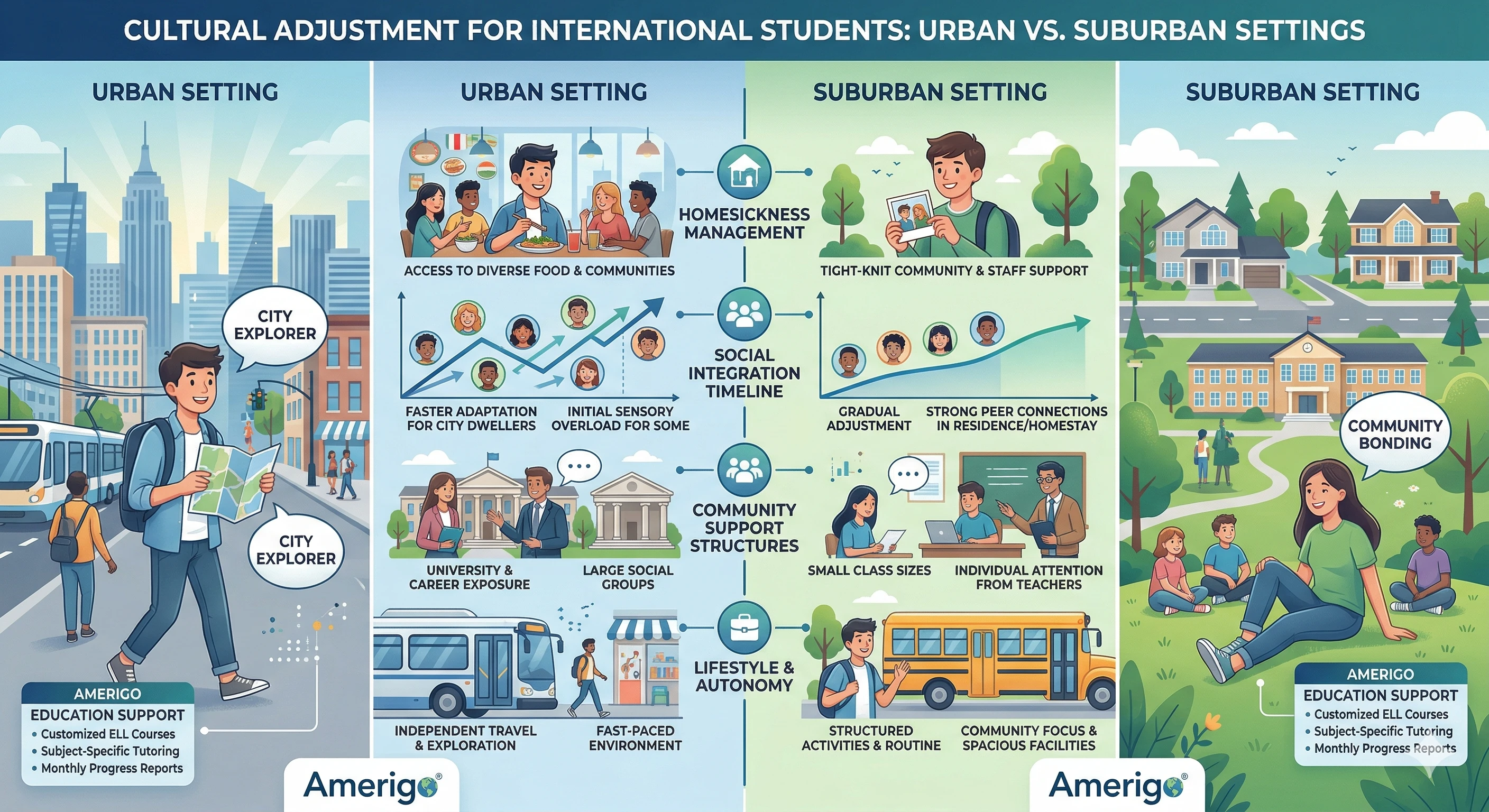
- Students from major cities (Shanghai, Seoul, Ho Chi Minh City, Mexico City) often prefer urban US settings for familiarity
- Students from smaller communities may find suburban settings less sensory overload during initial adjustment
- Urban areas offer international communities that reduce cultural isolation in early months
- Suburban schools provide smaller class sizes where teachers notice and respond to adjustment challenges faster
- Monthly progress reports from Amerigo Education track adjustment alongside academic performance at all locations
- 24/7 emergency assistance is available across both urban and suburban partner schools
- Safety technology through Life360 or Reach provides parent location tracking regardless of setting
How Do Extracurriculars Compare?
Extracurricular activities differ by setting based on available facilities and community resources. Urban schools provide access to city-based internships, professional mentorship programs, museum partnerships, and performing arts venues that suburban schools cannot replicate. Suburban schools offer larger athletic campuses, more outdoor sports facilities, and nature-based activities that urban campuses lack due to space constraints.
For university applications, admissions officers evaluate extracurricular involvement relative to what each school offers rather than against an absolute standard. A student who leads the robotics club at a suburban school with limited tech partnerships demonstrates the same initiative as one interning at a city tech company. Both demonstrate the leadership and intellectual curiosity that admissions offices value.
- Urban schools provide access to professional internships and industry exposure relevant to university essays
- Suburban schools offer more varsity sports options with larger athletic facilities and playing fields
- Both settings provide standard extracurriculars including academic clubs, performing arts, debate, and community service
- Urban students can attend professional sports events, concerts, and cultural exhibitions independently
- Suburban students benefit from outdoor activities including hiking, water sports, and nature programs
- University admissions officers evaluate extracurricular depth relative to the student's specific school context
What Safety Factors Should Families Consider?
Safety concerns are the most common reason international families hesitate about urban school settings. According to FBI Uniform Crime Report data, crime rates vary by individual neighborhood and community rather than by broad urban or suburban classification. Some urban neighborhoods have lower crime rates than certain suburban areas, and vice versa. The safety of a specific school depends on the institution's campus security, local police responsiveness, and community characteristics rather than whether the address falls within city limits.
Amerigo Education partner schools in both settings implement campus safety protocols and provide students with safety technology including Life360 or Reach for parent location tracking. On-campus international department staff monitor student well-being daily, and 24/7 emergency assistance is available at all US and Canadian locations. Families should evaluate the specific neighborhood surrounding each school rather than making assumptions based on urban or suburban labels.
How Does Setting Affect University Admission?
University admissions offices do not favor applicants from urban schools over suburban schools or the reverse. Admissions officers evaluate each applicant within the context of their school's available resources, course offerings, and community. A student who completes every AP course available at a suburban school with 12 AP options demonstrates the same academic ambition as one who selects 8 from a school offering 25. Geographic diversity in the applicant pool can benefit students from less common locations.
Urban settings do offer practical advantages for demonstrated interest, a factor that some universities consider in admission decisions. Students near Boston can visit Harvard, MIT, and Northeastern on weekends. Students near New York can attend Columbia and NYU open houses. Suburban students in the Midwest have proximity to Big Ten universities. Amerigo Education's Top 100 Guarantee at US Signature partner schools provides a $50,000 USD refund if a student does not receive Top 100 university admission after meeting all requirements: two consecutive years of enrollment, a cumulative GPA (Grade Point Average) of 3.2 or higher, a TOEFL score of 85 or above, and completion of at least one AP, IB (International Baccalaureate), or Honors course. Grade 12 direct entry students are not eligible.
- Admissions officers evaluate students within the context of what their specific school offers
- Urban students benefit from proximity to universities for campus visits and demonstrated interest
- Suburban students can leverage smaller school environments for stronger teacher recommendation letters
- Geographic diversity in applications can benefit students from either setting type
- 97% of the Class of 2025 gained admission to Top 100 US universities across both urban and suburban partner schools
- The Top 100 Guarantee is available at US Signature partner schools regardless of urban or suburban setting
How Should Families Choose the Right Setting?
Choosing between urban and suburban settings requires matching the student's personality, academic goals, and lifestyle preferences to the environment where they will spend two to four years. Families should consider whether the student thrives with independence and stimulation (urban advantage) or with routine, close community, and outdoor access (suburban advantage). Neither setting is inherently superior for international students. The right choice depends on the individual.
The Amerigo Education school finder helps families compare schools across settings and regions. Because the application covers multiple schools at no additional cost, families can explore both urban and suburban options before deciding. The enrollment team provides personalized recommendations based on transcript, English scores, and family priorities. Visa services are provided through a third-party visa consulting partner and billed separately from program fees.
Frequently Asked Questions
Do urban schools have more AP courses than suburban schools?
Not necessarily. AP course availability depends on school size, funding, and curriculum design rather than location. Some suburban schools offer 20 or more AP courses because of higher per-student funding, while some urban schools offer fewer but supplement with dual enrollment partnerships. Amerigo Education's exclusive partner schools offer 20 or more AP courses regardless of setting.
Are suburban schools safer for international students?
Crime statistics vary by individual community rather than by broad urban or suburban classification. FBI Uniform Crime Report data shows that specific neighborhoods within cities can have lower crime rates than some suburban areas. School safety depends on the institution's protocols and surrounding community. Amerigo Education partner schools in both settings provide 24/7 emergency assistance and safety technology.
Which setting is better for cultural adjustment?
Both settings offer adjustment advantages. Urban areas provide diverse cultural communities, ethnic grocery stores, and international restaurants that reduce homesickness. Suburban areas offer smaller communities where international students receive more individual attention. The best setting depends on the student's personality and comfort level with different social environments.
Do universities prefer applicants from urban or suburban schools?
University admissions offices evaluate applicants within the context of their school's available resources. Admissions officers assess whether a student took the most challenging courses available at their specific school, not whether it was urban or suburban. Geographic diversity in applications can benefit students from either setting. Individual achievement matters more than location type.
Is public transportation important for international students?
Public transportation access affects daily independence and weekend activities. Urban areas typically offer bus and rail systems that allow students to travel without relying on school transportation. Suburban areas may require school-provided transportation or host family assistance for travel beyond campus. Students who value independent mobility may prefer urban settings.
How does cost of living differ between urban and suburban areas?
Urban areas in cities like Boston, New York, and San Francisco have higher costs for food, entertainment, and daily expenses compared to suburban communities. Suburban areas in the Midwest and smaller metropolitan areas generally offer lower living costs. Program tuition at Amerigo Education partner schools is set by the school and Amerigo's program structure, though personal spending budgets vary by location.
Can students switch between urban and suburban schools?
Students enrolled through Amerigo Education can discuss transfer options with the enrollment team if their current setting is not a good fit. Transfers between partner schools require coordination with both schools and may affect course sequencing. Starting the conversation early in the academic year provides more flexibility. The enrollment team helps families evaluate whether a transfer serves the student's goals.
Do Amerigo partner schools exist in both settings?
Yes. Amerigo Education's 40 Niche A+/A rated partner schools across the US, Canada, and UK include schools in both urban and suburban settings. Schools in Boston, New York, and California include urban and suburban campuses, while Midwest schools tend toward suburban and smaller-community settings. Every US and Canadian partner school operates with the same on-campus international department.
How do extracurricular opportunities differ by setting?
Urban schools often provide access to city-based internships, museum partnerships, cultural events, and professional sports. Suburban schools typically offer larger campuses with more athletic facilities and outdoor activities. Both settings offer standard high school extracurriculars including academic clubs, performing arts, and community service. Specific offerings depend on each school's resources.
Does school setting affect English language development?
English development depends more on ELL program quality and daily immersion than on location. Suburban areas with smaller international student populations may provide more English-only interaction outside school. Urban areas expose students to multiple accents and communication styles. Amerigo Education provides in-school customized ELL courses at all partner schools regardless of setting.
Conclusion
Urban and suburban US high school settings each offer distinct advantages for international students without one being universally superior. Academic quality, university outcomes, and Amerigo Education's standardized support infrastructure remain consistent across both settings. The decision rests on matching the student's personality, lifestyle preferences, and university goals to the environment where they will adjust and thrive most effectively.
Find the Right Setting for Your Student
International families comparing urban and suburban school environments can explore US partner schools, view Canadian options, or learn about Brentwood School in the UK. Apply now to start the single-application process across urban and suburban schools, or contact us for a personalized school recommendation based on your student's academic profile and setting preferences.
People Also Read
- How to Choose a US High School for International Students: Complete Selection Guide 2026
- Top 10 Private Schools in the US for Foreign Students
- Homestay vs Residence for High School International Students: How to Choose the Right Accommodation
About the Author
This guide was written by the Amerigo Education content team, drawing on program data from staff operating the on-campus international department at Amerigo Education's partner schools across the US, Canada, and UK. Learn more about Amerigo Education.
Disclaimer: This article provides general information for educational purposes only. Families should conduct independent research, request current program data from providers, and consult with program representatives regarding specific circumstances. Contact us with questions.