All news
April 5, 2026
Study Abroad 101
The Bilingual Advantage: How Speaking Two Languages Helps University Admissions
The bilingual advantage for university admissions: how speaking two languages builds cognitive skills and strengthens applications for international students.

The Bilingual Advantage: How Speaking Two Languages Helps University Admissions
Last Updated: April 2026
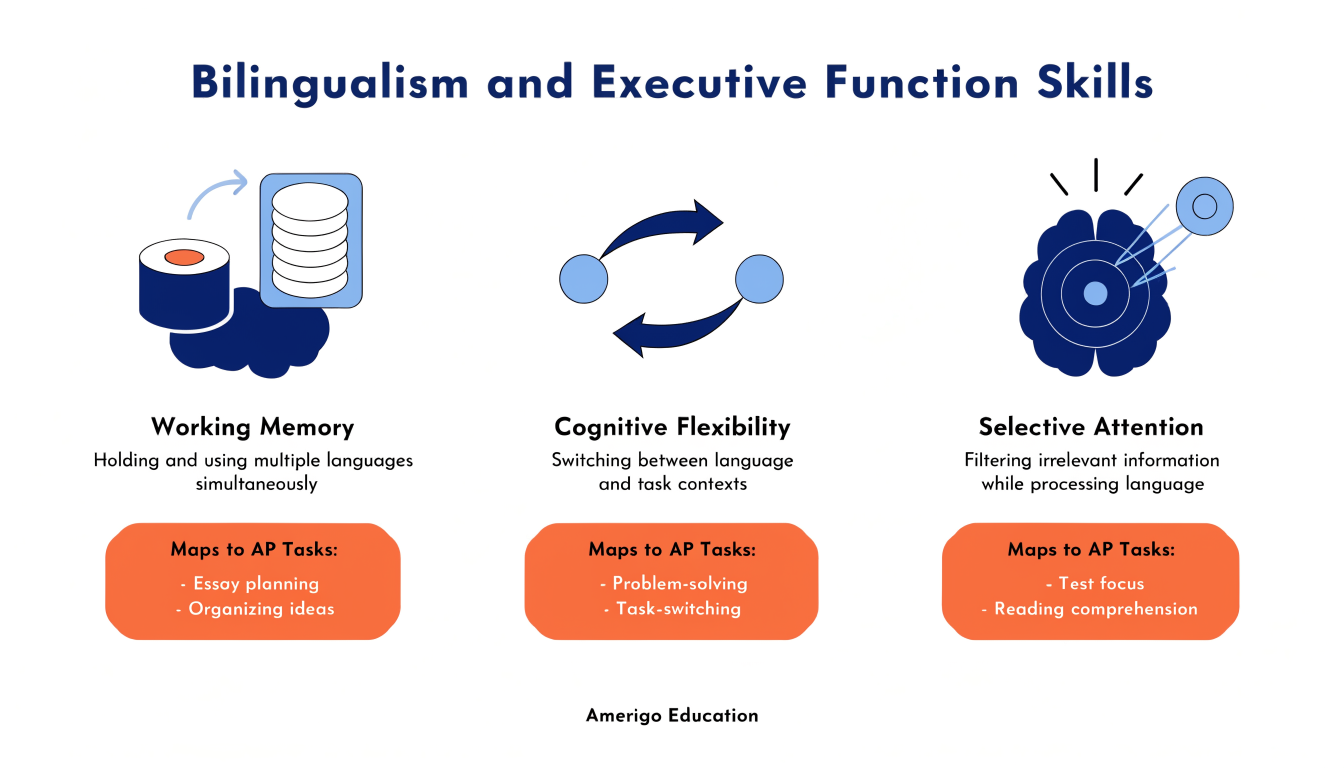
The bilingual advantage is the set of cognitive, academic, and social benefits that accrue to individuals who speak two languages fluently, and for international students ages 14-18 applying to US universities, those benefits translate directly into application strength. According to the American Psychological Association (2024), bilingual individuals demonstrate measurably stronger executive function, including working memory, cognitive flexibility, and selective attention - skills that overlap significantly with the academic abilities US universities assess in applicants. For families whose student speaks two or more languages, understanding how bilingualism shows up in university applications helps position that advantage strategically.
Amerigo Education partners with 40 Niche A+/A rated schools across the US, Canada, and the UK, supporting 3,500+ students from 55+ countries. The Class of 2025 achieved 97% admission to Top 100 US universities. For bilingual students from 55+ countries, the program provides an academic environment where English develops alongside the home language - a combination that shows clearly in university transcripts, essays, and interviews.
This guide explains what the bilingual advantage means for international students in the US university application context - from the cognitive research that defines it, to how it shows up in transcripts, essays, and interviews, to the practical steps students can take at US Signature Schools to develop it during high school.
Key Takeaways
- Cognitive Edge: Bilingual students demonstrate stronger executive function - including working memory and cognitive flexibility - skills that directly support academic performance in AP (Advanced Placement) and Honors courses.
- Application Differentiation: Language background is a legitimate differentiator in university applications when framed through specific academic experiences, not just listed as a skill.
- English Proficiency as Evidence: International students who complete high school in an English-language environment arrive at university applications with a demonstrated academic English record, not just a TOEFL score.
- Essays and Interviews: Bilingualism provides concrete, story-rich material for personal statements and interviews - cross-cultural navigation, identity, and language learning are recurring themes in strong applications.
- 97% Top 100 Rate: Amerigo's Class of 2025 - students from 55+ countries who developed academic English through the US high school program - achieved a 97% Top 100 university admission rate.
What Is the Bilingual Advantage in Academic Terms?
The bilingual advantage refers to cognitive benefits associated with managing two language systems simultaneously. Bilingual individuals constantly monitor which language to use and suppress interference from the other - a process that exercises the brain's executive control system over time.
According to NCES (2025), students who use more than one language at home score higher on average in reading comprehension tasks than monolingual peers at the same grade level, reflecting the processing discipline that bilingualism builds. This advantage is not automatic - it correlates with regular, active use of both languages, which is the condition that most international students satisfy when they study in an English-language school while maintaining their home language at home and with peers.
For students at Amerigo US Signature Schools, the daily academic environment accelerates English development while home language use continues outside school, creating the dual-language activation that produces measurable cognitive benefits over time.
How Does Bilingualism Strengthen a University Application?
Bilingualism strengthens a university application in multiple layers - none of which require the student to simply list "speaks two languages" on a resume. The most impactful contributions come through course selection, extracurricular records, essays, and demonstrated academic performance.
A student who takes AP Spanish Language and Culture after growing up speaking Spanish at home earns a credential that shows language mastery at a college-assessed level. A student who has tutored peers in their home language demonstrates leadership and community contribution. A student whose personal statement traces the experience of navigating two languages across two cultures gives an admissions reader a window into their perspective that few domestic applicants can offer.
Key ways bilingualism appears in a strong university application:
- AP Language Courses: Taking an AP exam in the student's home language demonstrates advanced mastery and earns a weighted GPA point. College Board offers AP exams in Spanish, French, Chinese, Italian, German, Japanese, and Latin.
- Language-Related Extracurriculars: Interpretation volunteering, heritage language tutoring, cultural club leadership, or international pen-pal programs document the student's bilingual identity in a verifiable record.
- Personal Statement Theme: Cross-cultural experience and language navigation are among the most effective personal statement topics when grounded in specific scenes and insights rather than general claims.
Does Bilingualism Improve US High School Performance?
The research consistently shows that bilingual students who maintain both languages perform better in academic reading and writing tasks than students who abandon their home language upon entering an English-speaking environment. According to the APA (2024), students who develop academic literacy in two languages show stronger metalinguistic awareness - the ability to think about language structure itself - which supports comprehension in complex academic texts across all subjects.
In a US high school context, this matters most in AP and Honors courses, where reading demands are high and analytical writing is assessed rigorously. A student who has read complex texts in two languages and written analytically in both arrives at AP English Language or AP History with a processing depth that benefits performance.
The Amerigo on-campus international department at US Signature Schools supports students from B1 English level through the academic English development process - 96% of B1 entrants in the Class of 2025 achieved Top 100 admission.
How Do Students Develop the Bilingual Advantage?
International students who study in the US develop their bilingual advantage through the specific combination of English immersion during school hours and home language maintenance outside them. At Amerigo US Signature Schools, students from 55+ countries study in English-language classrooms while maintaining their home language communities through student groups, family communication, and social connections. This is the environment - English immersion with home language maintenance - that research identifies as most effective for developing genuine bilingual advantage.
Steps international students can take to build their bilingual advantage during US high school:
- Take an AP Language Exam: If the student's home language has a College Board AP exam, register for it in junior or senior year. A score of 4 or 5 demonstrates college-level mastery and strengthens the transcript.
- Maintain Home Language Reading: Read complex texts - news articles, novels, academic content - in the home language regularly throughout the school year to sustain academic literacy in both languages.
- Document Language-Related Activities: Keep a record of any tutoring, interpretation, cultural club participation, or community service that involves the home language - this becomes application material.
What Do Universities Look for in Bilingual Applicants?
US universities do not have a formal bilingual admissions preference, but they do actively seek students who bring diverse perspectives, demonstrated language skills, and cross-cultural experience to their campus communities. According to the National Association for College Admission Counseling (2024), diversity of perspective - including linguistic and cultural background - is among the factors admissions officers at selective universities consider when building an incoming class.
Admissions readers look for evidence, not claims. A student who writes "I am bilingual" in an application provides less usable information than a student who describes the experience of mediating a misunderstanding between two cultural groups, or who lists three concrete language-related activities in their extracurricular record.
Frequently Asked Questions
What is the bilingual advantage?
The bilingual advantage is the set of cognitive benefits associated with managing two language systems regularly. These include stronger working memory, enhanced cognitive flexibility, and improved selective attention - all of which support academic performance in demanding high school and university environments. According to the APA (2024), bilingual individuals demonstrate measurably stronger executive function than monolingual peers across a range of cognitive tasks.
Does being bilingual help with university admission?
Yes, when the language background is documented and framed strategically. Bilingualism helps through AP language course performance, extracurricular records tied to language and culture, and personal statement material grounded in cross-cultural experience. Simply listing two languages without supporting evidence is less effective. Students who build a documented record of their bilingual identity during high school arrive at applications with concrete material that admissions readers can evaluate.
Should international students maintain their home language while studying in the US?
Yes. Research consistently shows that students who maintain active home language use alongside English immersion develop stronger overall language skills than those who abandon their home language. Continued reading, writing, and communication in the home language reinforces cognitive benefits of bilingualism while English proficiency develops through daily academic engagement. Suppressing the home language does not accelerate English acquisition and removes the dual-language activation that produces cognitive benefits.
Can bilingualism improve academic performance in AP courses?
Yes. The metalinguistic awareness that bilingual students develop - the ability to analyze language structure itself - supports comprehension of complex academic texts across all subjects. Students who have read and written analytically in two languages often arrive at AP English Language, AP History, and other reading-intensive courses with processing depth that benefits performance. The advantage is strongest in students who have maintained academic literacy in both languages, not just conversational fluency in one.
How does Amerigo support bilingual international students?
Amerigo's US Signature Schools enroll students from 55+ countries who study in English-language classrooms while maintaining their home language communities through student groups and family connections. The on-campus international department provides structured academic support for students who arrive at B1 English level, supporting the English development process without requiring students to abandon their home language. University counseling support helps students frame their bilingual background in applications.
What AP language exams can bilingual students take?
The College Board offers AP language exams in Spanish Language and Culture, French Language and Culture, Chinese Language and Culture, Italian Language and Culture, German Language and Culture, Japanese Language and Culture, and Latin. Students whose home language has a corresponding AP exam can register during junior or senior year. A score of 4 or 5 demonstrates college-level mastery, earns a weighted GPA point, and provides concrete evidence of bilingual ability in the application.
How should bilingualism appear in a personal statement?
The most effective personal statement use of bilingualism is scene-based and specific - describing a moment when language mediation, cultural navigation, or the experience of thinking in two languages produced a concrete insight or action. General claims like "being bilingual taught me to see multiple perspectives" are weaker than a specific scene that shows the reader what that experience looked like. Students should begin developing their bilingual narrative in Grade 11 to allow time for revision and refinement.
Is bilingualism more valuable than TOEFL scores for university admission?
Bilingualism and TOEFL serve different purposes in a university application. TOEFL is a standardized threshold measure that most universities require for international applicants. Bilingualism is a differentiating factor that strengthens the full application profile through course selection, extracurricular records, and essay narrative. Students need both - a TOEFL score that meets the university's requirement and a well-framed bilingual profile that demonstrates what their language background has produced academically and personally.
At what grade should international students start building their bilingual profile?
The most complete bilingual application profiles are built from Grade 9 onward. Students who enroll at a US Signature School in Grade 9 have four years to accumulate AP language exam results, extracurricular records, and the academic English record needed for competitive applications. Students entering in Grade 11 can still develop a strong two-year bilingual profile, particularly if they register for an AP language exam and develop a specific personal statement narrative during junior year.
Can speaking three or more languages strengthen a university application further?
Yes. Students who speak three or more languages demonstrate an even higher level of language learning aptitude, which is itself a valued signal in university applications. The same principles apply - documented evidence of language use (AP exams, tutoring, community service) and a specific, scene-based personal statement carry more weight than a simple list of languages. Students who speak three or more languages should identify which two are most strongly supported by their academic record and application evidence.
Do Amerigo students have an advantage because of their language backgrounds?
Amerigo students come from 55+ countries and enter the US high school system with diverse language backgrounds, including Mandarin, Korean, Vietnamese, Spanish, and many others. The structured academic environment at US Signature Schools develops their academic English while their home language remains active, creating the dual-language activation that supports the bilingual advantage. Of the Class of 2025, 97% gained Top 100 admission - evidence that the combination of bilingual background and structured US high school preparation produces strong university outcomes.
Conclusion
The bilingual advantage is not automatic - it develops through active use of both languages across academic and personal contexts, and it shows up in university applications through documented evidence rather than self-reported claims. For international students ages 14-18, the US high school environment provides the English immersion that builds academic language skills while the student's home language continues to develop the cognitive foundation that bilingualism creates.
Ready to Build Your University Application Profile?
Amerigo Education supports international students from 55+ countries through the full journey from high school enrollment to university admission, with structured academic programs, dedicated university counseling, and a Top 100 Guarantee for qualifying students at US Signature Schools. Explore US study options, apply now, or contact us to speak with an admissions representative.
People Also Read
- How to Improve English for International Students: Proven Methods
- How Long Does It Take International Students to Go from Basic English to AP Classes?
- University Admission Results by English Level: How B1 Students Achieve Top 100 Acceptance
About the Author
This guide was written by the Amerigo Education content team, drawing on program data from staff operating the on-campus international department at 40 Niche A+/A rated US, Canadian, and UK partner schools. Learn more about Amerigo Education.
Disclaimer: This article provides general information for educational purposes only. Families should conduct independent research, request current program data from providers, and consult with program representatives regarding specific circumstances. Contact us with questions.