All news
May 2, 2026
Study Abroad 101
Sample F-1 Visa Interview Questions for High School Students (and How to Answer Them)
Sample F-1 visa interview questions for high school students: what officers ask, how to answer intent and financial questions, and what causes denial.
Sample F-1 Visa Interview Questions for High School Students (and How to Answer Them)
Last Updated: May 2026
The F-1 visa interview is a required step for most international students before they can enter the United States to attend high school. According to IIE Open Doors (2025), more than 1.1 million international students enrolled in US institutions in 2023-24, and the vast majority obtained F-1 (student visa for academic programs) status through a consular interview at a US embassy or consulate in their home country. The interview is typically brief - lasting 3-10 minutes - but the officer's decision is based on whether the applicant presents a clear, credible case as a genuine student with strong ties to their home country.
Amerigo Education partners with 40 Niche A+/A rated schools across the US, Canada, and the UK, supporting 3,500+ students from 55+ countries. The Class of 2025 achieved 97% admission to Top 100 US universities of those who applied. For students enrolling at US Signature Schools, visa preparation is supported through Amerigo's pre-departure orientation, and families can access optional F-1 visa support via ZF Visa, a third-party partner Amerigo works with for US student visa coordination.
This guide covers the most common F-1 visa interview questions for high school students, how to prepare strong answers, which documents to bring, and the mistakes that lead to denial - from the initial intent questions through to financial and academic readiness queries.
Key Takeaways
- Interview purpose: The consular officer is assessing whether the student is a genuine, bona fide applicant who intends to study and return home after graduation.
- Duration and format: Most F-1 interviews last 3-10 minutes at a US embassy or consulate; answers must be concise, honest, and specific.
- Intent matters most: According to the U.S. Department of State (2025), students must demonstrate ties to their home country and a clear academic plan in the US.
- Documents support answers: Bring the I-20, admission letter, financial evidence, and school profile - they confirm what you say verbally.
- ZF Visa support available: Families enrolling at Amerigo US Signature Schools can access F-1 visa support through ZF Visa, Amerigo's optional third-party visa coordination partner.
What Is the F-1 Visa Interview for High School?
The F-1 visa interview is a mandatory consular appointment for international students seeking to study in the United States. It takes place at a US embassy or consulate in the student's home country, typically after the student has received an I-20 form from a SEVIS (Student and Exchange Visitor Information System)-approved school and paid the SEVIS fee. The purpose is to verify that the applicant is a genuine student, has the financial means to study, and intends to return home after completing their program.
According to SEVP, the F-1 visa category is the primary visa type for full-time academic programs at US schools. For high school students, this includes both private and public school placements. The interview is brief but decisive - officers make approval or denial decisions during or immediately after the appointment.
- Before the interview: Obtain the I-20, pay the SEVIS fee, complete DS-160, and schedule the appointment.
- At the interview: Present documents, answer questions clearly, and demonstrate genuine academic intent.
- After approval: Receive the visa stamp; F-1 status activates when you enter the US.
What Questions Do F-1 Officers Ask High Schoolers?
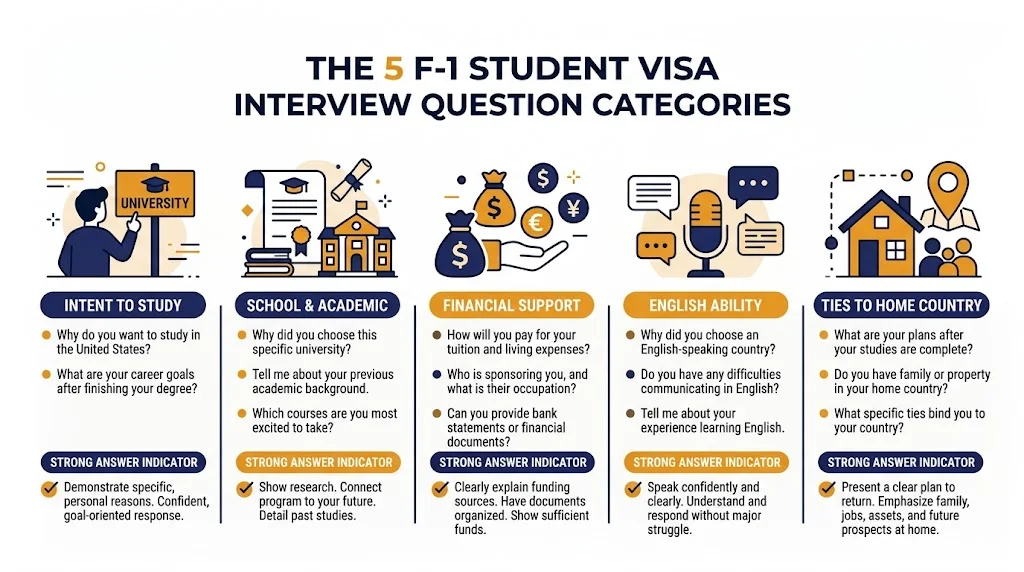
Consular officers follow a consistent line of questioning for student visa applicants. The questions fall into five main categories: academic intent, school choice, financial support, English language ability, and home country ties. For high school students specifically, officers pay close attention to whether the parents understand the program, why US high school was chosen, and whether the student has a realistic plan.
Common F-1 interview questions for high school students include: "Why do you want to study in the United States?" - testing genuine motivation; "Which school will you attend and what grade will you join?" - confirming the I-20 matches the student's plan; "Who is paying for your education and living expenses?" - addressing financial credibility; and "Do you plan to return home after completing your studies?" - the core intent question.
- Intent questions: Why the US? Why this school? What are your future goals?
- Financial questions: Who pays, how much, and are funds already available?
- Academic questions: What grade, what subjects, do you speak English?
- Ties to home country: Parents' employment, property ownership, return plan.
How Do You Answer F-1 Intent Questions?
Intent questions are the most critical part of the F-1 interview. The officer must be convinced that the student is coming to study - not to work or remain in the US permanently. A strong answer to "Why do you want to study in the United States?" is specific, academically framed, and grounded in a concrete career or educational goal.
Weak answer: "Because America is a great country and I want a better future." This is vague and could apply to anyone seeking immigration.
Strong answer: "I want to study AP (Advanced Placement) courses in science and mathematics at [school name] to prepare for a Computer Science degree at a US university. My parents work in [field] in [home country] and expect me to return and contribute to our family business after graduation."
Ties to home country are demonstrated through parental employment, property ownership, extended family, and the absence of close relatives already living permanently in the US. Students whose parents attend the interview - where consulates permit - often present stronger tie evidence.
- Be specific: Name the school, the subjects, and why you chose the US over alternatives.
- State your return plan: US university goal followed by a home-country career is the strongest framing.
- Connect to family: Reference parents' professions, home property, or siblings still at home.
How Do You Answer F-1 Financial Questions?
Financial questions require precise, confident answers because insufficient financial evidence is among the most common reasons for F-1 denial at the high school level. The officer wants to know who is funding the education, whether those funds exist now, and whether they cover the full program duration.
A strong answer names the sponsor clearly - typically a parent - gives an approximate funding source (savings, employment income, or a business), and confirms the funds cover the full program cost. According to the U.S. Department of State (2025), students should be able to articulate the total estimated cost of their program and explain how the family can meet that amount.
For students enrolling at Amerigo partner schools, program fees start from $40,000 per year for entry-level placements, rising to $75,000-$110,000+ for Premium Signature schools. The officer may ask about accommodation and whether a sponsor letter or bank statement is available.
- Name the sponsor: "My father is funding my education from his business income and savings."
- Know the amount: State the approximate annual program cost and confirm it is covered.
- Bring documentation: Bank statements, sponsor letters, and parent employment records support verbal answers.
- Don't overstate: Quote verified program costs - do not inflate or estimate.
What Documents Help at an F-1 Visa Interview?
The documents you bring to the interview support and verify your verbal answers. The officer may ask to see them or may proceed on verbal evidence alone. A well-organized document folder reduces the risk of being unable to evidence a critical answer.
Core documents for a high school F-1 interview include: the I-20 form, a valid passport (valid at least 6 months beyond the study start date), DS-160 confirmation, the SEVIS fee receipt, the school acceptance letter, financial evidence (bank statements or sponsor letter), and academic transcripts from the home country school.
Students enrolling through Amerigo receive the I-20 as part of the enrollment process. Amerigo's pre-departure orientation covers document preparation, arrival logistics, and emergency contacts, with native-language support so parents can attend. Amerigo's official pre-departure resource is the Know Before You Go Guide.
- I-20 form: The foundational document - must match the school named in your answers exactly.
- Financial evidence: Bank statements and sponsor letters confirming program costs are covered.
- School profile: A Niche rating sheet or brochure helps explain why this specific school was chosen.
- Transcripts: Confirm prior academic achievement and readiness for US coursework.
What Mistakes Lead to F-1 Denial for Students?
F-1 denial for high school students typically results from one or more consistent patterns: vague answers about academic intent, inconsistency between verbal answers and document details, insufficient financial evidence, weak ties to the home country, or signs that the student is following a script rather than speaking from genuine knowledge.
One of the most common errors is not knowing basic details about the school - officers expect applicants to know the school's location, grade level, and why that specific school was chosen. Students who cannot answer "Why not a school in your home country?" raise credibility concerns. A second common error is being unable to explain financial support - for example, not knowing who is listed as the financial sponsor on the I-20.
Amerigo's pre-departure orientation prepares students for these scenarios, and families with additional visa needs can access support through ZF Visa, Amerigo's optional third-party partner for F-1 (student visa) coordination. ZF Visa covers US F-1 applications only - UK Student Visa applications for Brentwood or Berkhamsted are handled directly with the school admissions team.
Frequently Asked Questions
What is the F-1 visa interview for high school students?
The F-1 visa interview is a required consular appointment at a US embassy or consulate where an officer determines whether the student qualifies for the F-1 (student visa for academic programs) category. The officer evaluates genuine academic intent, financial capacity, English language readiness, and ties to the home country. Interviews typically last 3-10 minutes. Approval or denial is usually communicated on the spot or within a short waiting period.
What are the most common F-1 interview questions for high school?
The most common questions cover five areas: why the student wants to study in the US, which school they will attend and in what grade, who is funding the education and how much, whether the student intends to return home after completing the program, and what the student plans to do after high school. Students should prepare specific, honest answers for each area before the appointment.
How should students answer "Why the US?" at the F-1 interview?
A strong answer names a specific academic reason - for example, access to AP (Advanced Placement) courses, a particular curriculum strength, or a career goal best served by US education - and connects it to a post-graduation plan that involves returning to the home country. Vague answers like "America is the best" raise credibility concerns. Specific, goal-oriented answers with a clear return plan are consistently stronger.
What documents do students need for the F-1 visa interview?
Required documents include the I-20 form from the SEVIS-approved school, a valid passport, DS-160 application confirmation, SEVIS fee receipt, the school acceptance letter, and financial evidence such as bank statements or a sponsor letter. Academic transcripts from the home country school are also helpful. All documents should be organized and accessible - do not rely on the officer asking for them; have them ready.
Can parents attend the F-1 visa interview with the student?
In many countries, parents or legal guardians may accompany a minor to the embassy or consulate, though entry to the interview room varies by post. Some consulates permit parents inside the interview room for minor applicants; others conduct the interview with the student only. Families should check the specific US embassy or consulate website for their country to confirm the policy before the appointment date.
What causes F-1 visa denial for high school students?
The most common causes include inability to explain the school choice credibly, inconsistency between verbal answers and the I-20 or acceptance letter, insufficient financial documentation, weak ties to the home country (such as all close family already living in the US), and appearing to follow a rehearsed script rather than speaking from genuine knowledge. Each of these signals to the officer that the applicant may not be a genuine student.
Does Amerigo help with F-1 visa preparation?
Amerigo's pre-departure orientation covers arrival logistics, documentation, and program preparation, with native-language support so parents can attend alongside students. For families who want additional F-1 (student visa) coordination, Amerigo works with ZF Visa, an optional third-party partner offering visa support. ZF Visa covers US F-1 applications only - UK Student Visa applications for Brentwood School Essex or Berkhamsted School are handled directly with those schools' admissions offices.
How long does the F-1 visa interview take?
Most F-1 visa interviews at US embassies and consulates last between 3 and 10 minutes. The majority of the overall appointment time is spent waiting in the consular queue, not in the interview room itself. The actual officer interview is brief, focused, and decisive. Students should be prepared to communicate clearly and confidently within a short window, without overly long or complex answers that obscure key points.
What is the SEVIS fee and when must it be paid?
The SEVIS fee covers registration in the Student and Exchange Visitor Information System (SEVIS), the US government database that tracks F-1 status. As of 2025, the fee is $350 for most F-1 applicants. It must be paid and confirmed before scheduling the visa interview appointment. The payment receipt is a required document to bring to the interview. Students receive their SEVIS ID from the I-20 form issued by their school.
What happens after the F-1 visa is approved?
After approval, the visa stamp is placed in the student's passport. Students may enter the US up to 30 days before the program start date listed on the I-20. Upon arrival, the student clears US Customs and Border Protection and F-1 status is activated. For students enrolling at Amerigo US Signature Schools, the in-person orientation week takes place after arrival and covers campus integration, banking support setup, and all practical first-week logistics.
Conclusion
The F-1 visa interview is a brief but decisive appointment where officers evaluate academic intent, financial capacity, and home country ties. Students who prepare specific answers, organize documents carefully, and demonstrate genuine knowledge of their school and program are well-positioned for approval. Amerigo's pre-departure orientation and optional ZF Visa support give families a structured preparation framework.
Prepare for Your F-1 Visa and US High School Enrollment
To learn more about studying in America at an Amerigo partner school and accessing F-1 visa coordination support, contact us to speak with a program advisor, or apply now to take the first step toward enrollment.
People Also Read
- Visa Interview Preparation Guide: Complete Success Strategy
- What Documents Are Required for F-1 Visa Interview? Complete Checklist 2026
- F-1 Visa Changes for High School Students 2025-2026: What Parents Need to Know
About the Author
This guide was written by the Amerigo Education content team, drawing on program data from staff operating the on-campus international department at 40 Niche A+/A rated US, Canadian, and UK partner schools. Learn more about Amerigo Education.
Disclaimer: This article provides general information for educational purposes only. Families should conduct independent research, request current program data from providers, and consult with program representatives regarding specific circumstances. Contact us with questions.