All news
March 25, 2026
Study Abroad 101
Is It Too Late to Apply to US High School? Late and Mid-Year Enrollment Guide 2026
Is it too late to apply to US high school as an international student? Rolling admissions, mid-year entry, and late enrollment options for 2026-2027.

Is It Too Late to Apply to US High School? Late and Mid-Year Enrollment Guide 2026
Last Updated: March 2026
A late enrollment application is one submitted after a school's primary admissions deadline has passed, typically after March for fall entry or after October for spring entry. According to IIE Open Doors data, over 60,000 international secondary students attended US schools in the most recent reporting year, and a growing share of these students entered through rolling admissions or mid-year start dates rather than traditional fall-only cycles. The SEVIS system processed F-1 visa records for students beginning classes in both fall and spring semesters, confirming that US immigration infrastructure supports non-standard enrollment timelines.
Amerigo Education partners with 40 Niche A+/A rated schools across the US, Canada, and UK, supporting 3,500+ students from 55+ countries. The Class of 2025 achieved 97% admission to Top 100 US universities. Most Amerigo Signature partner schools operate on rolling admissions, meaning families can apply after standard deadlines and still secure placement for the upcoming semester when seats remain available.
Key Takeaways
- Rolling admissions keeps the door open: Most Amerigo Signature partner schools accept applications on a rolling basis, allowing families to apply after traditional deadlines when seats are available.
- Spring semester entry is a real option: Students can begin in January rather than waiting for the following August, provided visa processing is completed at least four months before the start date.
- One application covers multiple schools: A single Amerigo Education application gives families access to 40 partner schools, eliminating the need to track separate deadlines.
- Visa processing is the true timeline constraint: The F-1 visa process requires at least four months from application to approval, making this the factor that determines whether a late application results in enrollment.
- Grade 12 direct entry carries limitations: Students entering Grade 12 directly are not eligible for the Top 100 Guarantee, which requires two consecutive years of enrollment.
What Does Rolling Admissions Actually Mean?
Rolling admissions means a school reviews applications as they arrive rather than waiting for a single deadline to evaluate all candidates at once. For international families, this means an application submitted in May or June for fall entry is reviewed on its own merits rather than rejected automatically for missing a March deadline. The school simply needs available seats and adequate time for the student to complete visa processing.
Most Amerigo Signature partner schools in the US use rolling admissions for international student enrollment. This differs from the fixed-deadline model used by many selective boarding schools, where all applications close by January or February. Rolling admissions schools continue accepting qualified students until classes reach capacity, which may extend into summer for fall entry or into November for spring entry. Families should confirm seat availability directly, as popular schools and grade levels fill earlier than others.
- Applications are reviewed individually as they arrive, not held until a batch deadline
- Admission decisions are typically issued within two to four weeks of a completed application
- Schools continue accepting students until all seats in a grade level are filled
- Popular grade levels (Grades 9 and 10) tend to fill earlier than Grades 11 and 12
- A single Amerigo Education application covers all 40 partner schools simultaneously
- Late applicants receive the same admissions evaluation criteria as early applicants
When Is the Real Deadline for Fall 2026?
The real deadline for fall 2026 enrollment is determined by visa processing time, not by school application cutoffs. Since the F-1 visa process requires at least four months from initial application to visa approval, a student targeting an August or September start should apply no later than April. Applications submitted in May or June may still succeed if consular interview appointments are available, but the margin for delays shrinks significantly.
School-side processing includes reviewing the application, issuing an acceptance letter, and generating the I-20 form needed for the visa application. This typically takes two to four weeks. After receiving the I-20, the student must pay the SEVIS fee, complete the DS-160 form, and schedule a consular interview. Interview wait times vary by country and season, with embassies in China, Vietnam, and Korea often experiencing longer summer queues. Families applying after April should verify current consular wait times before assuming fall enrollment is feasible.
Can Students Start in the Spring Semester?
Yes, international students can start US high school in the spring semester, which typically begins in January. Spring entry works well for students who missed fall deadlines, need additional time for English preparation, or are finishing a semester at their current school before transferring. Schools with rolling admissions evaluate spring applicants using the same criteria as fall applicants, and the I-20 issuance process is identical.
Spring enrollment requires applying by approximately September or October to allow four months for visa processing. Students entering mid-year join classes already in progress, which means adjusting to coursework that started in August. Schools experienced with international students build academic transition support into the process, including credit evaluation from the student's previous school and placement into appropriate course levels. On-campus international departments at Amerigo Education partner schools provide structured onboarding for mid-year arrivals, including ELL courses and subject-specific tutoring.
- Spring semester typically runs from January through May or June
- Application should be submitted by September or October for January entry
- Credit evaluation determines which courses transfer from the student's previous school
- ELL courses and SAT/ACT prep are available for spring entrants at the same level as fall entrants
- Mid-year students join existing student communities and extracurricular activities immediately
- Accommodation options - homestay, on- and off-campus supervised residences, and self-provided - are available for spring enrollment
- Monthly progress reports begin immediately, keeping families informed from the first month of enrollment
What Visa Steps Must Happen Before Arrival?
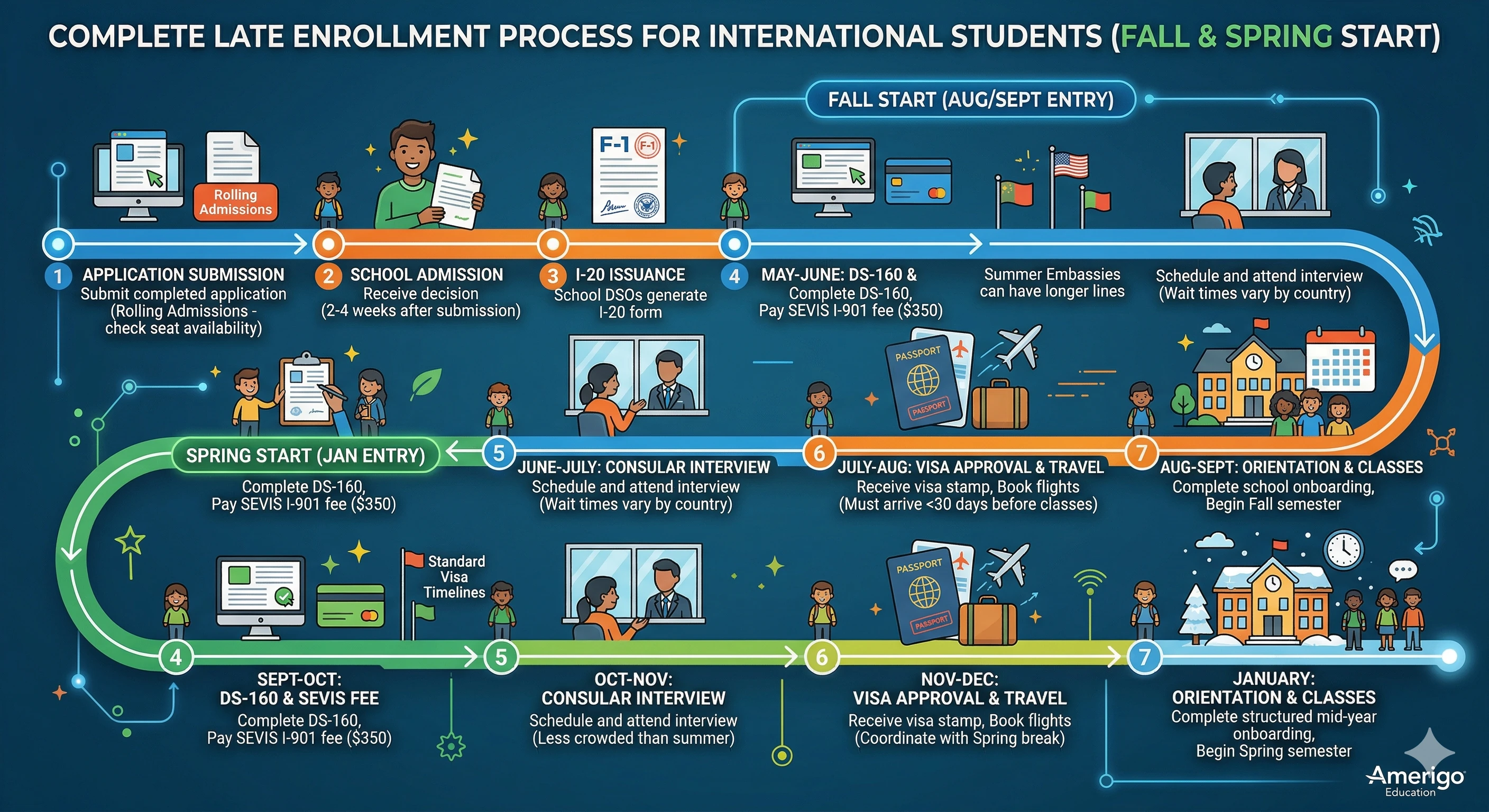
The F-1 student visa process involves multiple sequential steps, each with its own processing time. The minimum timeline from submitting a school application to receiving a visa is approximately four months, assuming no delays at any stage. Families should treat this as a floor, not a ceiling, and build in buffer time for unexpected consular delays or document requests.
Visa services through Amerigo Education's third-party partner, ZF Visa, are available and billed separately. ZF Visa assists with document preparation, DS-160 completion, and interview preparation. Families can also manage the visa process independently using guidance from the on-campus international department. The I-20 form, which the school issues after admission, is the foundational document for the entire visa application. Without it, no other visa steps can begin.
- Submit application and receive school admission (2-4 weeks)
- Receive I-20 form from the school's designated school official (1-2 weeks after admission)
- Pay the SEVIS I-901 fee ($350 USD as of 2026)
- Complete and submit the DS-160 online visa application
- Schedule and attend the consular interview (wait times vary by location and season)
- Receive passport with F-1 visa stamp (typically 1-2 weeks after interview approval)
- Arrange travel and arrive in the US no more than 30 days before classes begin
- Complete school orientation and begin classes
Does Late Entry Affect University Outcomes?
Late entry does not reduce a student's chances of gaining admission to a Top 100 US university, provided the student completes sufficient credits and maintains strong academic performance. Universities evaluate transcripts, test scores, extracurricular involvement, and recommendation letters without penalizing the semester in which a student began high school. The timing of enrollment matters far less than the quality of the academic record built during enrollment.
However, late entry does affect eligibility for specific guarantees. The Top 100 Guarantee at Amerigo Education US Signature partner schools provides a $50,000 USD refund if a qualifying student does not gain admission to a Top 100 US university. Eligibility requires two consecutive years of enrollment, a cumulative GPA of 3.2 or higher, a TOEFL score of 85 or higher, and completion of at least one AP, IB, or Honors course. Students who enter Grade 12 directly do not meet the two-year requirement and are therefore not eligible for this guarantee.
What Support Exists for Mid-Year Students?
Mid-year students receive the same academic and personal support services as fall entrants at Amerigo Education partner schools. On-campus international departments provide orientation, academic advising, and social integration programming regardless of when a student arrives. ELL courses, SAT/ACT prep, and university counseling begin immediately upon enrollment rather than following a fixed annual calendar.
Monthly progress reports are sent to families from the first month of enrollment, covering academic performance, social adjustment, and any concerns flagged by on-campus staff. Native-language support is available for families from China, Vietnam, Korea, Mexico, the Taiwan Region, and more, ensuring parents can communicate with staff about their child's progress in their preferred language. Mid-year students also have immediate access to the full range of extracurricular activities at their partner school, which supports both social integration and university application building.
- ELL courses tailored to the student's current English proficiency level
- SAT and ACT preparation integrated into the academic schedule
- University counseling beginning at the point of enrollment, not the start of the academic year
- Monthly progress reports covering academics, social adjustment, and staff observations
- Native-language communication support for families in Chinese, Vietnamese, Korean, Spanish, and more
- Accommodation placement into homestay, on- and off-campus supervised residences, or self-provided housing
- Access to all school extracurricular activities, sports, and clubs from the date of enrollment
How Do Families Choose the Right School Late?
Choosing a school after standard deadlines requires focusing on which schools still have available seats rather than starting with an unrestricted list. A single Amerigo Education application covers 40 Niche A+/A rated partner schools, and the admissions team identifies which schools have openings in the student's grade level. This narrows the selection process to available options rather than requiring families to contact dozens of schools individually to check seat availability.
Families should prioritize factors that directly affect the student's success: the school's English language support program, available AP or IB courses relevant to the student's academic interests, accommodation options at the specific location, and the school's track record with international student university outcomes. The 97% Top 100 admission rate for the Class of 2025 reflects outcomes across the Amerigo Education partner school network. Families evaluating late options can review school profiles and filter by location, academic focus, and accommodation type through the Amerigo Education website.
- Confirm seat availability in the student's grade level at target schools
- Evaluate ELL program strength and English proficiency entry requirements
- Review AP, IB, and Honors course offerings relevant to the student's academic goals
- Confirm accommodation availability - homestay, on- and off-campus supervised residences, or self-provided
- Check visa processing timelines based on the student's home country and target start date
- Review the school's university placement outcomes for recent graduating classes
- Assess extracurricular offerings that align with the student's interests for university applications
- Confirm native-language family support availability at the specific school location
Frequently Asked Questions
Can international students start US high school in January?
Yes, many private high schools with rolling admissions accept international students for spring semester entry in January. Availability depends on remaining seats and the student completing visa processing, which requires at least four months of lead time. Programs like Amerigo Education coordinate I-20 issuance and enrollment across multiple partner schools through a single application.
What is the latest month I can apply for fall enrollment?
For fall semester starting in August or September, students should ideally apply by April to allow adequate time for visa processing. Some rolling admissions schools accept applications through June or July if seats remain, though visa appointment availability at US consulates may limit options for students applying after May. Earlier applications provide more school choices and more flexible visa scheduling.
Do late applicants get the same financial aid?
Financial aid and scholarship availability varies by school and enrollment timing. Some schools reserve scholarship funds for early applicants, while others distribute awards on a rolling basis until funds are exhausted. Late applicants should ask about remaining scholarship availability during the admissions process. Merit-based aid tied to academic records is generally available regardless of application timing.
Can a Grade 12 student enroll mid-year?
Grade 12 students can enroll mid-year at schools with available seats, but credit transfer and graduation timeline require careful evaluation. Students entering Grade 12 directly are not eligible for the Top 100 Guarantee, which requires two consecutive years of enrollment. A mid-year Grade 12 entry works best for students who have already completed most graduation requirements at their previous school.
How long does the F-1 visa process take?
The F-1 visa process typically requires at least four months from initial application to visa approval. This includes school admission, I-20 issuance, SEVIS fee payment, DS-160 form submission, and a consular interview. Wait times for consular interviews vary by country and season, with summer months generally having longer wait times at US embassies in China, Vietnam, and Korea.
What documents are needed for late enrollment?
Late enrollment requires the same documentation as standard enrollment: academic transcripts, English proficiency test scores (TOEFL or equivalent), passport copy, financial documentation, and completed application forms. Some schools may request mid-year transcripts or current semester grades for students applying after the academic year has begun. A single Amerigo Education application covers multiple partner schools.
Will my child fall behind academically starting mid-year?
Mid-year entrants may need to adjust to coursework already in progress, but schools experienced with international students build transition support into the enrollment process. ELL courses, subject-specific tutoring, and academic advising help students catch up on material covered in the first semester. Schools with on-campus international departments provide structured academic onboarding for mid-year arrivals.
Can I apply to multiple schools with one application?
Through Amerigo Education, a single application provides access to 40 Niche A+/A rated partner schools across the US, Canada, and UK. The admissions team evaluates each student's academic profile, English level, and preferences to recommend schools with available seats. This eliminates the need to submit separate applications and manage multiple deadlines across different institutions.
Is housing still available for mid-year enrollment?
Housing availability for mid-year students depends on remaining capacity at each school location. Amerigo Education offers homestay, on- and off-campus supervised residences, and self-provided accommodation options. Mid-year students are placed into the same housing structures as fall entrants, with the same 24/7 staff supervision and support services. Families should confirm housing availability early in the application process.
Does late enrollment affect university admissions later?
Late enrollment does not negatively affect university admissions if the student completes the required credits and maintains strong grades. Universities evaluate academic performance, test scores, extracurriculars, and recommendation letters regardless of when a student started high school. Students who enroll for at least two consecutive years at an Amerigo Education US Signature partner school and meet GPA and test score thresholds qualify for the Top 100 Guarantee.
Conclusion
Late and mid-year enrollment at US high schools is available through rolling admissions programs that accept international students after standard deadlines. The primary constraint is visa processing time, which requires at least four months of lead time before the target start date. Students who enter before Grade 12 and maintain qualifying academic performance remain eligible for structured university admission guarantees.
Start Your Late Enrollment Application
Families ready to explore late or mid-year enrollment can apply now through a single application covering 40 partner schools, or contact us for guidance on available seats and visa timelines for the 2026-2027 academic year. Explore US partner schools, view Canadian options, or learn about Brentwood School in the UK.
People Also Read
- How to Choose a US High School for International Students: Complete Selection Guide 2026
- F-1 Visa Changes for High School Students 2025-2026: What Parents Need to Know
- How to Choose a Study Abroad Program
About the Author
This guide was written by the Amerigo Education content team, drawing on program data from staff operating the on-campus international department at Amerigo Education's partner schools across the US, Canada, and UK. Learn more about Amerigo Education.
Disclaimer: This article provides general information for educational purposes only. Families should conduct independent research, request current program data from providers, and consult with program representatives regarding specific circumstances. Contact us with questions.