
All news
April 19, 2026
Study Abroad 101
How to Read a US High School Transcript: International Guide
How to read a US high school transcript: GPA calculation, weighted vs unweighted grades, AP course weighting, credit hours, and how Amerigo facilitates transcript transmission to universities.

Last Updated: April 2026
How to read a transcript is a practical skill that international families need before and during their student's US high school enrollment. A high school transcript is an official academic record issued by a school that lists every course a student has taken, the grade or mark earned in each course, and the total credit hours accumulated toward graduation. According to the National Student Clearinghouse (2025), transcripts are the most universally required document in US university admission, with virtually every accredited university requiring an official transcript from every secondary school a student has attended.
Amerigo Education partners with 40 Niche A+/A rated schools across the US, Canada, and the UK, supporting 3,500+ students from 55+ countries. The Class of 2025 achieved 97% admission to Top 100 US universities. At Amerigo Signature campuses, the on-campus international department facilitates sending transfer transcripts directly to US universities on behalf of students, removing one of the most logistically complex steps in the admission process for international families.
Key Takeaways
- Transcript definition: A US high school transcript is the official document listing courses, grades, and credits accumulated by a student each academic year.
- GPA impact: Cumulative GPA (Grade Point Average) calculated from the transcript is the primary academic metric in US university admission.
- AP course weight: AP (Advanced Placement) courses typically add a 1.0 GPA boost per course on weighted GPA scales, making them strategically important.
- Top 100 Guarantee: Amerigo's Top 100 Guarantee requires a cumulative GPA of 3.2 or above as one of four eligibility conditions.
- Transcript transmission: At Amerigo Signature campuses, the on-campus international department facilitates direct transcript transfer to US universities.
What Does a US High School Transcript Include?
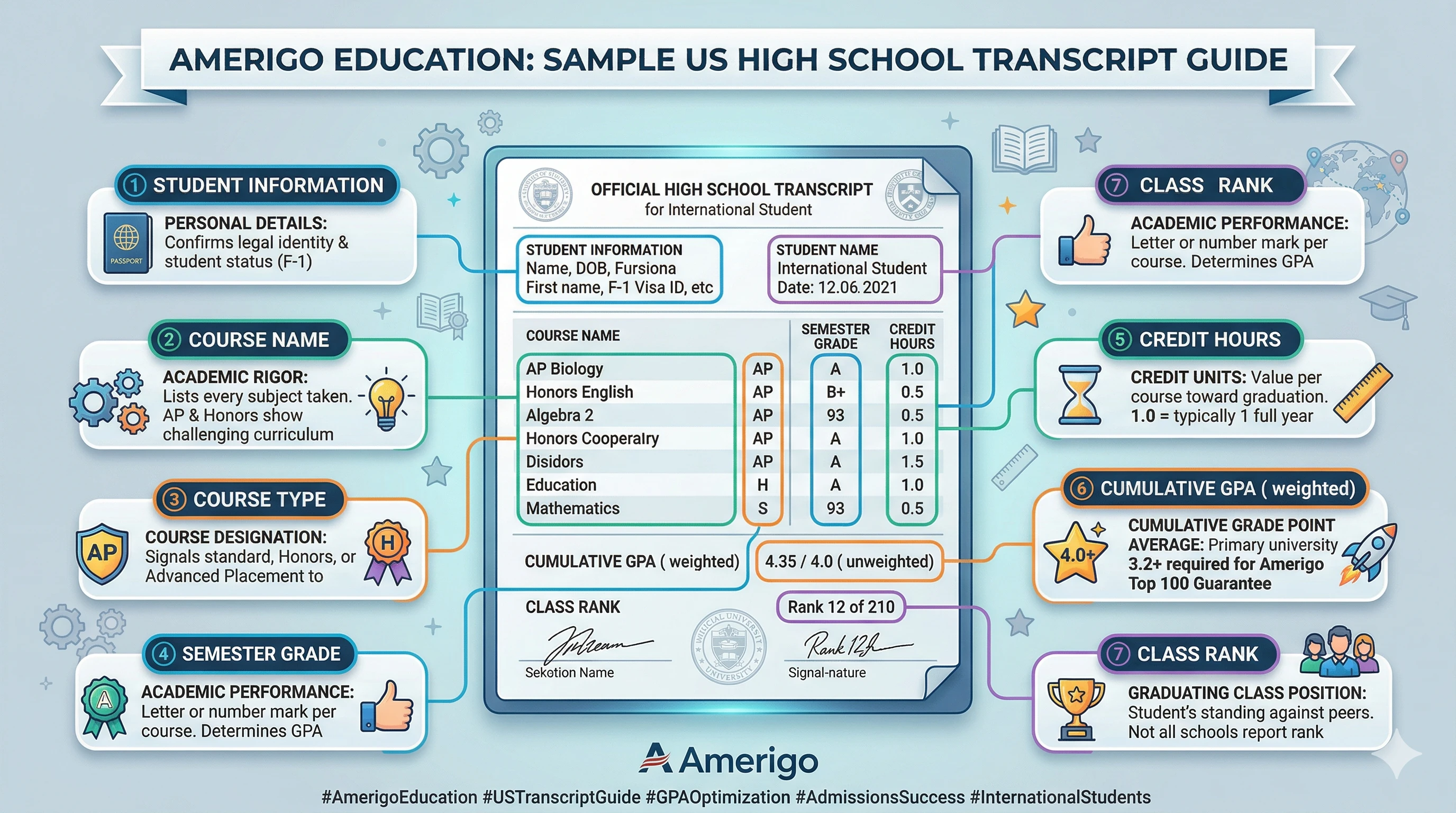
A US high school transcript includes the student's full name, school name, date of birth, enrollment dates, and a list of every course taken each semester or year. Each course entry shows the course name, credit hours awarded, and the grade earned, typically shown as a letter grade and a numerical equivalent. The transcript also shows cumulative GPA (Grade Point Average), which is the average of all grades weighted by the number of credit hours each course carries.
Some transcripts also include class rank, which shows where a student places academically relative to their graduating cohort. Many US private high schools have moved away from class rank, but the GPA figure remains universal. According to the Common Application (2024), GPA and course rigor as shown in the transcript are the top two factors considered by selective US university admission offices, making the transcript the most consequential document in the application package.
| Transcript Section | What It Shows | Why It Matters |
|---|---|---|
| Course list | Every subject taken each semester | Shows breadth and rigor of academic program |
| Grades | Letter and numerical grades per course | Directly determines GPA |
| Credit hours | Units earned per course | Required for graduation and university eligibility |
| Cumulative GPA | Average across all courses | Primary academic metric for university admission |
| Course type | Standard, Honors, AP, IB | Indicates academic challenge level |
How Is GPA Calculated on a US Transcript?
GPA (Grade Point Average) in the US uses a 4.0 scale for standard courses, where an A equals 4.0, B equals 3.0, C equals 2.0, D equals 1.0, and F equals 0. Schools calculate GPA by multiplying each course grade point by the number of credit hours for that course, summing all results, and dividing by total credit hours attempted. This produces a single cumulative GPA figure that appears on the official transcript and is used by universities in admission decisions.
Many US high schools use a weighted GPA scale for AP (Advanced Placement) and Honors courses, where an A in an AP course equals 5.0 instead of 4.0. This gives students who take challenging courses a GPA advantage. International families sometimes find weighted versus unweighted GPA confusing because their home country systems use different scales. When reading an Amerigo partner school transcript, parents should note whether the GPA shown is weighted or unweighted, as universities may recalculate GPA using their own methods. See What GPA Do International Students Need for Top US Universities? for university-specific thresholds.
- Identify whether the transcript shows weighted or unweighted GPA
- Note each course's credit hours alongside its grade
- Calculate cumulative GPA by averaging grade points across all credit hours
- Check whether AP or Honors courses are listed separately from standard courses
- Look for a semester GPA and a cumulative GPA, as both may appear
- Confirm the grading scale used by the school (4.0, 5.0 weighted, or other)
- Note any incomplete or withdrawn course notations, which differ by school
What Do Letter Grades Mean on a US Transcript?
US high school letter grades run from A (highest) to F (failing), with plus and minus variations at most schools. An A typically represents 90 to 100 percent, a B represents 80 to 89 percent, a C represents 70 to 79 percent, a D represents 60 to 69 percent, and an F represents below 60 percent. Some schools use a stricter scale where an A begins at 93 percent. Families from countries using numerical grades or pass/fail systems need to understand this letter-to-percentage conversion when reviewing their student's transcript.
For international families from China, South Korea, Vietnam, Mexico, and the Taiwan Region, whose home country grading scales differ significantly from the US letter system, the conversion can be confusing at first review. Amerigo Education provides native-language communication support for families from these markets, and monthly progress reports sent to all families, residential and homestay, include grade information that advisors can help parents interpret in context. See Why US High School Transcripts Give International Students a University Admission Advantage for analysis of how US transcript grades translate into admission outcomes.
| Letter Grade | Percentage Range | GPA Points (Unweighted) | GPA Points (Weighted AP) |
|---|---|---|---|
| A | 90-100% | 4.0 | 5.0 |
| B | 80-89% | 3.0 | 4.0 |
| C | 70-79% | 2.0 | 3.0 |
| D | 60-69% | 1.0 | 2.0 |
| F | Below 60% | 0.0 | 0.0 |
How Do AP and Honors Courses Appear on a Transcript?
AP (Advanced Placement) courses appear on a US high school transcript with an AP designation next to the course name, for example "AP Biology" or "AP United States History." IB (International Baccalaureate) courses are similarly labeled. Honors courses may be listed as "Honors English" or use an "H" notation. These course type labels are visible to university admission officers and signal the academic rigor of a student's program.
AP course grades matter in two ways on a transcript. The course grade contributes to weighted GPA on the school's internal calculation. In addition, students who take the AP exam at the end of the year may earn college credit if they score 3 or higher out of 5, though credit policies vary by university. The Top 100 Guarantee offered by Amerigo requires eligible students to complete at least one AP, IB, or Honors course as one of four qualifying conditions, alongside two consecutive enrollment years, a cumulative GPA of 3.2 or above, and a TOEFL score of 85 or higher. See What is Advanced Placement Credit: Complete Guide 2026 for a detailed explanation of how AP credit works at universities.
What Is the Difference Between Semester and Cumulative GPA?
A semester GPA shows a student's average grade performance for a single academic term, typically 18 weeks. A cumulative GPA averages all semester GPAs since the student first enrolled, weighted by total credit hours. Both figures usually appear on the same transcript. Semester GPA allows families to track whether their student is improving, maintaining, or declining in performance from one term to the next.
For international students working toward Amerigo's Top 100 Guarantee, the cumulative GPA is the figure that counts, and it must remain at 3.2 or above across their full enrollment period at a US Signature School. Monthly progress reports sent by Amerigo to families include GPA tracking information so parents can monitor whether their student is on track. When a student's semester GPA drops in a way that threatens their cumulative figure, Amerigo staff can reach out in real time rather than waiting for the next scheduled monthly report. The on-campus international department also provides individualized academic planning to identify which courses need more focus.
How Are Transcripts Sent to US Universities?
US universities require official transcripts sent directly from the high school, not copies submitted by students or families. At Amerigo Signature campuses, the on-campus international department facilitates sending transfer transcripts directly to US universities on behalf of students as part of the university counseling process. This service removes the logistical burden from families and ensures transcripts arrive in the correct official format accepted by US admission offices.
Families should understand that transcript requests typically need to be made in advance of university application deadlines and that some universities require transcripts in both English and an official translated version if the student attended any non-English-medium schools. For more information on how the university application process works alongside transcript preparation, visit Amerigo's university guaranteed admission page and review the our schools page to see which partner schools are included in the Signature network.
Frequently Asked Questions
What is a US high school transcript?
A US high school transcript is an official academic record issued by a school listing every course a student has completed, the grade earned in each course, total credit hours accumulated, and cumulative GPA. It is the primary document used by US universities in admission decisions. Transcripts must be official, meaning they are sent directly by the school to the receiving institution, not handled by students or families. Most schools issue transcripts with a registrar seal or signature to confirm authenticity.
How do international families read a US transcript for the first time?
Start by identifying the four main sections: the course list, the grades next to each course, the credit hours per course, and the cumulative GPA at the bottom. Check whether the GPA is weighted (includes AP/Honors bonus points) or unweighted (standard 4.0 scale). If grades are in letter format, convert them to percentages using the school's grading scale, which is usually printed on the transcript itself. Amerigo's on-campus international department can walk families through a transcript reading during a scheduled meeting.
What GPA do students need to qualify for Amerigo's Top 100 Guarantee?
To qualify for Amerigo's Top 100 Guarantee, a student must maintain a cumulative GPA of 3.2 or above across their enrollment period at a US Signature School. This is one of four conditions: the others are completing two consecutive years of enrollment, achieving TOEFL 85 or higher, and completing at least one AP, IB, or Honors course. Students who meet all four conditions and do not gain Top 100 university admission are eligible for a refund of up to $50,000 USD.
What is the difference between weighted and unweighted GPA?
Unweighted GPA uses a standard 4.0 scale for all courses, regardless of difficulty. Weighted GPA adds extra points for AP, IB, or Honors courses, typically raising the maximum for those courses to 5.0. A student with a 3.8 unweighted GPA who takes several AP courses may show a 4.3 or higher weighted GPA. US universities typically recalculate GPA using their own methodology, so both figures are worth understanding. Amerigo's academic counselors can explain which GPA figure is most relevant for specific university targets.
Do AP grades on a transcript help with university admission?
Yes. AP courses signal academic rigor to university admission officers. An A in AP Biology carries more weight than an A in a standard biology course because the AP designation indicates college-level content. Additionally, high AP exam scores (3 to 5) may earn college credit at many US universities, potentially allowing students to skip introductory courses. Amerigo partner schools offer AP courses across a wide range of subjects, giving students options to match their academic goals and university targets.
How does Amerigo help with sending transcripts to universities?
At Amerigo Signature campuses, the on-campus international department facilitates sending transfer transcripts directly to US universities on behalf of students as part of the university counseling service. This ensures transcripts are submitted in the correct official format on schedule with application deadlines. Families do not need to manage this step independently. Students should work with their Amerigo academic counselor early in their application year to identify which universities require transcripts and by what deadlines.
What is class rank and does it appear on all transcripts?
Class rank shows a student's academic standing relative to their graduating class, for example "top 10%" or "rank 15 of 200 students." Not all US high schools include class rank on their transcripts, and many selective private schools have moved away from it because it can disadvantage students at highly competitive schools. Families should not be concerned if class rank does not appear on their student's transcript, as universities that have moved away from class rank typically rely more on GPA and course rigor indicators.
What happens to a transcript if a student transfers schools?
When a student transfers, the new school typically issues a new transcript that may include transferred grades and credits from the previous school or show only the courses completed at the new institution, depending on the school's policy. At Amerigo Signature campuses, the on-campus international department supports transfer transcript processes and can help families understand how prior coursework from a student's home country or previous school will be reflected in the new transcript. Monthly progress reports keep families informed throughout any transition period.
How many accommodation options does Amerigo offer?
Amerigo offers four accommodation options: homestay, off-campus residences, on-campus residences at select partner schools, and self-provided accommodation for students with nearby family. Each option comes with academic support access. Off-campus residences include 24/7 staff, in-residence homework help, and structured study hours with campus staff available. Homestay students access academic support through the on-campus international department. Accommodation choice does not affect a student's transcript content, but it does affect the type and timing of academic support available.
Do international students need their home-country transcripts translated?
Yes, in most cases. US universities typically require official transcripts from all secondary schools attended, including those in a student's home country. If those transcripts are not in English, a certified translation is required. Some universities specify which translation services they accept. Amerigo's university counseling process guides students through document preparation for their university applications, including identifying whether translated transcripts are needed and how to obtain them in the correct format.
Conclusion
Understanding how to read a US high school transcript is a foundational skill for international families monitoring their student's academic progress and preparing for university applications. The transcript records every course, grade, credit hour, and cumulative GPA from a student's enrollment, and this document is the primary data source used by US university admission offices. At Amerigo Signature campuses, the on-campus international department facilitates direct transcript transmission to universities, supports individualized academic planning to build a strong GPA, and sends monthly reports to families so they can track their student's transcript trajectory throughout the program.
Get Expert Guidance on Your Student's Transcript and Application
If you have questions about how your student's US high school transcript will be read by university admissions officers, contact Amerigo Education to speak with an advisor. When you are ready to enroll your student in a program with dedicated transcript support and university counseling, apply online. Amerigo accepts a single application for multiple Niche A+/A rated partner schools at no extra cost.
People Also Read
- Why US High School Transcripts Give International Students a University Admission Advantage
- What GPA Do International Students Need for Top US Universities?
- What is Advanced Placement Credit: Complete Guide 2026
About the Author
This guide was written by the Amerigo Education content team, drawing on program data from staff operating the on-campus international department at 40 Niche A+/A rated US, Canadian, and UK partner schools. Learn more about Amerigo Education.
Disclaimer: This article provides general information for educational purposes only. Families should conduct independent research, request current program data from providers, and consult with program representatives regarding specific circumstances. Contact us with questions.