All news
April 9, 2026
Study Abroad 101
How Dual Enrollment Works for International Students
How dual enrollment works for international high school students: which Amerigo schools offer it, university partners, credit transfer, costs, and how it compares to AP courses.
_converted.webp)
How Dual Enrollment Works for International Students
Last Updated: April 2026
Dual enrollment is an academic arrangement that allows high school students to take college-level courses and earn both high school and university credit simultaneously, while still completing their secondary education. According to NCES (National Center for Education Statistics, 2024), approximately 1.4 million US high school students participated in dual enrollment programs, reflecting broad adoption across public and private school systems. For international students on an F-1 (student visa for academic programs) visa, dual enrollment offers a meaningful path to begin accumulating university credits, strengthen college applications, and demonstrate academic readiness - all during high school.
Amerigo Education partners with 40 Niche A+/A rated schools across the US, Canada, and the UK, supporting 3,500+ students from 55+ countries. The Class of 2025 achieved 97% admission to Top 100 US universities. Several Amerigo partner schools offer dual enrollment programs in partnership with universities including UC San Diego, University of San Diego, University of Minnesota, Milwaukee School of Engineering, Project Lead The Way, Catholic Virtual, and University of Massachusetts.
Key Takeaways
- Credit earns twice: Dual enrollment courses count toward both the high school diploma and the student's future university transcript, reducing total time and cost at university level.
- Amerigo's dual enrollment schools: Besant Hill School, Justin-Siena High School, Carmel Catholic High School, and Cretin-Derham Hall offer dual enrollment options through verified university partners.
- Not available at all schools: Dual enrollment is not a feature of every Amerigo partner school - students should confirm availability at their target school during the selection process.
- Cost varies: Certain dual enrollment courses are included as part of the comprehensive program offering, while other courses may require additional fees depending on the university partner and specific course.
- Class of 2025 outcomes: 25% of the Class of 2025 gained admission to Top 30 US universities, reflecting the competitive academic preparation that dual enrollment supports.
What Is Dual Enrollment and How Does It Work?
Dual enrollment is an academic program where a high school student enrolls in a college or university course while simultaneously completing their high school requirements. The student earns credit from both the high school and the university - a process sometimes called concurrent enrollment when both occur at the same time. This arrangement is structured to appear on an official university transcript, which admissions reviewers and registrars at receiving universities treat differently from a high school AP credit, because the coursework was completed under direct university supervision.
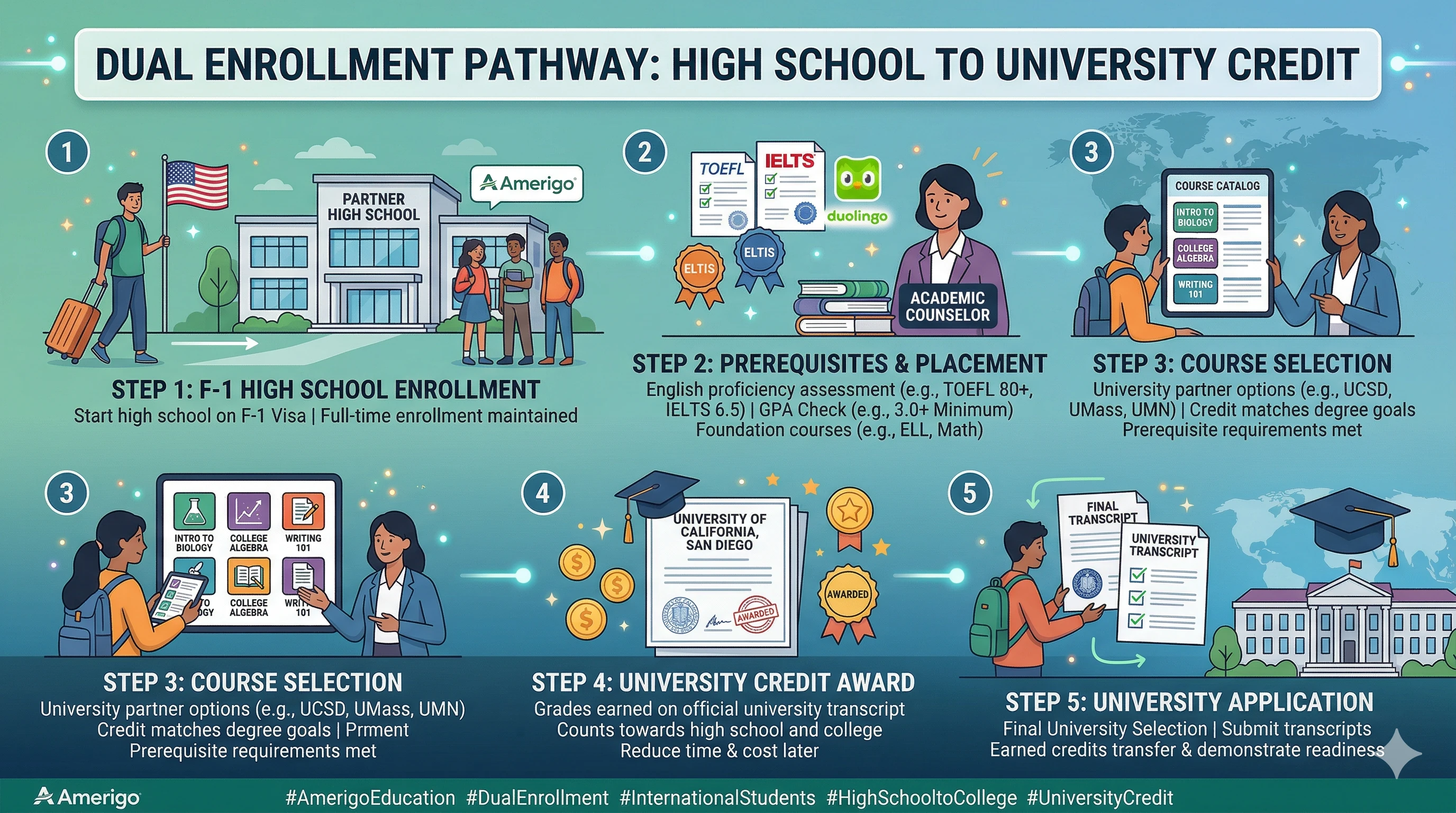
For international students, dual enrollment typically happens in one of two ways: the student travels to a nearby university campus for certain classes, or the courses are delivered online or on the high school campus through a university partnership. The high school student must meet the university's course prerequisites and minimum proficiency standards. Completed credits appear on an official university transcript, which the student can submit when applying to universities or after enrollment to potentially skip introductory courses.
Which Amerigo Partner Schools Offer Dual Enrollment?
Dual enrollment is available at select Amerigo partner schools - not at all 40. The schools currently offering dual enrollment programs are Besant Hill School, Justin-Siena High School, Carmel Catholic High School, and Cretin-Derham Hall. Each of these schools has established a formal agreement with a university partner to deliver college-level coursework on campus or online, allowing enrolled international students to pursue university credit as part of their regular academic schedule.
These schools work with verified university partners including UC San Diego, University of San Diego, University of Minnesota, Milwaukee School of Engineering, Project Lead The Way, Catholic Virtual, and University of Massachusetts. Students considering dual enrollment as part of their academic plan should prioritize these schools during the school selection process. Availability of specific courses and the university partners may vary by academic year - students should confirm current offerings directly with the school and with Amerigo's academic counselors.
What Are the Academic Requirements to Access Dual Enrollment?
Dual enrollment courses are college-level, meaning students must demonstrate adequate academic and English proficiency before enrolling. High schools and their university partners set prerequisite requirements that students must meet before joining a dual enrollment course. For international students, this typically includes reaching a minimum English proficiency level, completing foundational coursework in the relevant subject area, and meeting the GPA threshold set by the university partner, which is often 3.0 or higher on a 4.0 scale.
Amerigo's individualized academic planning model includes identifying prerequisite courses students must complete before accessing AP (Advanced Placement) or dual enrollment courses. This planning begins before the student's first semester and is updated as the student progresses. A student who arrives with B1 English level (as measured by TOEFL, IELTS, Duolingo English Test, or Eltis) will typically follow a pathway through ELL (English Language Learning) courses and foundational academic subjects before being eligible for dual enrollment. GPA (Grade Point Average) requirements also apply - typically a minimum GPA of 3.0 or above is expected by most university partners.
- Complete ELL coursework to reach academic English proficiency
- Meet the minimum GPA requirement set by the university partner
- Complete prerequisite high school courses in the relevant subject
- Obtain academic counselor approval and school sign-off
- Register for the dual enrollment course through the school's process
- Confirm credit transfer policies with target universities before enrolling
How Much Does Dual Enrollment Cost for International Students?
The cost of dual enrollment varies by school and by the specific university partner involved. Certain dual enrollment courses are included as part of the comprehensive program offering, while other courses may require additional fees depending on the university partner and specific course. Amerigo's comprehensive program fee, which starts from $40,000 per year, already covers tuition, accommodation, on-campus international department support, and university counseling - but dual enrollment fees, where applicable, are assessed separately based on the partnering institution's course pricing.
This means students and families should not assume dual enrollment is entirely free or entirely additional - the answer depends on which school the student attends and which specific course they enroll in. Amerigo program fees already cover tuition, accommodation, on-campus international department support, university counseling, and 24/7 emergency assistance. Additional dual enrollment fees, where they apply, are separate from these comprehensive fees. Families should request specific cost details for dual enrollment at their target school during the program inquiry process.
How Does Dual Enrollment Compare to AP Courses?
Both AP (Advanced Placement) courses and dual enrollment allow high school students to earn college credit. They differ in how credit is awarded, how universally it transfers, and how the courses are structured. AP credit depends on a student's exam score at the end of the year, while dual enrollment credit is awarded by the university as a direct course grade, which often makes it more straightforward for receiving universities to evaluate and accept. Understanding the difference helps students and families choose the right academic path.
All exclusive Amerigo partnership schools offer 20+ AP courses. AP credits are earned by passing the AP exam (scored 1-5) at the end of the year, with most universities granting credit for scores of 3 or higher. Dual enrollment credit appears as actual university credit on a college transcript, which many universities view as more transferable than AP credit because it is course-specific rather than exam-based. However, some universities have specific AP credit policies that make AP equally or more valuable for their programs. Amerigo's university counseling team advises students on which path best serves their target universities and intended major.
Frequently Asked Questions
Can international students on F-1 visas take dual enrollment courses?
Yes. F-1 students enrolled full-time in their primary high school program can take dual enrollment courses as part of or in addition to their standard high school schedule. The dual enrollment courses are part of the student's academic program, not separate employment or work activity. Students should confirm their specific course arrangement complies with their school's F-1 compliance policies and confirm with their DSO (Designated School Official).
Do dual enrollment credits transfer to all US universities?
Transfer policies vary by university. Most US universities accept dual enrollment credits from accredited institutions, but policies on which courses fulfill which requirements differ significantly. Students should research the specific transfer credit policies of their target universities before selecting dual enrollment courses. Amerigo's university counseling team helps students align course choices with their target institutions' credit transfer rules.
Is dual enrollment available to students in all grade levels?
Dual enrollment is typically available to students in 11th or 12th grade who have met the prerequisite academic and English proficiency requirements. Students in earlier grade levels focus on building the academic foundation - through ELL courses, foundational subjects, and AP prerequisite courses - that makes them eligible for dual enrollment later. Grade-specific eligibility varies by school and university partner.
How does dual enrollment appear on a US university application?
Dual enrollment courses appear on both the student's high school transcript (as high school course credits) and on an official university transcript from the partnering institution. When applying to US universities, students submit their high school transcript and may separately submit the dual enrollment university transcript to demonstrate college-level coursework completion. This strengthens the application by showing demonstrated ability in a college-level environment.
What happens to dual enrollment credits if a student does not go to that university?
Dual enrollment credits appear on a transcript from the university that taught the course - for example, UC San Diego or University of Minnesota. When a student applies to a different university, that university reviews the transcript and applies its own transfer credit policy. Credits from accredited US universities are accepted by most other US universities, though the specific course requirements they fulfill may differ. Students should check individual policies.
Can dual enrollment help international students graduate from university faster?
Potentially yes. If a student earns significant dual enrollment credits that transfer to their chosen university, they may be able to skip introductory courses and enter at a more advanced level - reducing the time needed to fulfill graduation requirements. However, this outcome depends on which credits transfer, how the target university applies them, and which major the student pursues. Amerigo's university counseling team helps students project realistic outcomes.
What subjects are available through Amerigo's dual enrollment partners?
Subject availability depends on the specific university partner and the Amerigo school offering dual enrollment. Partners including UC San Diego, University of Minnesota, and University of Massachusetts offer courses across multiple disciplines. Project Lead The Way focuses on STEM (science, technology, engineering, and mathematics) and engineering pathways. Catholic Virtual offers online coursework. Students should review each school's current dual enrollment catalog during the school selection process.
Does dual enrollment affect F-1 visa status?
Dual enrollment courses are part of the student's full-time academic program at their primary high school and do not in themselves affect F-1 status, provided the student remains enrolled full-time at their primary school. Any arrangement that would reduce the student's hours at their primary school below full-time enrollment could affect status. Students should consult their DSO before making scheduling changes related to dual enrollment.
Does Amerigo's Top 100 Guarantee count dual enrollment courses toward eligibility?
Amerigo's Top 100 Guarantee requires two consecutive years of enrollment at a US Signature School, a cumulative GPA of 3.2+, TOEFL 85+, and at least one AP, IB, or Honors course. Dual enrollment courses do not substitute for the AP, IB, or Honors requirement under the Guarantee terms - students need at least one AP, IB, or Honors course in addition to any dual enrollment work. The Guarantee applies to US Signature Schools only.
Conclusion
Dual enrollment allows international high school students to earn university credit while completing their secondary diploma, strengthening applications and potentially accelerating university completion. At Amerigo, dual enrollment is available at Besant Hill School, Justin-Siena High School, Carmel Catholic High School, and Cretin-Derham Hall, through partnerships with seven accredited US universities. Cost varies by school and course, and academic prerequisites must be met before enrolling.
Explore Dual Enrollment Options with Amerigo
If dual enrollment is part of your student's academic plan, Amerigo Education's counselors can help you identify the right partner school and plan the academic pathway. Contact us to discuss which schools currently offer dual enrollment programs, or apply now to begin the school selection process.
People Also Read
- What is Advanced Placement Credit: Complete Guide 2026
- Why US High School Transcripts Give International Students a University Admission Advantage
- How Long Does It Take International Students to Go from Basic English to AP Classes?
About the Author
This guide was written by the Amerigo Education content team, drawing on program data from staff operating the on-campus international department at 40 Niche A+/A rated US, Canadian, and UK partner schools. Learn more about Amerigo Education.
Disclaimer: This article provides general information for educational purposes only. Families should conduct independent research, request current program data from providers, and consult with program representatives regarding specific circumstances. Contact us with questions.