All news
May 6, 2026
Study Abroad 101
F-1 Visa Interview at Beijing or Shanghai Consulate: What Chinese High School Families Should Prepare
F-1 visa interviews at Beijing or Shanghai require I-20, SEVIS fee, and DS-160. Learn required documents, common interview questions, and preparation tips.
_converted.webp)
Last Updated: May 2026
The F-1 visa interview is a required step in the US student visa application process for Chinese high school students. F-1 (student visa for academic programs) applicants in mainland China schedule their consular appointments at one of several US Embassy and Consulate locations, with Beijing and Shanghai among the most frequently used for student applications. According to IIE Open Doors (2024), China remains the largest single source country for international students in the United States, with over 277,000 students enrolled across all education levels. High school applicants face the same consular interview process as university students, with an additional focus on demonstrating that the student - not just the parents - understands the program and intends to comply with F-1 status requirements.
Amerigo Education partners with 40 Niche A+/A rated schools (independent academic rankings based on school-reported curriculum quality, faculty credentials, student outcomes, and college matriculation data) across the US, Canada, and the UK, supporting 3,500+ students from 55+ countries. The Class of 2025 achieved 97% admission to Top 100 US universities. Approximately 50% of Amerigo's enrolled students come from China, and Amerigo's optional visa support service is available through ZF Visa - Amerigo's third-party visa support partner that provides F-1 (US student visa) application assistance to students at Amerigo's US Signature Schools - a network of partner schools in the United States where Amerigo provides dedicated on-campus international support, including residential accommodation, an on-campus international department, university counseling, and the Top 100 Guarantee - a refund of up to $50,000 USD in senior year tuition fees for US Signature School students who complete two consecutive years of enrollment, maintain a cumulative GPA of 3.2 or higher, achieve a TOEFL score of 85 or above, complete at least one AP, IB, or Honors course, and apply to Top 100 US universities but do not gain admission for eligible students, including DS-160 preparation, interview coaching, and document review. ZF Visa supports F-1 applications only and does not cover UK Student Visa applications for families seeking additional guidance on the US F-1 application process.
This guide covers the US consulate locations in China, the complete document checklist for a high school F-1 interview, how to prepare the student for consular questions, common denial reasons and how to address them, and how Amerigo coordinates pre-departure support for Chinese families.
Key Takeaways
- Consulate locations: US visa interviews for China-based applicants are conducted at the US Embassy in Beijing and US Consulates in Shanghai, Guangzhou, Chengdu, and Wuhan.
- Required documents: Every F-1 interview requires a valid I-20, paid SEVIS (Student and Exchange Visitor Information System) fee receipt, completed DS-160 form, and a valid passport - additional financial documents are typically expected.
- Student readiness: Consular officers ask the student directly about the program, the school, and future plans - parents are not permitted to answer on the student's behalf.
- Common denial reason: Administrative processing holds (221(g)) are most commonly triggered by incomplete documentation or insufficient demonstration of ties to China that would ensure the student's return.
- Amerigo support: Amerigo communicates with Chinese families via WeChat and offers optional F-1 visa guidance through ZF Visa, a third-party partner - Amerigo does not provide visa services directly.
What Consulates Issue F-1 Visas in China?
Chinese nationals applying for an F-1 student visa must schedule their appointment at a US Embassy or Consulate in mainland China. The six locations are:
- US Embassy Beijing: Covers applicants from northern provinces; highest volume of student visa processing in China.
- US Consulate Shanghai: Covers applicants from eastern China including Jiangsu, Zhejiang, and Anhui provinces.
- US Consulate Guangzhou: Covers applicants from southern China; also processes immigrant visas for a large proportion of China's applicant pool.
- US Consulate Chengdu: Covers applicants from southwest China including Sichuan, Yunnan, and Guizhou.
- US Consulate Shenyang: Covers applicants from northeast China including Liaoning, Jilin, and Heilongjiang.
- US Consulate Wuhan: Covers applicants from central China.
Applicants are not required to apply at the consulate closest to their home address - they can schedule at any location with available appointment slots. According to NAIS (2024), Chinese students enrolling at US private secondary schools typically apply 3-6 months before their program start date, allowing enough lead time for consular appointment scheduling and any administrative processing delays.
Appointment availability varies significantly by location and season, with peak demand in May-July for students starting in September. Families should schedule as early as possible once the I-20 has been issued.
What Documents Are Required for the Interview?
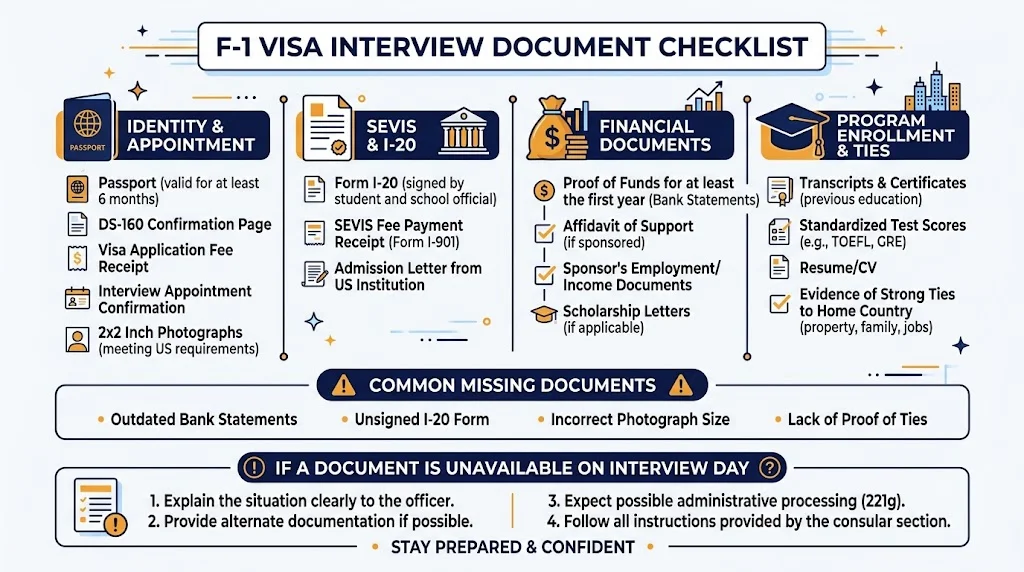
Every F-1 visa applicant at a US consulate in China must bring a complete document package on the day of the interview. Missing any required item typically results in the interview being terminated and rescheduled.
Required documents:
- Valid passport: Must be valid for at least six months beyond the intended period of stay in the United States.
- I-20 form: Original copy issued and signed by the DSO (Designated School Official) at the enrolled US school.
- SEVIS fee receipt: Proof of payment for the SEVIS I-901 fee - currently $350 for F-1 applicants - paid online through the SEVIS fee payment portal before the appointment.
- DS-160 confirmation page: Printed confirmation page from the completed online DS-160 nonimmigrant visa application, with the barcode visible.
- Visa appointment confirmation: Printed confirmation of the scheduled interview appointment.
- Passport-style photographs: Meeting US visa photo specifications (2x2 inches, white background, taken within six months).
- Financial documentation: Bank statements, tax records, or other evidence that the sponsoring family can cover the cost of tuition and living expenses for the full program duration.
- School acceptance letter: The official offer of enrollment from the partner school, distinct from the I-20.
How Should Students Prepare for the Interview?
Consular officers conduct F-1 interviews in English at US consulates in China. The interview typically lasts 2-5 minutes and focuses on a small number of direct questions. Preparation should center on the student's ability to answer clearly and confidently, not on memorizing scripted responses.
The three areas consular officers assess are:
- Genuine intent to study: The student should be able to explain their chosen school, why they want to study in the United States, and what subject area or program they intend to pursue.
- Financial capacity: The student should be able to confirm that their family will cover tuition and living costs without requiring unauthorized employment in the United States.
- Intent to return: The officer looks for evidence of home-country ties - family, property, or future plans - that make the student likely to return to China after completing the program.
Students should review their own I-20 before the interview and be able to state the name of the school, the program start date, the program duration, and the estimated annual cost. Students who cannot answer basic questions about their own enrollment documents raise flags regardless of the quality of their supporting paperwork.
What Common Questions Do Consular Officers Ask?
While interview content varies by officer, the following questions are consistently reported by F-1 applicants at US consulates in China:
- "Where will you be studying?" - Name the school exactly as it appears on the I-20.
- "Why did you choose this school?" - Provide a specific, factual answer (location, program, partner recommendation) rather than a vague response about "good education."
- "What will you study?" - State the intended grade level, subject focus, or AP (Advanced Placement) coursework plan.
- "Who will pay for your studies?" - Confirm the sponsoring parent or family member and state that funds are available.
- "What do you plan to do after graduating?" - Describe plans to apply to university in the US or return to China for university; officers look for a credible post-graduation plan.
Answers should be direct and consistent with the documents. Inconsistencies between verbal answers and written documentation are among the most common triggers for administrative processing.
Why Are F-1 Visa Applications Sometimes Denied?
The most common outcomes for F-1 interviews in China are approval, administrative processing (221g hold), or denial. Understanding the difference helps families prepare appropriate supporting materials.
| Outcome | Meaning | Common Cause |
|---|---|---|
| Approved | Visa issued (typically within 3-5 business days) | Complete documents, clear interview answers |
| 221(g) Administrative Processing | Application under additional review; no immediate decision | Incomplete documents, security screening, additional verification required |
| Denied | Visa not issued; must reapply with stronger documentation | Insufficient financial evidence, unclear ties to China, inconsistent interview answers |
According to IIE Open Doors (2024), Chinese student visa refusal rates have fluctuated in recent years, underscoring the importance of presenting complete documentation and a credible study plan at the interview rather than assuming approval based on prior travel history.
Families who receive a 221(g) hold should respond promptly to any document requests from the consulate and avoid making travel arrangements until the visa is physically in hand.
How Does Amerigo Support Chinese Families?
Amerigo provides native-language communication support for Chinese families throughout the enrollment and pre-departure process. Amerigo's in-country staff communicate with families via WeChat, which is the primary channel for Chinese family communication - not generic messaging platforms. Before departure, families attend a pre-departure orientation session covering logistics including emergency contacts, arrival procedures, and health documentation.
For visa guidance, Amerigo offers optional support through ZF Visa - Amerigo's third-party visa support partner that provides F-1 (US student visa) application assistance to students at US Signature Schools, including DS-160 preparation, interview coaching, and document review. ZF Visa supports F-1 applications only and does not cover UK Student Visa applications, a third-party partner that specializes in F-1 visa applications for US-bound students. ZF Visa services are an add-on and are not included in the standard Amerigo program fee; Amerigo does not provide visa services directly.
On arrival at an Amerigo US Signature School, the on-campus international department - a dedicated team at each US Signature School consisting of a Director of Campus Operations, Academic Director, Senior Campus Coordinators, Campus Coordinators, and an ELL teacher, who provide daily academic support, residential supervision, university counseling, and welfare oversight for enrolled international students manages SEVIS-related compliance, tracks I-20 renewal timelines, and coordinates with the school's DSO throughout the student's enrollment. Families receive monthly progress reports, school activity calendars and event announcements through StudyStudyGo - Amerigo's parent communication platform that delivers monthly progress reports, school activity calendars, and event announcements to families of enrolled students at US Signature Schools, with real-time outreach when matters require immediate attention.
Frequently Asked Questions
How early should Chinese families schedule the F-1 visa interview?
Families should schedule the consular interview as soon as the I-20 has been issued and the SEVIS fee has been paid. For students starting in September, this typically means scheduling in March-May to allow time for appointment availability, the interview itself, and any administrative processing delays. Peak demand at Beijing and Shanghai consulates in June-July can extend wait times significantly. The SEVIS fee payment must be completed at least three business days before the interview appointment.
Can parents accompany a minor to the F-1 visa interview?
A parent or guardian may accompany a minor to the consulate and wait in the waiting area, but the consular officer interviews the student directly. Parents are not permitted to speak on behalf of the student or answer questions during the interview itself. Students under 14 may have different interview requirements - families should confirm current protocols with the specific consulate before the appointment.
What happens if the student cannot speak English fluently at the interview?
F-1 interviews are conducted in English at US consulates in China. Students who are not yet fully fluent should prepare standard answers to common interview questions in English before the appointment. Consular officers are familiar with interviewing students who are still developing English proficiency; what they assess is whether the student can confirm basic facts about their enrollment. Completely unintelligible responses or reliance on a parent to translate raise flags.
How long does F-1 visa processing take in China?
Most F-1 visas are issued within 3-5 business days of a successful interview. Administrative processing (221g) can extend this to several weeks or months. Families should not purchase plane tickets until the visa is physically in hand. Processing times at Beijing and Shanghai tend to be more predictable than at smaller consulate locations due to higher staffing volume, but all timelines are subject to fluctuation based on application backlog and security review requirements.
Does a previously refused visa affect a new F-1 application?
A prior visa refusal must be disclosed on the DS-160 form. It does not automatically disqualify a student from receiving a visa, but it requires that the new application address the reason for the previous refusal. Families whose prior application was denied for insufficient financial documentation should provide more comprehensive bank and tax records in the new application. Families should consult an immigration professional if the prior refusal involved more complex grounds.
What financial documents are most important for a high school F-1 application?
Consular officers look for evidence that the sponsoring family can cover the full annual cost of the program without the student needing to work. Bank statements covering 3-6 months and showing a consistent balance greater than the annual program cost are the most effective form of financial evidence. Tax records, property ownership documentation, and employer letters confirming income can supplement bank statements. Families should bring originals and translated copies of all financial documents to the interview.
What is the SEVIS fee and how is it paid?
The SEVIS I-901 fee is $350 for F-1 applicants, paid online at fmjfee.com using the SEVIS ID from the student's I-20. After payment, a confirmation receipt is generated and must be printed and brought to the consular interview. Payment should be completed at least three business days before the appointment to allow the record to update in the consulate's system.
Can the F-1 visa interview be conducted at any US consulate in China?
Yes - Chinese applicants are not restricted to the consulate closest to their home province. Students can schedule at whichever US consulate in China has the most available appointment slots. Families in northern China often apply at Beijing, while those in eastern China commonly use Shanghai. Some families choose alternate locations like Chengdu, Shenyang, or Wuhan during peak seasons when Beijing and Shanghai appointment slots are unavailable for several weeks.
What is administrative processing (221g) and how should families respond?
A 221(g) hold means the consular officer has determined that additional administrative processing is required before a decision can be made. The applicant may be asked to submit additional documents, such as updated financial records or supporting materials. Families should respond to any document request promptly and avoid booking travel until the visa is issued. Administrative processing is not a denial - most cases are resolved once the additional review is complete.
What should Chinese families do if the visa is denied?
A visa denial requires the family to address the stated reason before reapplying. Common reasons include insufficient financial documentation, unclear interview answers, or concerns about non-immigrant intent. Families should request the reason from the officer if possible, consult an immigration attorney if unclear, and allow several weeks before reapplying. Amerigo's in-country staff in China are available via WeChat to coordinate next steps.
Conclusion
F-1 visa interviews at US consulates in Beijing and Shanghai require complete documentation - I-20, DS-160, SEVIS fee receipt, financial records, and passport - and a student who can confidently answer basic questions about their program in English. Administrative processing holds are resolvable with prompt document submission, while outright denials require addressing the stated reason before reapplying.
Apply to an Amerigo Partner School
To learn more about studying in America at an Amerigo partner school, contact us to speak with a program advisor, or apply now to take the first step toward enrollment.
People Also Read
- F-1 Visa Stability for Chinese Families 2026
- What Documents Are Required for F-1 Visa Interview? Complete Checklist 2026
- When Should I Apply for F-1 Visa? Complete Timeline Guide 2026
About the Author
This guide was written by the Amerigo Education content team, drawing on program data from staff operating the on-campus international department at 40 Niche A+/A rated US, Canadian, and UK partner schools. Learn more about Amerigo Education.
Disclaimer: This article provides general information for educational purposes only. Families should conduct independent research, request current program data from providers, and consult with program representatives regarding specific circumstances. Contact us with questions.