All news
May 9, 2026
Study Abroad 101
Cornell Admissions for International High School Students
Cornell's admit rate is around 7.6%. International high school students need strong GPA, test scores, and US transcript experience to be competitive.
_converted.webp)
Last Updated: May 2026
Cornell University is a private Ivy League research university in Ithaca, New York, with one of the most selective undergraduate admissions processes in the United States. Cornell's overall admit rate for the Class of 2028 was approximately 7.6%, reflecting the volume of highly qualified applicants competing for a limited number of places across seven undergraduate colleges. According to IIE Open Doors (2024), international students represent a growing share of applicants to highly selective US universities, with demand for Ivy League and near-Ivy placements increasing from Asia-Pacific source countries.
Amerigo Education partners with 40 Niche A+/A rated schools (independent academic rankings based on school-reported curriculum quality, faculty credentials, student outcomes, and college matriculation data) across the US, Canada, and the UK, supporting 3,500+ students from 55+ countries. The Class of 2025 achieved 97% Top 100 university admission rate. Of those who applied to Top 30 universities in the Class of 2025, 25% of Amerigo students gained admission - a tier that includes Cornell and other Ivy League institutions.
This guide covers Cornell's admission rates, which undergraduate colleges have different competitiveness levels, what academic profiles competitive applicants typically present, how the Common App process works for international students, and how US high school preparation improves Cornell admission outcomes.
Key Takeaways
- Admit rate: Cornell's overall admit rate is approximately 7.6% (Class of 2028) - making it the most accessible Ivy League school by admit rate while still highly selective.
- Seven colleges: Cornell has seven undergraduate colleges with differing admit rates - some professional schools are more accessible than the general College of Arts and Sciences.
- International applicants: International students apply through the Common App with the same academic requirements as domestic applicants, plus English proficiency documentation.
- US transcript advantage: International students who complete 2+ years at a US high school can present GPA, AP (Advanced Placement) course rigor, and recommendation letters on a familiar academic framework for Cornell admissions officers.
- Amerigo outcomes: Of those who applied to Top 30 universities, 25% of Amerigo's Class of 2025 students gained admission to universities in this tier.
How Competitive Is Cornell for International Students?
Cornell's overall admit rate of approximately 7.6% for the Class of 2028 reflects the combined pool across all seven colleges. International students are not tracked or reported as a separate admit-rate cohort by Cornell, but they compete in the same evaluation process as domestic applicants - assessed on academic achievement, intellectual engagement, and alignment with each college's specific criteria.
Cornell received over 67,000 applications for the Class of 2028, according to NACAC (2024), representing a significant increase in applicant volume relative to previous cycles. The increase in applications has further compressed the effective admit rate across highly selective institutions.
International students from countries where English is not the primary language must submit TOEFL, IELTS (International English Language Testing System), or other approved English proficiency tests in addition to SAT or ACT scores. Cornell does not waive the English proficiency requirement for international applicants based on academic track record alone.
Which Cornell Colleges Have Different Acceptance Rates?
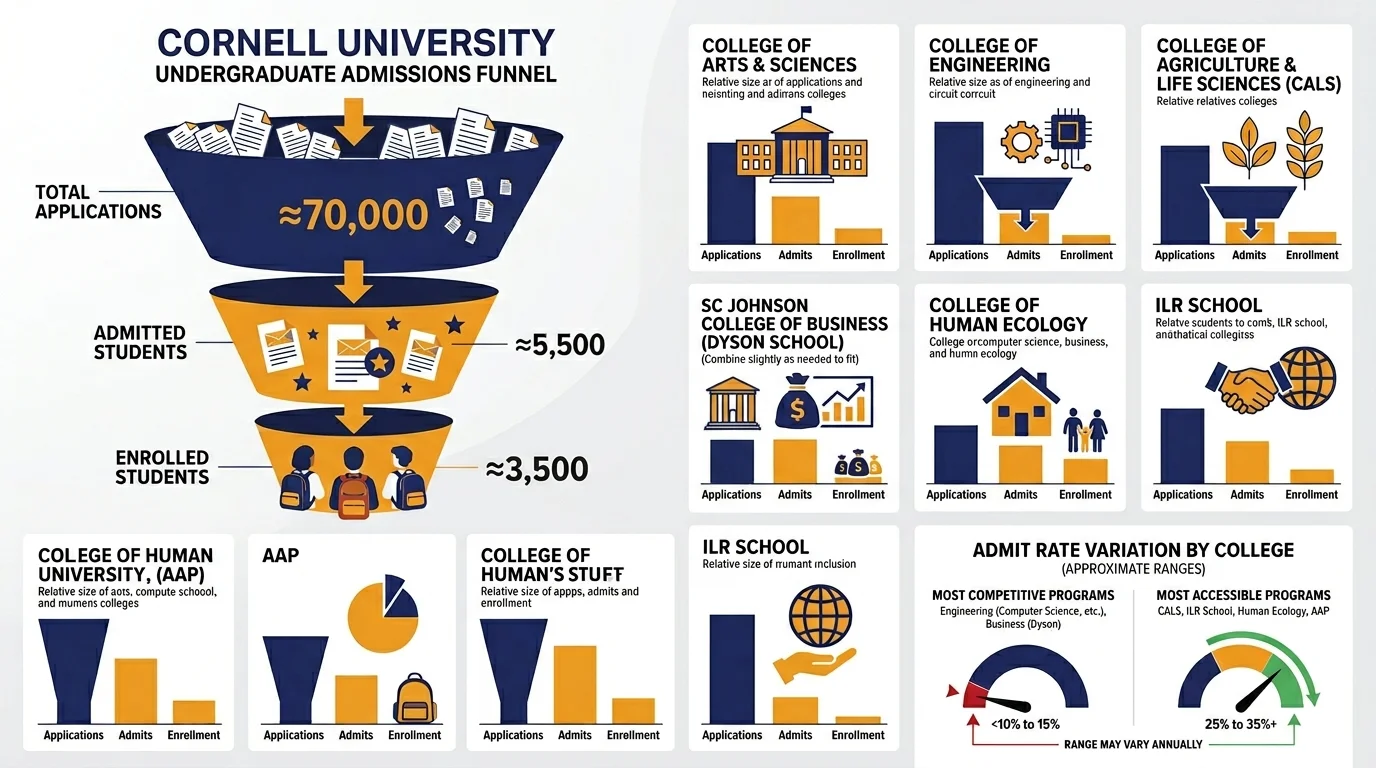
Cornell's seven undergraduate colleges differ in competitiveness, program focus, and applicant volume. Admission to a specific college is determined by the application - students apply to a single college, not to Cornell generally.
The seven colleges and their general admission profile:
- College of Arts and Sciences (CAS): The largest liberal arts college; highly competitive with one of the lowest per-college admit rates.
- College of Engineering: Strong demand from international students; competitive particularly for computer science and electrical engineering.
- School of Hotel Administration (SHA): Consistently cited as one of the world's leading hospitality programs; selective but with a distinct applicant pool.
- College of Agriculture and Life Sciences (CALS): Includes biological sciences, environmental studies, and nutritional science; generally slightly higher admit rates than CAS.
- College of Human Ecology: Focuses on human development, policy, design, and nutrition; generally higher admit rates than CAS or Engineering.
- SC Johnson College of Business: Competitive undergraduate business program; strong interest from international applicants in finance, operations, and economics.
- ILR School (Industrial and Labor Relations): Highly distinctive program; competitive but with a smaller applicant pool than CAS or Engineering.
International students should select the college that genuinely aligns with their academic interests, not simply the one perceived as more accessible.
What Academic Profile Do Competitive Applicants Present?
Cornell does not publish minimum GPA (Grade Point Average) or test score thresholds, but admitted student profiles from published Common Data Set reports indicate that competitive applicants typically present:
- Class rank: Top 10% of their secondary school class, where rank is available.
- Course rigor: Full schedule of advanced courses - AP or IB (International Baccalaureate) coursework for US-based applicants.
- SAT/ACT scores: Competitive applicants typically present SAT scores above 1500 or ACT composite scores above 34.
- Demonstrated interest: Specific intellectual motivation for the chosen Cornell college, expressed through essays and extracurricular alignment.
According to NACAC (2024), highly selective institutions weigh non-academic factors - essays, recommendations, and extracurricular depth - heavily alongside academic metrics. International students who can demonstrate academic excellence AND a compelling personal narrative are better positioned than those with strong scores alone.
How Do International Students Apply to Cornell?
Cornell accepts applications through the Common App (Common Application) only - no separate international student application portal. The standard application components for international students include:
- Common App essay: 650-word personal statement addressing one of seven prompts.
- Cornell supplement: Required college-specific essay(s) explaining the student's interest in their chosen Cornell college.
- Academic transcripts: Official secondary school records, including any external exam results (GCE A-levels, Chinese Gaokao scores, IB transcripts).
- Recommendations: Typically two teacher recommendations and one school counselor report.
- English proficiency: TOEFL (minimum 100 iBT recommended), IELTS (6.5+), or other approved test.
Cornell offers Early Decision (binding) in early November with a mid-December notification and Regular Decision in January with a late March-April notification. International students considering Early Decision should confirm financial aid eligibility, as binding commitment interacts with financial aid calculation timelines.
How Does US High School Preparation Improve Cornell Outcomes?
International students who spend 2+ years at a US high school before applying to Cornell present a fundamentally different application profile compared to international students applying directly from overseas curricula. The advantages include:
- GPA on a US scale: Cornell admissions officers can directly evaluate an unweighted 4.0 GPA and AP course rigor, rather than converting from a foreign grading system.
- AP course transcript: Completed AP courses with high scores (4s and 5s) demonstrate college-level readiness in a format Cornell is already familiar with.
- Stronger recommendations: US teachers who have observed the student in challenging coursework can write more specific and credible recommendation letters.
- Extracurricular depth: US high schools offer clubs, leadership roles, varsity sports, and community service platforms that enrich the application in ways international schools may not match.
Amerigo's university guaranteed admission support works with students at US Signature Schools to plan AP course selection, build extracurricular profiles, and prepare Common App materials throughout their enrollment.
How Does Amerigo Support Students Targeting Cornell?
Amerigo does not guarantee admission to Cornell or any specific university outside the Top 100 Guarantee - a refund of up to $50,000 USD in senior year tuition fees for US Signature School students who complete two consecutive years of enrollment, maintain a cumulative GPA of 3.2 or higher, achieve a TOEFL score of 85 or above, complete at least one AP, IB, or Honors course, and apply to Top 100 US universities but do not gain admission structure. However, students enrolled at Amerigo's US Signature Schools - a network of partner schools in the United States where Amerigo provides dedicated on-campus international support, including residential accommodation, an on-campus international department, university counseling, and the Top 100 Guarantee for eligible students who target Cornell and other highly selective institutions follow the Top 50 Track - a higher-tier program for students targeting universities ranked in the Top 50, combining elevated entry academic standards, structured extracurricular development, focused essay strategy, and dedicated university counseling from each Signature School's on-campus international department, which involves higher entry standards, more intensive extracurricular development, and academic acceleration through AP and Honors coursework.
The on-campus international department - a dedicated team at each US Signature School consisting of a Director of Campus Operations, Academic Director, Senior Campus Coordinators, Campus Coordinators, and an ELL teacher, who provide daily academic support, residential supervision, university counseling, and welfare oversight for enrolled international students coordinates with the school's university counseling team to identify students with Top 30 ambitions early in enrollment, and ensures academic planning from Grade 9-10 onward is aligned with the application profile Cornell and similar institutions expect. Students targeting Cornell should discuss their goals at the point of enrollment to allow sufficient planning lead time.
Frequently Asked Questions
What is Cornell's admit rate for international students?
Cornell does not publish a separate admit rate for international students. The overall admit rate for the Class of 2028 was approximately 7.6%. International applicants compete in the same evaluation pool as domestic applicants, assessed on academic achievement, course rigor, essays, recommendations, and fit with their chosen undergraduate college. English proficiency test scores (TOEFL or IELTS) are required for international applicants in addition to SAT or ACT scores.
Which Cornell college has the highest admission rate?
Cornell's College of Human Ecology and College of Agriculture and Life Sciences are generally cited as having higher admit rates than the College of Arts and Sciences or College of Engineering, though all Cornell colleges remain highly selective. Applicants should choose their target college based on genuine academic fit - applying to a college perceived as easier to enter without authentic program interest weakens the application through unmotivated essays and poor extracurricular alignment.
Does Cornell require the SAT or ACT from international students?
Cornell's standardized testing policy has varied in recent years. Families should confirm current requirements directly with Cornell's admissions office at the time of application. When required, international students submitting SAT or ACT scores are evaluated alongside all other applicants. English proficiency tests (TOEFL 100 iBT+ or IELTS 6.5+) remain a separate requirement for non-native English speakers and are not substituted by SAT verbal scores.
How important is the Cornell supplement essay?
The Cornell supplement essay is college-specific and asks applicants to articulate their genuine interest in their chosen undergraduate college. Admissions officers use the supplement to assess whether the student's academic goals align with what the college specifically offers - vague or generic answers are a clear weakness. Students should research their target college thoroughly and reference specific programs, faculty, research, or opportunities that connect to their personal academic history.
Can Amerigo students apply to Cornell through Early Decision?
Yes - Amerigo students can apply Early Decision to Cornell if they meet the academic preparation required. Early Decision is binding, meaning the student commits to enroll if admitted. Families considering Early Decision should verify financial aid implications before applying. Amerigo's school counseling team helps students assess Early Decision vs Regular Decision timing as part of the application strategy discussion, typically during junior or senior year of the US high school enrollment.
What extracurricular profile strengthens a Cornell application?
Cornell looks for depth rather than breadth in extracurricular involvement. A student who has developed significant achievement in 2-3 activities - school leadership, research, competition, arts - is typically better positioned than a student with surface-level involvement in many clubs. Amerigo hosts its own social events for students and their friends separate from school-organized activities, and facilitates community service participation through food drives, prom drives, and other structured initiatives that build application narratives.
How many AP courses do international students need for Cornell?
Cornell does not specify a minimum number of AP courses. Competitive applicants typically present 5-10 completed AP courses by graduation, with high scores (4s and 5s) in subject areas relevant to their intended college. Students targeting Engineering benefit from AP Calculus BC, AP Physics, and AP Computer Science. CAS applicants benefit from broad AP coverage in sciences, languages, and humanities. Amerigo's academic planning at US Signature Schools helps students identify the right AP courses for their target major.
What is the difference between Cornell's Early Decision and Regular Decision outcomes?
Early Decision applicants historically have higher admission rates than Regular Decision applicants at Cornell, as is typical across highly selective institutions. The gap is partly attributable to the commitment signal ED sends and partly to the composition of the ED pool. Regular Decision remains a viable path - the majority of Cornell's enrolled students enter through Regular Decision. Students uncertain about first-choice commitment, financial aid needs, or application readiness should apply Regular Decision.
Does a US high school diploma improve Cornell admission chances for international students?
Completing 2+ years at a US high school allows international students to present GPA, AP course grades, and US teacher recommendations - a profile Cornell admissions officers can evaluate directly without score conversion. According to IIE Open Doors (2024), international students who attend US secondary schools achieve stronger university admission outcomes than those applying from overseas curricula. The US high school track does not guarantee Ivy admission but materially strengthens the application on multiple dimensions.
Is Cornell a realistic target for an Amerigo student?
Cornell is achievable for students with exceptional academic profiles, strong AP performance, compelling personal narratives, and meaningful extracurricular development - all of which Amerigo's Top 50 Track is designed to support. Of those who applied to Top 30 universities in the Class of 2025, 25% of Amerigo students gained admission. Students who discuss Top 30 ambitions at enrollment and plan their academic and extracurricular profile accordingly over 2+ years are more competitive than those who decide late in their program.
Conclusion
Cornell University admits approximately 7.6% of applicants overall, with seven undergraduate colleges offering different program focuses and competitiveness levels. International students who complete US high school with strong AP course records, high SAT or ACT scores, and focused extracurricular profiles are better positioned for Cornell than those applying directly from overseas curricula.
Apply to an Amerigo Partner School
To learn more about studying in America at an Amerigo partner school, contact us to speak with a program advisor, or apply now to take the first step toward enrollment.
People Also Read
- Amerigo's Top 50 Track: How Students Reach Elite Universities
- What GPA Do International Students Need for Top US Universities? Strategic Guide 2026
- How to Use US University Rankings Strategically: A Guide for International Students
About the Author
This guide was written by the Amerigo Education content team, drawing on program data from staff operating the on-campus international department at 40 Niche A+/A rated US, Canadian, and UK partner schools. Learn more about Amerigo Education.
Disclaimer: This article provides general information for educational purposes only. Families should conduct independent research, request current program data from providers, and consult with program representatives regarding specific circumstances. Contact us with questions.