All news
March 26, 2026
Study Abroad 101
What US High School Graduation Requirements Mean for International Students
What credits, courses, and requirements do international students need to graduate from a US high school? Complete graduation requirements guide for families in 2026.

What US High School Graduation Requirements Mean for International Students
Last Updated: March 2026
A US high school graduation requirement is a specific course, credit total, or non-academic obligation that a student must complete before the school will issue a diploma. According to the National Center for Education Statistics (NCES), the average US high school requires between 22 and 26 total credits for graduation, with mandatory coursework spanning English, mathematics, science, social studies, and additional subjects that vary by state and school. The College Board reports that students who complete a rigorous course sequence aligned with graduation requirements are significantly more likely to succeed in college-level coursework, making the structure of these requirements directly relevant to university preparation.
Amerigo Education partners with 40 Niche A+/A rated schools across the US, Canada, and UK, supporting 3,500+ students from 55+ countries. The Class of 2025 achieved 97% admission to Top 100 US universities. Each partner school maintains an on-campus international department that evaluates transferred credits, maps out remaining graduation requirements, and builds individualized academic plans for students from China, Vietnam, Korea, Mexico, the Taiwan Region, and more. Families receive monthly reports tracking progress toward graduation milestones, and 24/7 emergency support is available at every location.
Key Takeaways
- Credits are the currency of graduation: US high schools require 22 to 26 total credits, with each full-year course earning 1.0 credit and each semester course earning 0.5 credits.
- Core subjects are non-negotiable: Every student must complete minimum credits in English (4), math (3-4), science (3), and social studies (3), with additional requirements varying by school.
- Transferred credits count: Schools evaluate international transcripts and assign credit equivalencies, meaning students who enter at Grade 10 or 11 do not start from zero.
- AP and Honors fulfill requirements while adding rigor: Advanced courses satisfy the same subject-area requirements as standard courses while providing weighted GPA points and potential college credit.
- The diploma is globally recognized: A US high school diploma, paired with an official transcript, is accepted by universities worldwide for admissions consideration.
How Many Credits Does Graduation Require?
US high schools measure academic progress in credits. Each full-year course a student completes with a passing grade earns 1.0 credit. Semester-long courses earn 0.5 credits. Over four years, a student taking six to seven courses per year accumulates between 24 and 28 credits. The school sets a minimum credit threshold, typically between 22 and 26 credits, that a student must reach before receiving a diploma.
The exact number varies by state and by school. Some states set a statewide minimum (for example, Texas requires 22 credits, while New York requires a minimum of 22 but many schools expect more), and individual schools often add requirements beyond the state floor. Private schools partnered with Amerigo Education publish their credit requirements during enrollment, and academic advisors build a personalized credit plan for each student during their first semester.
International students should note that the world language requirement may be partially or fully satisfied by their native language proficiency, depending on the school's policy. Some schools grant credit for demonstrated fluency through a proficiency exam, while others require enrollment in formal language courses regardless of prior knowledge.
How Do Transferred Credits Work?
When an international student enrolls at a US high school after completing coursework in their home country, the school registrar conducts a transcript evaluation. This process matches each course from the international transcript to its closest US equivalent and assigns credit accordingly. A student who completed two years of high school in Vietnam, for example, may receive credits for math, science, and social studies courses that align with US subject categories.
The evaluation process works as follows:
- Transcript submission: The student provides official transcripts with course names, grades, and contact hours, translated into English if necessary.
- Subject matching: The registrar compares each course to the US curriculum, determining whether it fulfills a specific graduation requirement or qualifies as elective credit.
- Credit assignment: Courses that align with US subject areas receive direct credit. Courses without a clear equivalent receive elective credit, which still counts toward the total credit minimum.
- Gap identification: The advisor identifies any required subjects not covered by the transferred credits and schedules those courses for upcoming semesters.
Students entering at Grade 9 (age 14-15) typically transfer fewer credits and complete most of their requirements at the US school. Students entering at Grade 10 or 11 bring more transferred credits but face a compressed timeline to complete remaining US-specific requirements like US History, which is rarely covered in international curricula. Amerigo Education partner schools have evaluated transcripts from over 55 countries and maintain familiarity with international grading systems and curricula from China, Vietnam, Korea, the Taiwan Region, and more.
What If a Student Enters with Fewer Credits?
Students who enter a US high school at Grade 10 or 11 with fewer transferable credits than expected face a credit gap that must be closed before graduation. This is a planning challenge, not a barrier. Schools address credit gaps through several strategies that allow students to graduate on schedule without compromising academic quality.
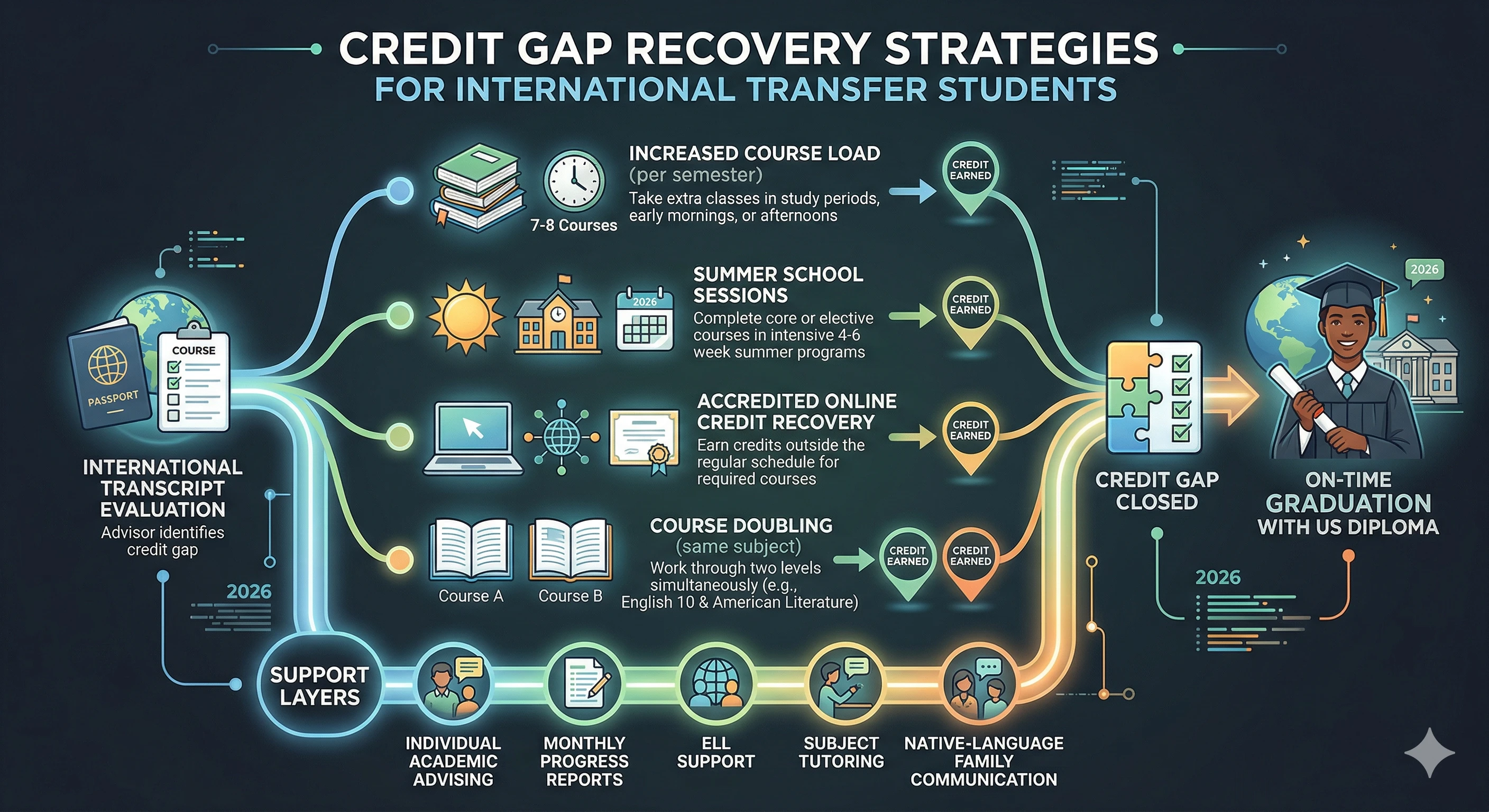
- Increased course load: Instead of the standard six courses per semester, a student may take seven, adding an extra class during a study period or before/after the regular school day.
- Summer school: Many schools offer summer sessions where students earn credits in four to six weeks per course, covering material that would normally take a full semester.
- Online credit recovery: Accredited online courses allow students to earn credits outside the regular schedule, particularly for required courses not available during a given semester.
- Course doubling: A student who needs two years of English may take both English 10 and American Literature in the same year, working through two levels simultaneously.
Academic advisors at schools with on-campus international departments build these recovery plans during the student's first weeks of enrollment. Monthly reports sent to families track credit accumulation against the graduation timeline, so parents can see exactly where their child stands at any point during the academic year.
Do AP and Honors Courses Fulfill Requirements?
Advanced Placement (AP) and Honors courses satisfy the same subject-area graduation requirements as their standard equivalents. AP US History counts as US History credit. Honors Chemistry counts as a science credit. The courses cover the same foundational material as standard versions but at a faster pace, with greater depth, and with the expectation of more independent analytical work.
The advantages of choosing AP or Honors courses over standard courses extend beyond simply meeting graduation requirements:
International students working to meet graduation requirements while building competitive university applications can use AP courses strategically. A student who needs three science credits might take Biology (standard), Chemistry (Honors), and AP Physics, satisfying the requirement while demonstrating increasing academic challenge. Schools with guaranteed university admission pathways factor AP enrollment into their advising recommendations, helping students balance graduation requirements with admissions positioning.
What Non-Academic Requirements Exist?
Beyond coursework and credits, many US high schools impose additional graduation requirements that fall outside the classroom. These requirements vary more widely between schools than academic requirements do, and international families are often unfamiliar with them because they have no equivalent in many other countries' education systems.
Community service hours. Many private high schools require between 20 and 100 hours of documented community service before a student can receive a diploma. Service may include volunteering at local nonprofits, participating in school-organized community events, tutoring younger students, or contributing to environmental projects. Schools typically require students to log their hours with supervisor signatures and submit documentation to a faculty advisor. Students at Amerigo Education partner schools receive guidance on identifying local volunteer opportunities that meet the school's service requirement.
Standardized testing. Some states require students to pass state-administered exams in subjects like English and mathematics as a graduation condition. These exit exams are separate from SAT or ACT scores and assess competency in core academic areas. Not all states use exit exams, and private schools may have their own assessment policies. International students should confirm whether their specific school or state requires these exams.
Senior project or capstone. Certain schools require a culminating project during Grade 12, which may involve a research paper, a community-based project, a portfolio presentation, or a combination of these elements. The senior capstone demonstrates that the student can apply skills acquired across multiple subject areas to an independent effort.
What Does the Diploma Document Mean?
A US high school diploma is a formal certificate confirming that a student has completed all graduation requirements set by the school and the state. The diploma itself is a single-page document printed on official paper bearing the school seal and signed by the principal and other school officials. It states the student's full legal name, the school name, and the date of graduation.
The diploma alone, however, is not the document that universities examine during the admissions process. Universities require the official transcript, which is a detailed record listing every course the student completed, the grade earned in each course, the credits assigned, and the cumulative GPA. The transcript provides the granular academic data that admissions committees use to evaluate a student's preparation. The diploma confirms completion; the transcript shows how the student performed.
For international students, the US high school diploma carries several practical outcomes:
- University eligibility: A US diploma satisfies the secondary education requirement for admission to US, Canadian, UK, Australian, and European universities without needing additional credential evaluation.
- Visa documentation: Graduating from a US high school provides a clear academic record for future visa applications, whether for university enrollment or other purposes.
- Credential recognition: Unlike some international qualifications that require apostille or third-party validation, a US diploma with an accompanying transcript is widely accepted at face value.
- Career foundation: For students who later pursue professional licensing or employment in the US, the high school diploma serves as a baseline educational credential.
Students who complete their program at an Amerigo Education US Signature partner school and meet GPA and standardized test score thresholds qualify for guaranteed admission to a Top 100 US university, provided they enroll for at least two consecutive years. This guarantee links graduation requirements directly to university outcomes, giving families a clear path from credit completion to university placement.
How Do State vs. School Requirements Differ?
US graduation requirements operate on two levels: state mandates and school-specific policies. Every state sets a minimum graduation standard that all schools within its borders must meet. Individual schools, particularly private schools, frequently add requirements beyond the state minimum. Understanding this layered system helps international families evaluate what their child will actually need to complete.
Private schools partnered with Amerigo Education set their own graduation policies that typically meet or exceed state standards. Because these schools regularly enroll international students, their requirements are designed with transfer students in mind. Academic advisors map each incoming student's transferred credits against the school's specific requirements during the first week of enrollment, identifying any gaps and building a schedule that addresses them. Families exploring partner school options can request graduation requirement details for specific schools during the admissions process.
Frequently Asked Questions
How many credits do international students need to graduate from a US high school?
Most US high schools require between 22 and 26 total credits for graduation, with each semester-long course earning 0.5 credits and each full-year course earning 1.0 credit. The exact number depends on the state and the individual school. Private schools partnered with Amerigo Education publish their specific credit requirements during enrollment, and academic advisors build a four-year credit plan for each student.
Do credits from my home country transfer to a US high school?
Yes, US high schools evaluate transcripts from international schools and assign credit equivalencies for completed coursework. The school registrar reviews subjects, contact hours, and grades to determine which courses align with US requirements. Some subjects transfer directly, while others may receive elective credit rather than fulfilling a specific requirement. Amerigo Education partner schools have experience evaluating transcripts from over 55 countries.
Can international students graduate early or do they need all four years?
Graduation depends on completing the required number of credits and mandatory courses, not on attending for exactly four years. A student who enters Grade 10 with transferred credits from their home country and takes a full course load each year can graduate on schedule in three years. However, students who enter with fewer transferable credits may need summer courses or additional semesters to meet all requirements.
What happens if my child is missing required courses when they transfer?
When a student transfers into a US high school without equivalent coursework in a required subject, the school places them into those courses during the next available term. Academic advisors prioritize filling graduation requirement gaps before adding electives. Students entering at Grade 10 or 11 may need to take additional courses per semester or use summer sessions to complete all requirements before their expected graduation date.
Is community service required to graduate from US high schools?
Community service requirements vary by school. Many private high schools require between 20 and 100 hours of documented community service before graduation. Some states also mandate service hours for public school graduation. Schools with on-campus international departments typically help students identify local volunteer opportunities and track their hours toward the graduation requirement.
Do AP courses count toward graduation requirements?
Yes, AP courses fulfill the same subject-area graduation requirements as standard courses while providing college-level rigor. An AP English Language course counts toward the English credit requirement just as a regular English course would. The difference is that AP courses carry weighted GPA points and offer the opportunity to earn college credit through the AP exam. Schools may recommend or require AP enrollment based on student readiness.
What does a US high school diploma look like?
A US high school diploma is a formal certificate issued by the school, printed on official paper with the school seal, and signed by the principal and registrar. It states the student's full name, the name of the school, and the date of graduation. The diploma is accompanied by a final transcript listing every course completed, the grade earned, and the cumulative GPA. Universities require the transcript rather than the diploma itself for admissions.
Are graduation requirements the same in every US state?
No, each US state sets its own minimum graduation requirements, and individual schools may add requirements beyond the state minimum. Core subject areas like English, math, science, and social studies are required everywhere, but the number of credits in each area and additional mandates like PE, health, or computer science vary. Private schools often have their own standards that meet or exceed state minimums.
Can my child take summer courses to catch up on credits?
Many US high schools offer summer school sessions where students can earn credits in required or elective courses. Summer courses are especially useful for international students who transferred in at Grade 10 or 11 with credit gaps. Each summer course typically runs four to six weeks and earns the same credit as a semester-long course during the regular academic year. Availability varies by school.
Is a US high school diploma recognized internationally for university admissions?
A US high school diploma is recognized by universities worldwide, including institutions in the UK, Canada, Australia, and across Asia and Europe. The diploma combined with the official transcript, standardized test scores, and school profile provides universities with sufficient information to evaluate the student. Amerigo Education's Class of 2025 achieved 97% admission to Top 100 US universities, demonstrating strong diploma recognition at the most selective institutions.
Conclusion
US high school graduation requirements follow a structured system of credits, required subject areas, and school-specific obligations that international students can navigate with proper planning and academic advising. Students who enter at any grade level receive a transcript evaluation, a personalized credit plan, and ongoing tracking to keep them on pace for an on-time graduation. The diploma they earn is recognized globally and, when paired with a strong transcript, serves as the foundation for university admissions at competitive institutions.
Plan Your Path to a US Diploma
Families ready to understand how their child's current academic record translates to US graduation requirements can apply now through a single application covering 40 partner schools, or contact us for a preliminary transcript review and credit assessment. Amerigo Education offers homestay, on- and off-campus supervised residences, and self-provided accommodation, with native-language support in Chinese, Vietnamese, Korean, Spanish, the Taiwan Region, and more. Visa processing is coordinated through a third-party provider. Students enrolled for two consecutive years at a US Signature partner school who meet GPA and test score thresholds qualify for guaranteed admission to a Top 100 US university, with $50,000 USD in scholarships available for US Signature programs. Explore US partner schools, view Canadian options, or learn about Brentwood School in the UK.
People Also Read
- What GPA Do International Students Need for Top US Universities?
- How Many AP Courses Do International Students Need for Top US Universities in 2026?
- What Grade Should International Students Start US High School? Complete Timing Guide 2026
About the Author
This guide was written by the Amerigo Education content team, drawing on program data from staff operating the on-campus international department at Amerigo Education's partner schools across the US, Canada, and UK. Learn more about Amerigo Education.
Disclaimer: This article provides general information for educational purposes only. Families should conduct independent research, request current program data from providers, and consult with program representatives regarding specific circumstances. Contact us with questions.