All news
May 25, 2026
Study Abroad 101
Vanderbilt Admissions for International High School Students: Pathway from US Boarding School
Vanderbilt's ~6.6% acceptance rate and need-blind aid for international students explained. See how Amerigo's Top 50 Track prepares students for admission.
Last Updated: May 2026
Vanderbilt University, located in Nashville, TN, admits roughly 6.6% of applicants in its Class of 2028, making it one of the most selective universities in the southeastern United States. International students who plan to study on an F-1 (student visa for US academic programs) must enroll in SEVIS (Student and Exchange Visitor Information System) and maintain full-time status throughout their program. According to IIE Open Doors (2023), international undergraduate enrollment at highly selective US universities has grown consistently over the past decade.
Amerigo Education partners with 40 Niche A+/A rated schools (independent academic rankings based on school-reported curriculum quality, faculty credentials, student outcomes, and college matriculation data) across the US, Canada, and the UK, supporting 3,500+ students from 55+ countries. The Class of 2025 achieved 97% admission to Top 100 US universities - and of those who applied to Top 30 universities, 25% gained admission.
This guide explains what Vanderbilt expects from international applicants, how its financial aid model works for non-US students, and how an Amerigo partner school placement can strengthen a student's application trajectory toward Vanderbilt.
Key Takeaways
- Selective Rate: Vanderbilt's Class of 2028 acceptance rate was approximately 6.6%, placing it in the Top-30 tier.
- Need-Blind Aid: Vanderbilt is need-blind for all students, including international applicants, and meets 100% of demonstrated financial need.
- Academic Benchmark: Admitted students typically present a 3.9+ GPA and complete 4-6 AP (Advanced Placement) or equivalent rigorous courses.
- Deadline Split: Early Decision (Nov 1) and Regular Decision (Jan 1) are both available; ED applicants generally see stronger outcomes.
- Amerigo Outcomes: Of Amerigo students who applied to Top 50 universities, 60% gained admission - and of those who applied to Top 30 universities, 25% were admitted.
What Is Vanderbilt's International Enrollment?
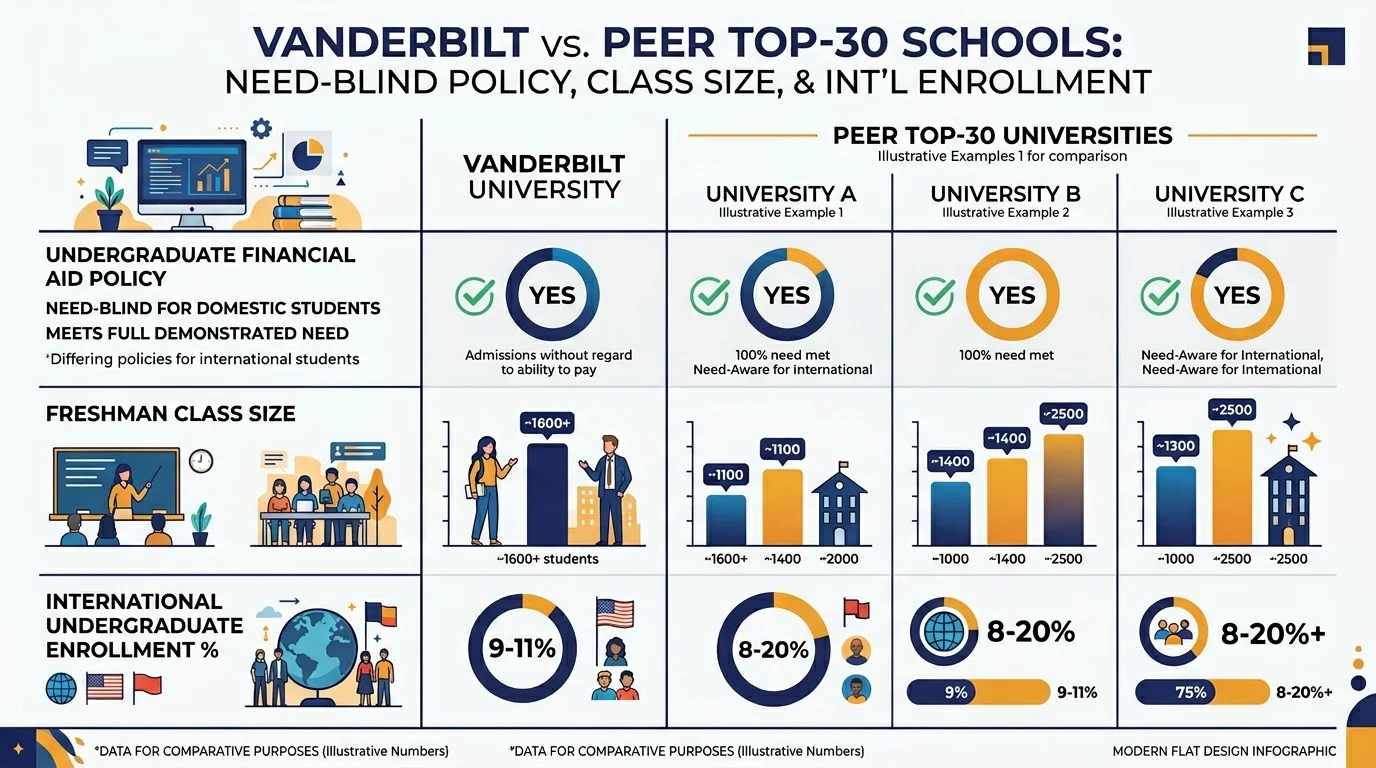
Vanderbilt enrolls approximately 9% international students - roughly 550 students from more than 50 countries - across its undergraduate programs. This modest share reflects a small overall class size of around 1,600 students per year.
Nashville's growing healthcare, technology, and music industries create internship and networking environments that complement Vanderbilt's rigorous academic programs. For international students, the combination of a globally minded campus and a dynamic city creates strong conditions for both academic and professional development.
The primary undergraduate units include:
- College of Arts and Science: The largest school, housing pre-med preparation, social sciences, and humanities.
- School of Engineering: Degrees in biomedical, civil, computer, electrical, and mechanical engineering.
- Peabody College of Education and Human Development: Consistently ranked among the top education schools in the US.
- Blair School of Music: A conservatory-level program for performance or music education.
What Academic Record Does Vanderbilt Expect?
Admitted Vanderbilt students almost universally present a GPA of 3.9 or higher on a 4.0 scale, supported by 4-6 AP, IB, or A-level courses that demonstrate sustained academic challenge. Vanderbilt's admissions team reviews curriculum rigor in context, meaning a student in a system without AP access will be evaluated relative to the highest level of coursework available.
According to NACAC (2023), grades and course rigor consistently rank as the two most important factors in selective university admissions decisions. For Vanderbilt specifically, strong standardized test scores (SAT/ACT) complement the GPA record, though submission is encouraged for students whose scores reflect their academic capability. International applicants should also verify English proficiency test requirements early in their application timeline, particularly if their secondary school instruction is not in English.
For students preparing through an Amerigo partner school, the academic environment is structured to match Top-30 university expectations:
- Rigorous Course Selection: Partner schools offer AP and honors tracks aligned with Vanderbilt's expectations.
- GPA Monitoring: Amerigo's on-campus international department - a dedicated team at each US Signature School consisting of a Director of Campus Operations, Academic Director, Senior Campus Coordinators, Campus Coordinators, and an ELL teacher, who provide daily academic support, residential supervision, university counseling, and welfare oversight for enrolled international students tracks academic progress each semester.
- Teacher Relationships: Small class sizes mean teachers can write specific, credible recommendation letters.
- Test Preparation: Structured SAT/ACT prep is embedded in the academic calendar at most partner schools.
What Makes Vanderbilt Unique Among Top-30 Schools?
Vanderbilt's most distinctive feature is its need-blind admissions policy for all students, including international applicants - a policy shared by fewer than ten universities in the United States. Vanderbilt meets 100% of demonstrated financial need for every admitted student through grants and work-study, with no loans required.
Beyond financial aid, Vanderbilt's Peabody College sets it apart from most research universities in the Top 30. Students interested in education policy, human development, cognitive science, and community-based research find Peabody's resources - including access to Vanderbilt University Medical Center for clinical research pipelines - difficult to match elsewhere. According to NAIS (2023), international students from boarding school backgrounds who enter universities with strong student support infrastructure show higher four-year graduation rates, a finding consistent with Vanderbilt's retention data.
Nashville's urban location provides direct access to one of the most dynamic economies in the South. Internship access in healthcare (anchored by Vanderbilt University Medical Center), the music industry, and a growing technology sector means students can begin career development before graduation.
Does Vanderbilt Offer Aid to International Students?
Yes. As one of fewer than ten US universities that operate a need-blind policy for international applicants, Vanderbilt meets 100% of demonstrated financial need for every admitted student regardless of citizenship. Aid packages are built entirely from grants and work-study; no loans are required.
International students must submit the CSS Profile (typically released in October of the application year). Families document income, assets, and household expenses, and Vanderbilt's financial aid office calculates need accordingly. Students admitted through Early Decision receive their financial aid award alongside their admission offer.
The CSS Profile timeline and document requirements are worth reviewing early:
- Create a College Board Account: The CSS Profile is managed through the College Board portal.
- Gather Financial Documents: Tax records, bank statements, and employer documentation for both parents are typically required.
- Submit by Nov 1 for ED: Early Decision applicants should complete the CSS Profile by the ED deadline.
- Review the Award Letter: Aid awards are issued with the admission decision for ED and in late March for RD applicants.
When Should International Students Apply to Vanderbilt?
Vanderbilt offers two primary application pathways: Early Decision (deadline Nov 1) and Regular Decision (deadline Jan 1). ED is binding, meaning students who are admitted must enroll and withdraw applications from other universities. RD is non-binding, allowing students to compare offers before committing.
According to NACAC (2023), students who apply Early Decision to highly selective universities typically benefit from a more favorable review pool and demonstrate a clear first-choice commitment. For international students, ED also has a practical advantage: financial aid awards are confirmed alongside the admission decision in December.
Key application milestones for international students targeting Vanderbilt:
- August-September: Finalize school list, begin Common App essays, request teacher recommendations.
- October: Complete CSS Profile, take final SAT/ACT, finalize ED school choice.
- November 1: Submit ED application and CSS Profile.
- January 1 (if RD): Submit RD application; receive decision in late March.
How Does Amerigo's Top 50 Track Help?
Amerigo's Top 50 Track - a higher-tier program for students targeting universities ranked in the Top 50, combining elevated entry academic standards, structured extracurricular development, focused essay strategy, and dedicated university counseling from each Signature School's on-campus international department is designed specifically for international high school students targeting universities in the Top 50, including Vanderbilt. Students placed at Amerigo partner schools gain access to an academic environment, counseling infrastructure, and extracurricular framework that aligns with what Top-30 admissions teams look for in international applicants.
The program's outcomes speak directly to Vanderbilt's profile. Of Amerigo students who applied to Top 50 universities, 60% gained admission; of those who applied to Top 30 universities, 25% were admitted. These figures reflect systematic preparation across academic rigor, essay development, and application strategy - not ad hoc guidance.
Families interested in this pathway can find a school matched to their student's academic profile and target university list. The on-campus international department at each partner school provides ongoing support from arrival through application submission, ensuring no step in the F-1 process or admissions timeline is navigated alone.
Frequently Asked Questions
Is Vanderbilt need-blind for international students?
Yes. Vanderbilt is one of fewer than ten US universities that operate a need-blind admissions policy for international applicants. This means the admissions office does not consider a family's financial situation when deciding whether to admit a student. All admitted students - regardless of citizenship - receive a financial aid package that meets 100% of demonstrated need, with no loans required in the package.
What GPA do international students need for Vanderbilt?
Most admitted Vanderbilt students present a GPA of 3.9 or higher on a 4.0 scale, supported by 4-6 AP, IB, A-level, or equivalent rigorous courses. Vanderbilt evaluates GPA in the context of what was available at the student's school, so a student without AP access is not penalized if they took the most challenging courses offered. Consistency across all four years of secondary school is viewed favorably by the admissions team.
What programs is Vanderbilt best known for?
Vanderbilt is particularly strong in pre-med preparation (supported by Vanderbilt University Medical Center), engineering, education and human development (Peabody College), music performance (Blair School of Music), and liberal arts. Peabody College is consistently ranked among the top education schools in the US and draws international students interested in education policy and cognitive science.
Does Vanderbilt require the SAT or ACT?
Vanderbilt has adopted a test-optional policy in recent admissions cycles, but students who have strong standardized test scores are encouraged to submit them, as scores can strengthen an application when they align with or exceed admitted student ranges. International students should check the current policy on Vanderbilt's admissions website, as test policies are reviewed annually. English proficiency scores (TOEFL or IELTS) may also be required depending on the applicant's secondary school language of instruction.
How many international students does Vanderbilt enroll?
Vanderbilt enrolls approximately 550 international undergraduates per year, representing about 9% of the student body, from more than 50 countries. The relatively small percentage reflects Vanderbilt's small overall class size of around 1,600 students per year. This creates a more intimate campus environment than many peer universities, with stronger faculty-to-student ratios and more individualized academic attention.
What is the Early Decision deadline at Vanderbilt?
The Early Decision deadline at Vanderbilt is November 1. ED is binding - students admitted must enroll and withdraw all other applications. The Regular Decision deadline is January 1. International students applying for financial aid should submit the CSS Profile by the application deadline. ED applicants receive both their admission decision and financial aid award in December, simplifying family planning considerably.
Does a US boarding school improve Vanderbilt admission chances?
Yes. Vanderbilt's admissions team is experienced with the US secondary school curriculum, AP course sequences, and extracurricular structures that boarding schools offer. International students who complete two or more years at a US boarding school arrive with GPA records, recommendation letters, and test scores that are directly legible to the admissions office. Amerigo partner schools are Niche A+/A rated institutions with established histories of placing students at selective US universities.
What is the CSS Profile and when should it be submitted?
The CSS Profile is a financial aid application managed by the College Board, used by Vanderbilt and many other selective universities to assess a family's financial need. It collects detailed information about family income, assets, and expenses from both parents. International students applying for Vanderbilt financial aid must submit the CSS Profile, ideally by November 1 for ED applicants. The CSS Profile typically becomes available in early October each application year.
Can students from China or South Korea apply to Vanderbilt?
Yes. Vanderbilt admits students from across Asia, including mainland China, South Korea, Japan, and the Taiwan Region. There is no country quota in Vanderbilt's admissions process. Students from any country are evaluated on the same academic and personal criteria. International students must meet English proficiency requirements and plan for F-1 visa processing timelines, which can vary by country and consular availability.
What extracurriculars strengthen a Vanderbilt application?
Vanderbilt values depth and leadership over breadth. A student who has pursued one or two activities with genuine commitment and achieved meaningful outcomes - leadership positions, research projects, community impact, or artistic accomplishment - is viewed more favorably than a student with a long list of superficial memberships. Research projects, music performance (given Blair School of Music), engineering competitions, and community-based initiatives all appear frequently in admitted student profiles.
Conclusion
Vanderbilt combines Top-30 selectivity with one of the most generous financial aid policies in American higher education. Its need-blind, no-loan model, strong pre-med and engineering programs, and dynamic Nashville location make it a compelling target for international students who arrive well-prepared and strategically advised.
Explore Vanderbilt Through an Amerigo Partner School
To learn more about studying in America at an Amerigo partner school, contact us to speak with a program advisor, or apply now to take the first step toward enrollment.
People Also Read
- How Students Get Into Top 50 US Universities
- Amerigo's Top 50 Track: How Students Reach Elite Universities
- 97% Top 100, 60% Top 50, 25% Top 30: Which University Tier Should You Target?
About the Author
This guide was written by the Amerigo Education content team, drawing on program data from staff operating the on-campus international department at 40 Niche A+/A rated US, Canadian, and UK partner schools. Learn more about Amerigo Education.
Disclaimer: This article provides general information for educational purposes only. Families should conduct independent research, request current program data from providers, and consult with program representatives regarding specific circumstances. Contact us with questions.