All news
March 28, 2026
Study Abroad 101
US vs Canada vs UK: Which Country for International High School?
Compare US, Canada, and UK high school programs for international students. Curriculum, costs, university pathways, visa, and support differences explained for 2026.

US vs Canada vs UK: Which Country for International High School?
Last Updated: March 2026
A country comparison for international high school is a structured evaluation of curriculum, visa requirements, costs, university pathways, and student support systems across multiple destination countries. According to the IIE Open Doors Report, international student enrollment at the secondary level has grown by 12% since 2020, with the United States, Canada, and the United Kingdom consistently ranking as the top three destination countries. Families from China, Vietnam, Korea, Mexico, the Taiwan Region, and more now face a decision that did not exist a generation ago: three English-speaking countries with distinct education systems, immigration frameworks, and support structures, each offering a viable pathway to top universities.
Amerigo Education operates partner schools across all three countries, with 40 Niche A+/A rated schools in the US, established programs in Canada, and a UK option at Brentwood School in Essex, England. The Class of 2025 achieved 97% admission to Top 100 US universities. This guide compares every dimension that matters to families making this decision, including where Amerigo's support model differs between countries, so you can choose based on facts rather than assumptions.
Key Takeaways
- Curriculum structure differs significantly: US schools use AP/IB/Honors within a broad diploma, Canada follows province-specific curricula with flexibility, and the UK requires deep specialization in 3-4 A-Level subjects.
- Visa complexity varies: Canada's study permit is the most straightforward application process, the US F-1 requires a consular interview, and the UK Tier 4 demands guardianship arrangements and additional documentation.
- Amerigo support is not identical everywhere: US and Canada schools receive full on-campus international department support including 24/7 emergency assistance and monthly family reports. Brentwood (UK) receives Amerigo university counseling only.
- The Top 100 Guarantee applies to US Signature Schools only: Students must attend for 2 consecutive years, maintain a 3.2+ GPA, score TOEFL 85+, and complete AP, IB, or Honors courses. This is not available in Canada or the UK.
- Cost ranges differ by country and currency: US private school costs are highest in absolute terms, Canada offers mid-range pricing with public school options, and UK boarding includes mandatory guardianship fees.
How Do the Three Curricula Compare?
The curriculum is the foundation of every other decision. What your child studies, how they are assessed, and what qualifications they earn determine which universities they can access and how competitive their application will be. Each country structures its high school education differently, and understanding these structures prevents families from making assumptions based on their home country's system.
In the US, students follow a broad curriculum across multiple subjects while adding rigor through AP (Advanced Placement), IB (International Baccalaureate), or Honors courses. A typical US high school student takes 6-8 courses per semester spanning English, math, science, history, world language, and electives. AP courses provide college-level content with standardized exams scored 1-5, and scores of 4 or 5 often earn university credit. This breadth allows students to explore interests before specializing in university.
In Canada, each province sets its own curriculum and graduation requirements. Ontario, British Columbia, and Alberta each have distinct diploma structures, course naming conventions, and provincial exam requirements. Canadian curricula generally fall between US breadth and UK specialization: students take required courses across core subjects but have significant flexibility in elective choices. Provincial diplomas are well recognized by US, Canadian, UK, and international universities.
In the UK, students follow the GCSE (General Certificate of Secondary Education) curriculum through Year 11, then specialize in 3-4 A-Level or BTEC subjects for Years 12-13. A-Levels require significantly deeper subject knowledge than AP courses but in fewer disciplines. A student studying A-Level Mathematics, Physics, and Chemistry will cover material equivalent to first-year university courses in those subjects but will not study English literature, history, or social sciences during those two years. This early specialization aligns with the UK university model, where students apply to study a single subject from day one.
What Visa Does Each Country Require?
Visa type affects application complexity, processing time, work rights, family involvement, and post-graduation options. Each country uses a different visa framework for international high school students, and the differences go beyond paperwork.
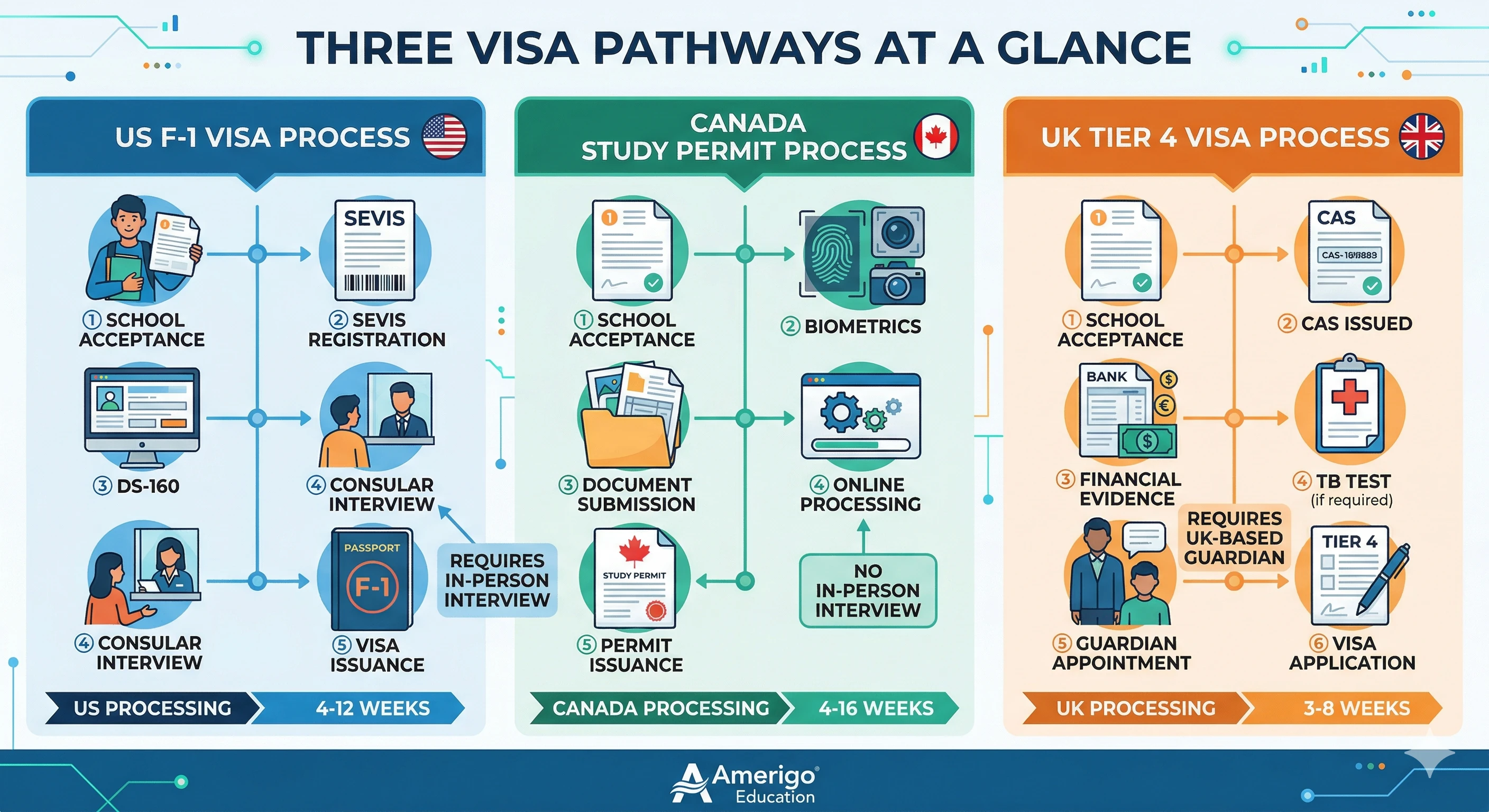
The US requires an F-1 student visa for international high school students attending private schools. The process involves school acceptance, SEVIS (Student and Exchange Visitor Information System) registration, DS-160 form completion, and an in-person interview at a US embassy or consulate. Interview requirements, wait times, and approval rates vary significantly by country of origin. Amerigo partners with ZF Visa to guide families through the F-1 application process, reducing the risk of documentation errors that cause delays or denials.
Canada requires a study permit, which has no in-person interview requirement for most nationalities. Students submit biometrics, proof of acceptance, proof of financial support, and a letter of intent. Processing times range from 4 to 16 weeks depending on country of origin. Canada's study permit also offers a clearer post-graduation immigration pathway: students who continue to Canadian post-secondary education can access the Post-Graduation Work Permit (PGWP) program, which is a structured route to permanent residency.
The UK requires a Tier 4 (Child) student visa for students under 18. The application requires a Confirmation of Acceptance for Studies (CAS) from the school, proof of funds held for at least 28 consecutive days, tuberculosis test results for applicants from certain countries, and parental consent documentation. Additionally, UK boarding schools require all international students under 18 to appoint a UK-based guardian, a legal requirement that adds GBP 2,000 to GBP 3,500 per year in costs. The guardian must be a UK resident over 25 who can act on the family's behalf during term breaks, emergencies, and school closures.
How Do Costs Compare Across Countries?
Cost is rarely the sole deciding factor, but it shapes which options are realistic. Families need to compare not just tuition but the full annual cost including accommodation, insurance, visa fees, and country-specific requirements like UK guardianship. Currency fluctuations also affect planning, since families typically pay in their home currency.
US private high school tuition for international students ranges from USD 30,000 to USD 65,000 per year, depending on the school and whether boarding is included. Amerigo programs include tuition, accommodation (homestay, on-campus or off-campus supervised residences, or self-provided), meals, on-campus international department support, and university counseling. Amerigo offers $50,000 USD in scholarships for qualifying students at US Signature Schools who attend for 2 consecutive years, maintain a 3.2+ GPA, score TOEFL 85+, and complete AP, IB, or Honors courses.
Canadian international tuition at public high schools ranges from CAD 14,000 to CAD 18,000 per year, while private schools charge CAD 20,000 to CAD 35,000. Adding homestay (CAD 10,000-15,000/year) and medical insurance (CAD 600-1,200/year) brings the total annual cost to approximately CAD 25,000 to CAD 50,000. Canada does not require guardianship in the same way the UK does, though some provinces require a custodian for students under a certain age.
UK boarding school fees, including Brentwood School where Amerigo operates, range from GBP 35,000 to GBP 45,000 per year. This includes tuition, boarding, and meals. Families must budget separately for mandatory guardianship (GBP 2,000-3,500/year), visa fees, health surcharge (Immigration Health Surcharge), school uniform, and extracurricular fees. The total annual cost for a UK boarding school student typically reaches GBP 40,000 to GBP 52,000.
What University Pathways Does Each Country Open?
Where your child attends high school shapes which universities they can access and how competitive their application will be. Each country's high school credentials carry different weight with different university systems, and the counseling infrastructure around university applications varies significantly.
US high school graduates have the most direct path to US universities. Admissions officers understand the US GPA system, AP scores, extracurricular expectations, and recommendation letter formats without translation. Students at Amerigo US partner schools benefit from guaranteed admission to Top 100 US universities at Signature Schools (2 consecutive years, 3.2+ GPA, TOEFL 85+, AP/IB/Honors required). The Class of 2025 achieved 97% Top 100 and 60% Top 50 university admission rates. US-based students also build relationships with US college counselors and participate in campus visits, college fairs, and alumni networks that are harder to access from abroad.
Canadian high school graduates apply to Canadian universities through centralized provincial systems (OUAC in Ontario, ApplyBC in British Columbia) and to US universities through the Common Application or Coalition Application. Canadian diplomas are well understood by both US and Canadian admissions offices. Students aiming for Canadian universities benefit from domestic applicant status at universities in the province where they attended high school, which can mean lower tuition and higher admission priority. For families prioritizing a post-graduation immigration pathway, Canada offers the clearest route from high school to university to permanent residency.
UK A-Level results are accepted by universities worldwide, including US and Canadian institutions. UK university applications go through UCAS (Universities and Colleges Admissions Service), a centralized system where students apply to up to five universities with a personal statement and predicted A-Level grades. The early specialization of A-Levels is an advantage for UK university applications, where admissions decisions are based heavily on subject-specific academic performance. For US university applications, A-Level students may need to provide additional standardized test scores (SAT/ACT) and explain the UK grading system to admissions officers less familiar with it.
- US to US universities: Most direct path. GPA, AP scores, and extracurriculars are the standard framework US admissions offices evaluate.
- US to Canadian universities: Straightforward. US diplomas are fully recognized. Students apply through provincial application centers.
- US to UK universities: Accepted. AP scores of 4-5 meet entry requirements for most UK programs. Apply through UCAS.
- Canada to US universities: Well recognized. Provincial transcripts are understood by experienced US admissions offices.
- Canada to Canadian universities: Strongest advantage. Provincial applicant status, familiar curriculum, lower domestic tuition at provincial universities.
- UK to US universities: Accepted but requires more explanation. A-Level grades may need supplementary standardized test scores.
- UK to UK universities: Most direct path. A-Level grades are the primary admission criteria. Apply through UCAS.
How Does Student Support Differ by Country?
This is where the three-country comparison becomes most important for families choosing between Amerigo's options, because the support model is not the same across all locations. Understanding exactly what your child will receive at each location prevents mismatched expectations.
In the US and Canada, Amerigo operates on-campus international departments at each partner school. These departments employ dedicated Amerigo staff who provide academic coaching, cultural adjustment support, university counseling, extracurricular guidance, and daily student life management. Families receive monthly reports on their child's academic progress, social integration, and well-being. Students have access to 24/7 emergency assistance through Amerigo's support lines. Native-language support is available in Chinese, Vietnamese, Korean, Spanish, and more. Technology platforms including Life360 and Reach keep families connected to their child's daily schedule and location. Accommodation options include homestay, on-campus supervised residences, off-campus supervised residences, and self-provided arrangements.
In the UK, Amerigo's partner is Brentwood School in Essex, England. Brentwood operates through the school's own established boarding program, not through Amerigo's on-campus international department model. Amerigo provides university counseling support at Brentwood, helping students with university selection, personal statement writing, and application strategy. However, day-to-day student care, pastoral support, and residential supervision are handled by Brentwood's own boarding staff, housemasters, and school systems. Monthly family reports from Amerigo, 24/7 Amerigo emergency assistance, Life360/Reach tracking, and dedicated on-campus Amerigo staff are not available at Brentwood. Students live in Brentwood's boarding houses, and families must arrange a UK-based guardian for term breaks and emergencies.
- Academic coaching: US/Canada = Amerigo on-campus staff. UK = Brentwood school staff.
- University counseling: US/Canada = Amerigo staff. UK = Amerigo support available.
- Monthly family reports: US/Canada = Yes. UK = Not from Amerigo.
- 24/7 emergency line: US/Canada = Yes (Amerigo). UK = Brentwood's school systems.
- Native-language support: US/Canada = Chinese, Vietnamese, Korean, Spanish, and more. UK = Amerigo home-country staff members available to support students enrolled at Brentwood.
- Accommodation management: US/Canada = Amerigo-managed options. UK = Brentwood boarding houses.
- Guardianship: US/Canada = Not required. UK = Mandatory (GBP 2,000-3,500/year).
- Top 100 Guarantee: US Signature Schools only. Canada and UK = Not available.
What Else Should Families Consider?
Beyond curriculum, visa, cost, and support structure, several practical factors influence the daily experience of international high school students. Climate, language environment, cultural integration speed, and application logistics all matter when families are choosing between three countries.
Climate varies dramatically within and between countries. The US offers everything from Florida's subtropical weather to Minnesota's severe winters. Canada's major student destinations (Ontario, British Columbia) range from moderate coastal climates to cold continental winters with heavy snowfall. The UK has a maritime climate with mild winters (rarely below freezing) but frequent rain and limited sunshine, which some students from tropical and subtropical countries find difficult to adjust to over extended periods.
Language environment also differs. In the US and UK, English is the primary language in all educational and social settings. In Canada, most Amerigo partner school locations are in English-speaking provinces, but Canada's official bilingual status means French appears in government communications, product labeling, and some community interactions. For students targeting French-English bilingualism as a university or career advantage, Canada offers immersion opportunities that the US and UK do not.
The application process through Amerigo is streamlined across all three countries. A single application through Amerigo's application portal covers all partner schools. Families can indicate their country and school preferences, and Amerigo's admissions team helps match students to the best-fit program. For US-bound students, Amerigo coordinates F-1 visa support through ZF Visa. For Canada-bound students, the study permit process is managed with Amerigo guidance. For UK-bound students, Brentwood School manages the Tier 4 visa and CAS process directly.
Frequently Asked Questions
Which country is cheapest for international high school students?
Canada generally offers the lowest tuition range for international high school students, with annual fees typically between CAD 14,000 and CAD 18,000 at public schools and CAD 20,000 to CAD 35,000 at private schools. US private high schools range from USD 30,000 to USD 65,000 per year including boarding. UK boarding schools, including Brentwood School where Amerigo operates, charge GBP 35,000 to GBP 45,000 per year plus additional fees for guardianship services (GBP 2,000 to GBP 3,500 annually). Exchange rates and cost of living also affect the total budget, so families should calculate the full annual cost including housing, insurance, and visa fees.
Can students get permanent residency in Canada after high school?
High school alone does not qualify students for Canadian permanent residency. However, Canada's immigration pathway is more structured than the US or UK for students who continue to post-secondary education. After completing a Canadian post-secondary program of two years or more, graduates can apply for a Post-Graduation Work Permit lasting up to three years, then accumulate Canadian work experience that qualifies for permanent residency through Express Entry or Provincial Nominee Programs. Starting high school in Canada gives students Canadian academic credentials and familiarity with the system that strengthens their later applications.
What is the difference between AP courses and A-Levels?
AP (Advanced Placement) courses are college-level classes taken within the US high school curriculum, with standardized exams scored 1 to 5. Students typically take four to six AP courses across grades 11 and 12 alongside their regular diploma. A-Levels are the UK's post-16 qualification, where students study three to four subjects in depth over two years. A-Levels require deeper specialization in fewer subjects, while AP courses allow broader coverage. Both are accepted by universities worldwide. US and Canadian universities accept A-Level results for admission and course credit, and UK universities accept AP scores of 4 or 5 as meeting entry requirements for most programs.
Do international students need a guardian in the UK?
Yes. UK boarding schools require all international students under 18 to have a UK-based guardian who can act on the family's behalf during term time and holidays. The guardian must be a UK resident over 25 years old who can collect the student during half-terms, respond to emergencies, attend parent meetings, and provide accommodation during school closures. Professional guardianship services cost GBP 2,000 to GBP 3,500 per year. This is a legal and practical requirement that does not apply in the US or Canada, where Amerigo's on-campus staff and host families fill similar support roles.
Which visa is easiest to get for high school students?
The Canadian study permit has the most straightforward application process for high school students, with no in-person interview requirement for most nationalities. The US F-1 visa requires SEVIS registration, DS-160 form completion, and an in-person consular interview, which adds complexity and processing time. Amerigo partners with ZF Visa to assist US-bound students through this process. The UK Tier 4 (Child) student visa requires a Confirmation of Acceptance for Studies from the school, proof of funds, tuberculosis test results for some nationalities, and parental consent documentation.
Does Amerigo offer the same support at UK schools as US schools?
No. Amerigo's UK option operates differently from its US and Canada programs. In the US and Canada, Amerigo runs on-campus international departments with dedicated staff providing academic coaching, monthly family reports, 24/7 emergency assistance, and native-language support. At Brentwood School in the UK, Amerigo provides support through home-country staff members, though academic advisors are specialized in US academic systems and do not counsel for UK university applications. The school's own established boarding program handles day-to-day student care, pastoral support, and residential supervision. Monthly family reports from Amerigo, 24/7 Amerigo emergency lines, and dedicated Amerigo on-campus staff are not available at Brentwood.
Is the Top 100 Guarantee available at all Amerigo schools?
No. The Top 100 University Guaranteed Admission program is available at Amerigo's US Signature Schools only. To qualify, students must attend for 2 consecutive years, maintain a 3.2+ GPA, score TOEFL 85+, and complete AP, IB, or Honors courses. This guarantee does not extend to Amerigo's Canadian or UK partner schools. However, students at all Amerigo locations receive university counseling support, and the Class of 2025 achieved a 97% Top 100 university admission rate across all partner schools.
Can a student transfer between Amerigo's US, Canada, and UK programs?
Transfers between countries are possible but require careful planning because each country uses a different curriculum, grading system, and visa type. A student moving from Canada to the US would need to apply for an F-1 visa, have transcripts evaluated for credit transfer, and potentially repeat coursework that does not align with US diploma requirements. A transfer from the UK to the US or Canada is more complex because A-Level subject specialization does not map directly to the broader North American curriculum. Families considering a transfer should contact Amerigo admissions early to assess feasibility.
What accommodation options exist in each country?
In the US and Canada, Amerigo offers homestay, on-campus supervised residences, off-campus supervised residences, and self-provided accommodation. The specific options available vary by partner school location. In the UK, Brentwood School operates as a traditional boarding school, so students live in the school's boarding houses under the supervision of housemasters and residential staff. Boarding is the standard accommodation model at Brentwood, and Amerigo does not manage separate residential options in the UK.
Which country gives the best path to US university admission?
Studying in the US provides the most direct path to US university admission because students earn a US high school diploma, build relationships with US-based college counselors, take AP exams recognized by every US university, and demonstrate the ability to succeed in the US academic system. Canadian high school diplomas are also widely accepted, and provincial curricula are well understood by US admissions offices. A-Levels from UK schools are accepted, but students may need to provide additional standardized test scores and explain the UK grading system. Amerigo's university counseling support at all locations helps students target and apply to US universities regardless of country.
Conclusion
Choosing between the US, Canada, and the UK for international high school is not a question of which country is objectively "best." It is a question of which country best fits your child's academic goals, university ambitions, budget, and need for structured support. The US offers the broadest curriculum, the most direct path to US universities, and Amerigo's full on-campus support infrastructure including the Top 100 Guarantee at Signature Schools. Canada offers competitive pricing, a clear post-graduation immigration pathway, and Amerigo's on-campus international departments with the same support model as the US. The UK offers deep academic specialization through A-Levels, a direct path to UK universities through UCAS, and Brentwood School's established boarding program with Amerigo university counseling. Each option produces strong outcomes. The right choice depends on your family's priorities.
Start Your Three-Country Comparison
Families ready to compare specific schools across the US, Canada, and UK can apply now through a single application covering all Amerigo partner schools, or contact us to discuss which country and program best fits your child's goals. Amerigo Education offers $50,000 USD in scholarships for qualifying students at US Signature Schools (2 consecutive years, 3.2+ GPA, TOEFL 85+, AP/IB/Honors required). Accommodation options in the US and Canada include homestay, on- and off-campus supervised residences, and self-provided housing. Monthly reports keep families informed (US/Canada), and native-language support is available in Chinese, Vietnamese, Korean, Spanish, and more, with 24/7 emergency assistance at US and Canada locations. Explore US partner schools, view Canadian options, or learn about schools in the UK.
People Also Read
- US vs Canada Education System: Key Differences for International Students 2025-2026
- Study in UK vs USA for International High School Students: Complete Comparison 2026
- A-Levels vs AP: Which Leads to Top US Universities
About the Author
This guide was written by the Amerigo Education content team, drawing on program data from staff operating the on-campus international department at Amerigo Education's partner schools across the US, Canada, and UK. Learn more about Amerigo Education.
Disclaimer: This article provides general information for educational purposes only. Families should conduct independent research, request current program data from providers, and consult with program representatives regarding specific circumstances. Contact us with questions.