All news
March 15, 2026
Study Abroad 101
US Immigration Policy and International HS Enrollment
How US immigration policy changes from 2020 to 2026 have affected international high school enrollment trends, F-1 visa processing, and family decision-making.
US Immigration Policy and International HS Enrollment
Last Updated: March 2026
A US immigration policy change is any federal action that alters visa processing, enrollment eligibility, or regulatory requirements for international students. Between 2020 and 2026, a series of policy shifts, pandemic responses, and regulatory updates reshaped how international families access US high school education. According to IIE Open Doors data, international student enrollment in the US dropped significantly during 2020-2021 before beginning a multi-year recovery that continues into 2026. These changes affected enrollment timelines, family decision-making, and the relative appeal of structured versus self-arranged programs.
Amerigo Education operates on-campus international departments at 40 Niche A+/A rated partner schools across the US and Canada, and has expanded to the UK through a partnership with Brentwood School in Essex, England. The program supports 3,500+ students from 55+ countries. The Class of 2025 achieved 97% Top 100 university admission. During periods of policy uncertainty, structured programs with SEVP-certified schools and dedicated visa support infrastructure provide families with greater stability than self-arranged placements.
Key Takeaways
- Enrollment dropped sharply in 2020-2021: Embassy closures, travel bans, and pandemic restrictions caused the steepest decline in international student enrollment in decades.
- Recovery accelerated from 2022 onward: IIE Open Doors data shows international enrollment rebounding as travel restrictions lifted and visa processing resumed normal timelines.
- Structured programs retained students better: Schools with on-campus international departments and SEVP compliance support experienced lower withdrawal rates during disruption periods.
- China remains the largest source market: Chinese families represent approximately 50% of international high school students, and policy changes affecting China disproportionately affect total enrollment numbers.
- Canada and the UK emerged as alternative pathways: Families concerned about US policy stability increasingly consider Canadian high schools as a dual-pathway option, while Amerigo's UK partner school (Brentwood School in Essex, England) offers British independent school education with A-Level qualifications for UK and international university admission.
How Has Immigration Policy Affected Enrollment?
US immigration policy directly controls the pipeline of international students entering American high schools. Every F-1 student must attend a SEVP-certified school, obtain a Form I-20, pass a visa interview, and maintain compliance throughout their enrollment. When any part of this pipeline slows or narrows due to policy changes, enrollment numbers respond. The period from 2020 to 2026 included the most significant disruptions to this pipeline in the modern history of international education.
Policy effects on enrollment are not immediate. Changes to visa processing during spring and summer affect enrollment for the following fall. Families making multi-year commitments factor policy stability into decisions alongside academic quality and cost. A single year of uncertainty can reduce enrollment for two to three subsequent cohorts as families defer or choose alternative destinations.
What Changed During the COVID-19 Period?
The COVID-19 pandemic created the most severe disruption to international student enrollment since the establishment of the modern F-1 visa system. Embassy closures across Asia, Latin America, and Europe prevented students from obtaining visa interviews. Travel bans restricted movement from key source countries. Schools shifted to remote instruction, raising questions about whether online learning satisfied F-1 enrollment requirements. These simultaneous disruptions compressed what would normally be a gradual enrollment decline into a sudden drop.
For high school students, the impact was compounded by age. Unlike university students who could defer independently, high school students required parental decisions about sending a minor abroad during a health crisis. Schools with on-campus international departments were better positioned to communicate with families, manage logistics, and retain enrolled students during this period.
- Embassy closures in China, Vietnam, South Korea, and Mexico lasted from March 2020 through much of 2021
- The US Department of State temporarily suspended routine visa services at most overseas posts
- SEVP issued temporary guidance allowing online coursework to count toward F-1 enrollment requirements
- Schools that transitioned quickly to structured remote learning retained more international students
- Families in countries with early travel reopening (South Korea, the Taiwan Region) recovered enrollment faster
- Students who maintained enrollment during COVID-19 avoided reapplication and re-entry challenges
How Do F-1 Visa Changes Affect High Schools?
F-1 visa policy changes affect high schools differently than universities because of the minor status of students and the public versus private school distinction. Under SEVP regulations, F-1 students attending public high schools are limited to one academic year and must reimburse the school for the full per-pupil cost. Private SEVP-certified schools have no such time limitation, making them the standard pathway for multi-year international high school programs. Policy changes that tighten public school access have historically increased demand for private school programs.
Visa processing timelines directly affect enrollment planning. When average visa processing times extend from four weeks to eight or twelve weeks, families must begin applications earlier or risk missing enrollment deadlines. Amerigo Education's visa support infrastructure, provided through a third-party visa consulting partner and billed separately from program fees, helps families navigate these timeline variations. This includes interview coaching, document review, and application guidance tailored to each family's country of origin.
What Enrollment Trends Emerged After 2022?
The 2022-2023 academic year marked the beginning of a sustained enrollment recovery. IIE Open Doors data indicates that international student enrollment in the US returned to pre-pandemic levels and continued growing as travel restrictions fully lifted and embassy operations normalized. The recovery was not uniform across all source markets. Countries that reopened travel earliest, including South Korea and countries in Western Europe, showed faster enrollment recovery than markets where travel restrictions persisted longer.
Several structural shifts emerged. Families increasingly prioritized programs with operational resilience and compliance infrastructure. Demand for structured pathway programs grew relative to self-arranged placements. Canada and the UK gained market share as alternative destinations. Source market diversification accelerated, with growth from Latin America and Southeast Asia partially offsetting fluctuations in traditional markets.
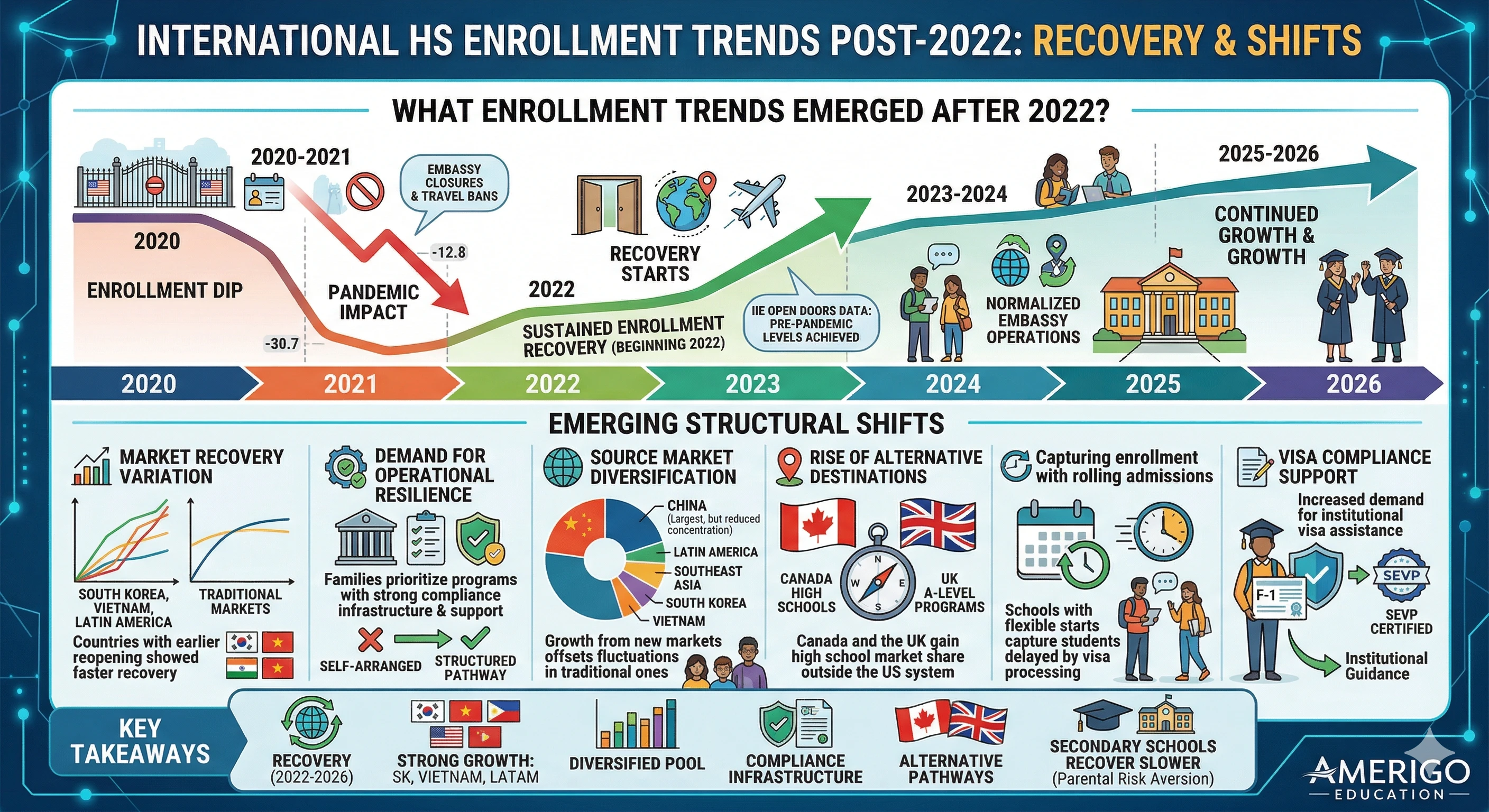
- Enrollment recovery began in 2022 and continued through 2024 and 2025 academic years
- South Korea, Vietnam, and Latin American markets showed strong recovery growth
- Chinese enrollment remains the largest segment but diversification reduced concentration
- Demand for programs with visa compliance support increased relative to pre-pandemic levels
- Canadian and UK high school programs gained interest from families seeking alternative pathways outside the US visa system
- Schools with rolling admissions captured enrollment from students with delayed visa processing
- Secondary school enrollment recovered more slowly than university enrollment due to parental risk aversion
How Do Structured Programs Provide Stability?
Structured programs at SEVP-certified schools provide institutional accountability that individual placements cannot match. A school with a Designated School Official manages SEVIS records, reports enrollment changes to the government, and ensures each student maintains compliance with F-1 requirements. Programs with on-campus international departments add a second layer of monitoring through daily interaction with students and monthly communication with families. This dual accountability structure reduces the risk of accidental non-compliance.
During the 2020-2022 disruption period, structured programs demonstrated measurably higher student retention than self-arranged placements. Schools with dedicated international staff could communicate policy changes to families in their native language, coordinate remote learning logistics, and manage re-entry procedures when travel resumed. Amerigo Education's partner schools across the US, Canada, and UK maintained this infrastructure throughout the disruption period. Students live in homestay placements, on- and off-campus supervised residences, or self-provided accommodation, with on-campus staff monitoring both academic progress and visa compliance.
- SEVP-certified schools maintain direct compliance reporting to the federal government
- Designated School Officials manage I-20 documentation and enrollment status changes
- On-campus international departments track visa expiration dates and renewal requirements
- Native-language support helps families from China, Vietnam, Korea, Mexico, the Taiwan Region, and more understand policy changes
- Monthly progress reports include visa status updates alongside academic performance data
- 24/7 emergency assistance addresses urgent situations including immigration-related emergencies
- Rolling admissions at most Signature partner schools allow enrollment flexibility during processing delays
- The Top 100 Guarantee at Signature partner schools provides up to $50,000 USD refund, protecting the family's investment even during uncertain policy periods
What Should Families Consider for 2026?
Families planning US high school enrollment for the 2026-2027 academic year should factor both current policy conditions and institutional resilience into their decision. Current visa processing timelines have stabilized relative to the 2020-2022 disruption period, but processing times can shift with administrative changes. Starting the visa application process at least four months before the intended enrollment date provides adequate buffer for most scenarios.
The choice between US, Canadian, and UK enrollment has become more strategic since 2020. Amerigo Education operates partner schools across the US, Canada, and UK, allowing families to apply through a single enrollment process. Students at Canadian schools can apply to both Canadian and US universities. Brentwood School in the UK offers British A-Level qualifications for families targeting UK universities or seeking an alternative outside the US immigration framework entirely. The enrollment team provides personalized guidance based on each family's risk tolerance, university targets, and preferred geographic environment.
Frequently Asked Questions
Can immigration policy changes revoke an existing F-1 visa?
Policy changes generally do not revoke existing valid F-1 visas. Students who maintain enrollment at a SEVP-certified school and comply with visa conditions retain their status. New restrictions typically affect future applicants rather than current visa holders. Students must maintain continuous enrollment and report changes to their Designated School Official.
How do embassy closures affect high school enrollment?
Embassy closures delay visa interview scheduling, which can push enrollment start dates from fall to spring or defer by a full academic year. During 2020-2021, widespread closures prevented thousands of students from completing visa processing on time. Programs with rolling admissions allowed students to defer rather than cancel, preserving their placement.
Are Canada or the UK safer options during US policy uncertainty?
Some families choose Canada or the UK during periods of US policy uncertainty because both countries maintain separate immigration frameworks. Canadian study permits and UK Tier 4 student visas operate independently from US F-1 visas. Students at Canadian schools can apply to US universities, and students at Brentwood School in the UK can apply to US, UK, and international universities through A-Level qualifications. Amerigo Education operates partner schools across the US, Canada, and UK, allowing families to consider multiple options within the same program.
What is a SEVP-certified school?
A SEVP-certified school is an institution approved by the Student and Exchange Visitor Program to enroll international students on F-1 visas. SEVP certification requires the school to maintain compliance with federal regulations, report student enrollment status, and designate a school official to manage immigration documentation. All Amerigo Education US partner schools hold SEVP certification as a condition of enrolling F-1 students.
How did COVID-19 affect international high school enrollment?
COVID-19 caused a significant decline in new international student enrollment between 2020 and 2022. Embassy closures, travel restrictions, and uncertainty about in-person instruction led many families to defer or cancel plans. Recovery began in 2022-2023 as travel restrictions lifted, embassies resumed normal processing, and schools returned to full in-person instruction.
Do structured programs offer more visa stability?
Structured programs at SEVP-certified schools provide institutional accountability that supports visa stability. Schools with Designated School Officials manage SEVIS records and report enrollment changes. Programs with on-campus international departments monitor visa status as standard practice, reducing the risk of accidental non-compliance.
What happens if visa processing takes longer than expected?
Extended processing timelines may delay enrollment start dates. Students can request deferred enrollment if their visa is not processed in time. Rolling admissions at most Amerigo Education Signature partner schools allow flexible entry points. Families should begin the visa application at least four months before the intended enrollment date.
Are high school F-1 students affected differently than university students?
High school F-1 students face distinct considerations as minors, affecting guardianship and consent documentation. F-1 visas at public schools are limited to one academic year, making private SEVP-certified schools the standard multi-year pathway. Policy changes affecting public school limitations have historically had less impact on private school enrollment.
How do families stay informed about policy changes?
Families should monitor the US Department of State website for visa processing updates and the SEVP portal for regulatory changes. Amerigo Education's on-campus international departments track policy changes that affect enrolled students and communicate relevant updates to families through monthly reports and direct outreach. Visa services through Amerigo's third-party visa consulting partner include guidance on current requirements and processing timelines.
Can students switch from a J-1 to an F-1 visa?
Students on J-1 exchange visas can apply for F-1 status by enrolling at a SEVP-certified private school. The transition requires a new I-20 and visa application. J-1 programs are limited to one year at public schools, while F-1 at private schools allows multi-year enrollment through graduation. Families should consult a visa specialist early.
Conclusion
US immigration policy changes between 2020 and 2026 significantly affected international high school enrollment through embassy closures, travel restrictions, and regulatory adjustments. The recovery that began in 2022 has continued, with enrollment approaching and exceeding pre-pandemic levels. Structured programs at SEVP-certified schools with on-campus international departments demonstrated greater stability during disruption periods, and families increasingly prioritize institutional compliance infrastructure when selecting programs.
Plan Your Enrollment with Policy Awareness
International families evaluating high school enrollment can view US partner schools, explore Canadian options, or learn about Brentwood School in the UK within the Amerigo Education network. Apply now to begin the enrollment and visa preparation process, or contact us for guidance on visa timelines, SEVP compliance, and choosing the right enrollment pathway for your family's circumstances.
People Also Read
- F-1 Visa Changes for High School Students 2025-2026: What Parents Need to Know
- Is America Still Safe for International Students in 2026?
About the Author
This guide was written by the Amerigo Education content team, drawing on program data from staff operating the on-campus international department at Amerigo Education's partner schools across the US, Canada, and UK. Learn more about Amerigo Education.
Disclaimer: This article provides general information for educational purposes only. Families should conduct independent research, request current program data from providers, and consult with program representatives regarding specific circumstances. Contact us with questions.