All news
April 1, 2026
Study Abroad 101
Student Orientation for International High School Students: What to Expect
Student orientation for international high school students: what to expect at arrival, academic placement, and support at Amerigo's 40 Niche A+/A schools.
Last Updated: April 2026
A student orientation is a structured program that introduces new students to their school's academic expectations, campus resources, support services, and social community before or during the first days of the academic year. According to IIE Open Doors (2025), over 1 million international students were enrolled in US educational institutions, with high school-age students among the fastest-growing segments. According to SEVP, students on F-1 (student visa for academic programs) visas must comply with SEVIS (Student and Exchange Visitor Information System) reporting requirements from their first day on campus, making compliance briefings a core part of international student orientation.
Amerigo Education partners with 40 Niche A+/A rated schools across the US, Canada, and the UK, supporting 3,500+ students from 55+ countries. The Class of 2025 achieved 97% admission to Top 100 US universities. For international students joining partner schools in the program, orientation is not a single event but a layered arrival process spanning pre-departure preparation, on-campus introductions, and structured academic onboarding. Orientation structures vary significantly across providers, from minimal pre-arrival information to comprehensive multi-stage support programs.
Understanding what a fully supported orientation includes helps families evaluate what to expect and how to prepare before their student departs for school.
Key Takeaways
- Orientation timing: Most US high school orientations begin two to five days before classes start, giving international students time to adjust and complete administrative tasks before academic pressure begins.
- Academic placement at arrival: Course schedules, including prerequisite courses for AP (Advanced Placement) enrollment, are confirmed with academic counselors during orientation week rather than before departure.
- Support activates immediately: At Amerigo's US Signature Schools, the on-campus international department is operational from day one, providing academic planning, study hours, and monthly progress monitoring.
- Pre-departure preparation: The most important pre-arrival step is a 1:1 call with the academic director covering transcript review, course plan development, and registration logistics.
- Native-language family updates: In-country staff communicate with families in Chinese, Korean, Vietnamese, Spanish, and other languages after key orientation events, providing summaries and next steps.
For international families, knowing what orientation covers and what extra layers of support are in place reduces anxiety before departure and helps students arrive prepared.
What Happens During School Orientation?
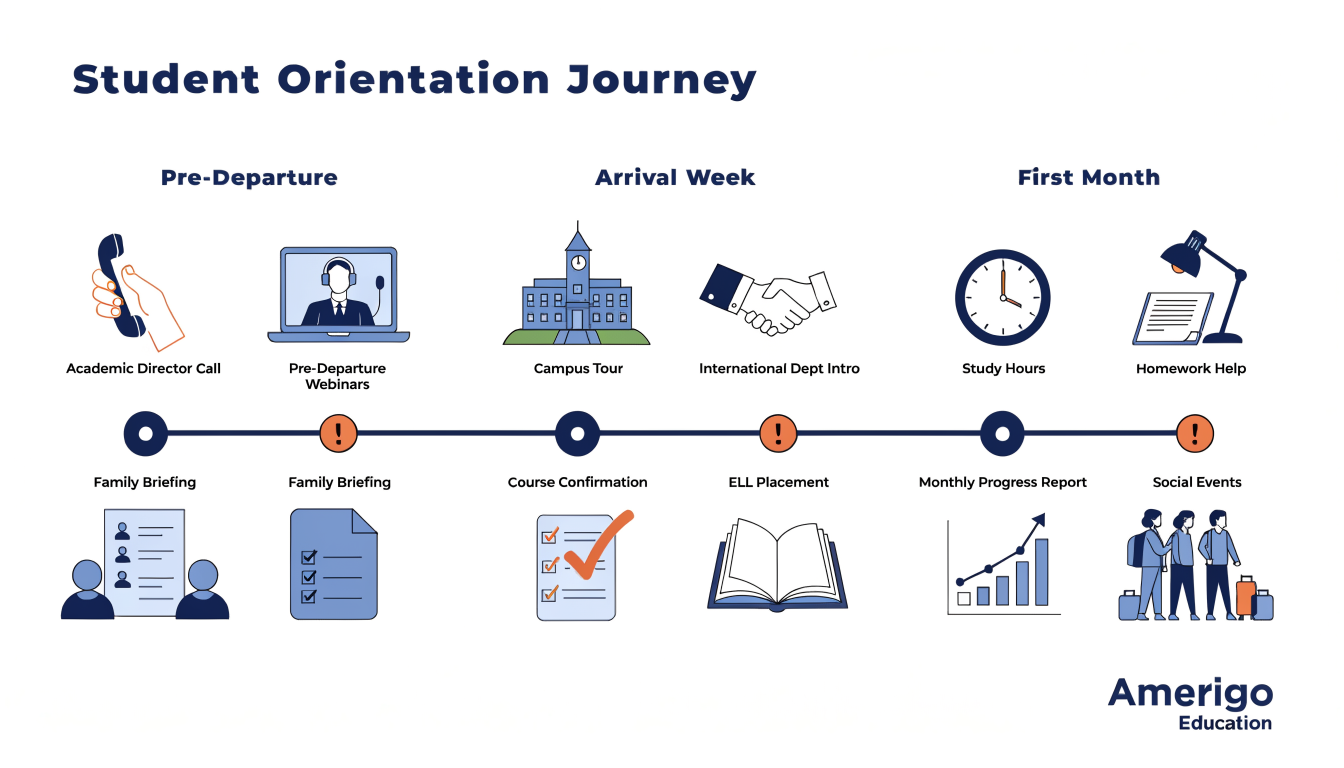
Student orientation covers school rules, campus layout, academic schedules, and introductions to key staff. Most Amerigo partner school orientations run two to five days before classes begin, giving students time to settle in before academic demands start. At US Signature Schools, the on-campus international department coordinates with school staff to ensure international students receive dedicated onboarding support from day one.
Students adjusting to a new country, academic system, and social environment simultaneously need this window more than domestic peers. The international department coordinates closely with school administration during orientation week to make sure every student receives the information relevant to their placement level and support needs.
- Welcome session: School administration introduces key staff and sets expectations for the orientation schedule.
- Campus tour: Students visit classrooms, the library, sports facilities, and student services offices.
- Academic materials: Students receive course schedules, textbooks, and student handbooks for the term.
- School rules overview: Staff cover attendance policies, academic integrity standards, and behavioral expectations.
- Extracurricular introduction: Students learn about available clubs, activities, and sports tryout timelines.
How Is Orientation Different for International Students?
International students go through additional orientation steps covering visa compliance reminders, bank account setup, local transportation, and native-language family communication. At partner schools, the on-campus international department provides international-specific sessions on course selection, ELL (English Language Learning) placement, and academic support access. Students with lower English proficiency are placed into in-school customized ELL courses immediately, and in-country staff relay key updates to parents in Chinese, Korean, Vietnamese, Spanish, and other languages.
According to NAIS (2024), international enrollment at US private high schools has grown steadily, with schools expanding dedicated international orientation tracks in response. SEVIS compliance briefings, health insurance enrollment, and bank account setup are tasks that must be completed in the first days on campus - a dedicated international department prevents these administrative requirements from disrupting a student's academic start.
| Orientation Component | Domestic Students | International Students |
|---|---|---|
| Campus and schedule tour | Yes | Yes |
| Academic rules overview | Yes | Yes |
| ELL course placement | Not applicable | Yes, based on English level |
| Visa compliance session | Not applicable | Yes, SEVIS and attendance rules |
| On-campus international department intro | Not applicable | Yes, at US Signature Schools only |
| Native-language family update | Not applicable | Yes, via in-country staff |
| Bank account and local transport help | Not applicable | Yes, where needed |
What Does Pre-Arrival Preparation Include?
Pre-arrival preparation begins weeks before orientation with a 1:1 call with the academic director covering transcript review, course plan development, and registration planning. Students arrive with a clear academic roadmap rather than making course decisions under pressure in their first days. The program also hosts pre-departure webinars covering packing, first-week expectations, and how the support system works. In-country staff brief families in their native language so parents understand the process before their student departs.
This structure separates a prepared student from an overwhelmed one. Arriving with a course plan reviewed and prerequisite needs identified means orientation week can focus on campus integration rather than starting from scratch. Families who receive native-language briefings before departure also arrive with fewer urgent questions, which reduces pressure during the student's most demanding transition week.
- Academic director call: Transcript review, course plan development, and registration planning completed before departure.
- Pre-departure webinars: Cover packing, arrival logistics, and first-week expectations before leaving home.
- Family briefing: In-country staff brief families in their native language so parents understand the process.
- Accommodation confirmation: Arrival date and housing type confirmed ahead of departure.
- Document review: School calendar, important dates, and required documents reviewed before travel.
What Academic Support Begins at Orientation?
According to NCES (2024), structured academic support programs that begin during orientation help international students transition more effectively into US high school expectations. Academic support activates during orientation week at US Signature Schools. The on-campus international department helps students confirm course schedules, identify prerequisite courses required before AP enrollment, and understand how structured study hours are organized. Students in Amerigo student accommodations have evening homework help access, while homestay students access support through the on-campus international department office. Monthly progress reports, school activity calendars and event announcements are shared with all students' families, with real-time outreach when immediate attention is needed.
Rather than waiting for a student to struggle, the international department reviews schedules during orientation week and puts support in place before the first assignment is due. This proactive approach means both residential and homestay students enter the first week of classes with a clear understanding of where to go for help and what support is already in place.
Amerigo offers four accommodation options: homestay, off-campus residences (the primary model, located 20-30 minutes from partner schools with single-gender units and 24/7 staff), on-campus residences at select schools, and self-provided accommodation for students with family nearby.
| Academic Support Feature | Residential Students | Homestay Students |
|---|---|---|
| In-residence homework help | Yes, evenings | Not applicable |
| On-campus international dept access | Yes | Yes |
| Structured study hours | Yes | Yes |
| Monthly progress reports | Yes | Yes |
| Academic counselor meetings | Yes, scheduled | Yes, scheduled |
| ELL course enrollment | Based on level | Based on level |
| SAT/ACT registration support | Yes | Yes |
What Social Integration Happens During Orientation?
Social orientation activities help international students build peer connections quickly. At partner schools, orientation includes structured social events, peer mentor introductions, and group activities that bring students from different countries together. The program also hosts its own social events for students and their friends separate from school-organized activities, giving students a chance to meet peers from China, South Korea, Vietnam, Mexico, the Taiwan Region, and across the full range of 55+ countries.
Knowing even a few peers before classes begin reduces the isolation that can otherwise affect academic performance in the first term. Social events are structured to mix students across countries and programs, giving students a practical way to build an early network before academic assignments and extracurricular commitments fill the schedule.
What Support Do Families Get During Orientation?
Families receive orientation-period updates through in-country staff, who relay key information in the family's native language after major milestones. Parents from China, Vietnam, Korea, Mexico, and the Taiwan Region receive summaries of what their student covered. The program shares school activity calendars and event announcements with parents throughout the year. Life360 or Reach safety technology at most partner schools gives parents real-time location access during the first weeks on a new campus.
In-country staff serve as the bridge between campus and home, translating not just language but also cultural context. This keeps families informed without placing the burden of interpretation on the student during one of the most demanding weeks of their academic life.
| Family Support Feature | Available During Orientation |
|---|---|
| Native-language updates via in-country staff | Yes |
| School calendar and event sharing | Yes |
| Life360 or Reach location access | Yes, at US Signature Schools |
| 24/7 emergency assistance | Yes |
| Monthly progress reports | Begin after orientation |
Frequently Asked Questions
When does orientation start for international students?
Orientation at most Amerigo partner schools begins two to five days before the first day of classes. Some schools hold separate international sessions covering SEVIS reporting requirements and ELL placement before the wider student body arrives. Students should confirm exact dates with the on-campus international department, as schedules vary across the 40 partner schools.
What should I bring to orientation?
Students should bring their passport, visa documents, school health forms, proof of health insurance, and a copy of their pre-confirmed course schedule. Amerigo's pre-departure webinars and the 1:1 academic director call both cover which documents to prepare before departure. Completing that call before leaving home ensures nothing is missed and the student arrives ready for administrative processing from day one.
Will I understand orientation if my English is not strong?
Orientation sessions are delivered in English, but the on-campus international department team is present to help international students follow key information. Students are placed into in-school customized ELL (English Language Learning) courses based on their English level so language support begins right away. In-country staff communicate orientation summaries to families in their native language after key sessions so parents stay informed throughout.
Can my parents attend orientation?
Most US high school orientations are designed for students, but some schools invite parents to a separate informational session during the orientation period. Families traveling to the US for the start of school should confirm with the Amerigo team at the specific partner school whether a parent session is available and whether advance registration is required. For families who cannot travel, in-country staff provide native-language updates after each major orientation milestone.
What happens if I miss orientation?
Students who miss orientation due to travel delays or visa issues typically receive a catch-up session from the on-campus international department at US Signature Schools. Staff coordinate with the school to ensure the student receives essential information, including SEVIS compliance reminders and course schedule confirmation. Families should contact Amerigo as early as possible if they anticipate a delay so arrangements can be made before arrival.
How is my course schedule confirmed at orientation?
Course schedules are reviewed and finalized with academic counselors during orientation week. The pre-departure 1:1 call with an Amerigo academic director covers transcript review and course planning, but formal registration happens on arrival at most partner schools. Prerequisite courses for AP (Advanced Placement) enrollment are confirmed at that point, and adjustments are made based on English placement results and counselor recommendations.
Is there orientation support for homestay students?
Yes. Homestay students and residential students go through the same school orientation program at Amerigo partner schools. Academic support for homestay students is accessed through the on-campus international department office rather than through in-residence staff. The program ensures all homestay students know how to find the international department office from their first day on campus so there is no gap in coverage regardless of accommodation type.
What activities happen during orientation social events?
The program hosts its own social events for students and their friends separate from school-organized activities, including group outings, welcome dinners, or structured peer activities during the first week on campus. School orientations at partner schools typically include get-to-know-you activities, club fairs, and sports information sessions so students can identify extracurricular interests from the start of term. These events give students a structured way to build connections before class pressure begins.
How soon after orientation do monthly progress reports begin?
Monthly progress reports, school activity calendars and event announcements begin once the academic term is underway, typically within the first four to six weeks of school. During orientation and the first week, staff make direct contact with families when immediate attention is needed rather than waiting for a scheduled report. The monthly cadence then follows for the remainder of the term, covering academic standing, engagement levels, and support adjustments the international department recommends.
Conclusion
Student orientation is the critical transition between arriving in a new country and becoming a functioning member of a school community. For international high school students, this transition spans pre-departure preparation, arrival-week activities, and the first weeks of academic life. Structured support at every stage separates programs that help students thrive from those that leave families navigating unfamiliar systems on their own.
Start Your Orientation Journey with Amerigo
Amerigo Education prepares international high school students for a successful orientation through pre-departure support, on-campus international department teams at US Signature Schools, and in-country staff who communicate with families throughout the process. To learn more about studying in America at an Amerigo partner school, contact us to speak with a program advisor, or apply now to take the first step toward enrollment.
People Also Read
- How to Prepare for Studying Abroad: Complete Guide 2025
- International Student Support Services: Complete Guide to Success
- Student Support Services: Best Practices Guide
About the Author
This guide was written by the Amerigo Education content team, drawing on program data from staff operating the on-campus international department at 40 Niche A+/A rated US, Canadian, and UK partner schools. Learn more about Amerigo Education.
Disclaimer: This article provides general information for educational purposes only. Families should conduct independent research, request current program data from providers, and consult with program representatives regarding specific circumstances. Contact us with questions.