All news
March 10, 2026
Study Abroad 101
Safety Checklist for International Students US
Safety checklist for international students in the US: visa compliance, residential supervision, health insurance, emergency contacts, and tracking for 2026.

Safety Checklist for International Students US
Last Updated: March 2026
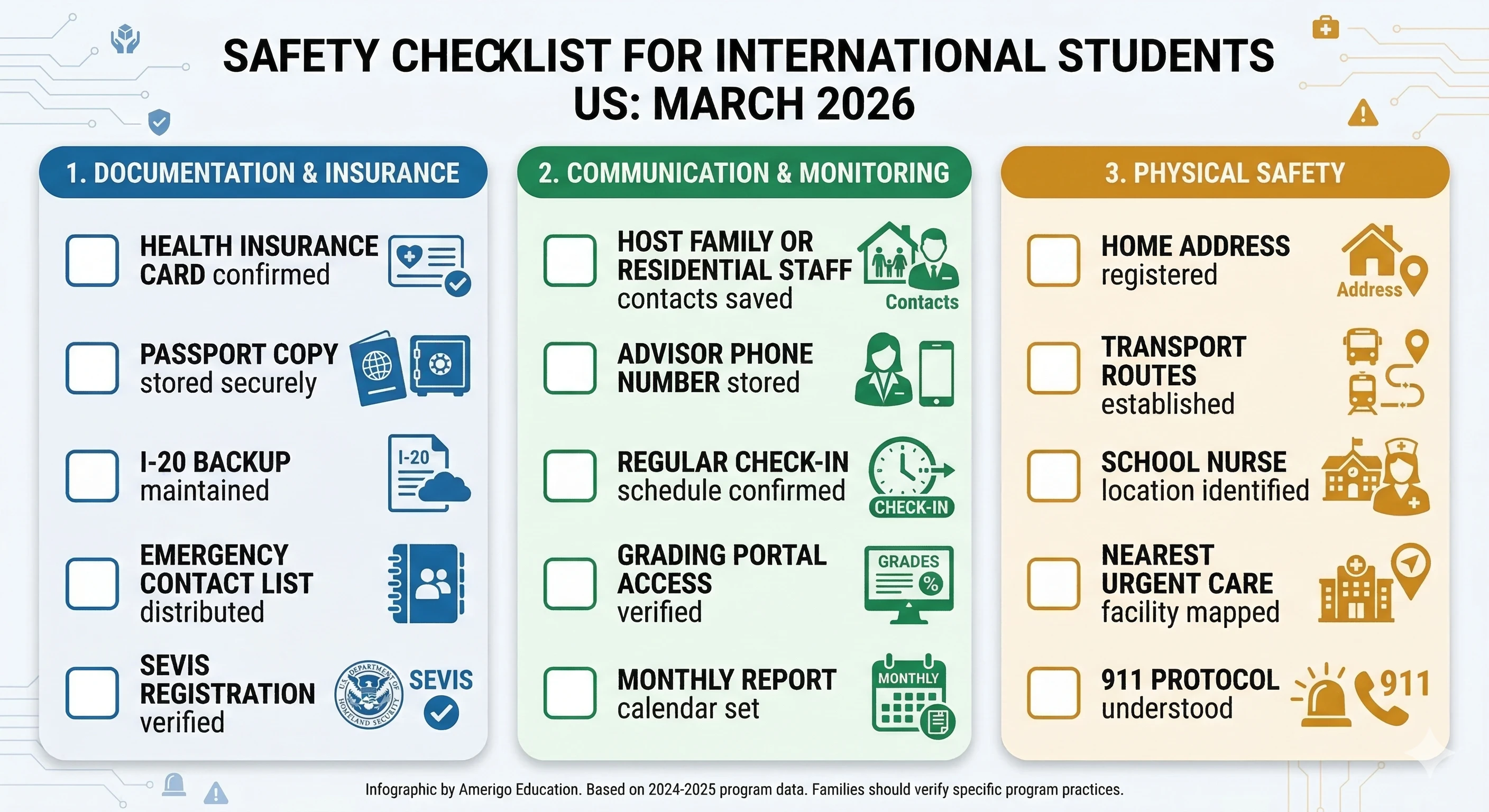
A safety checklist for international students is a structured framework that families use to evaluate whether a US high school program provides adequate visa compliance, residential supervision, health coverage, emergency communication, and location tracking for minors studying abroad. The Student and Exchange Visitor Program (SEVP) at the US Department of Homeland Security reports over 1.1 million international students hold active F-1 (student visa for academic programs) status. Schools enrolling F-1 students must meet federal SEVIS (Student and Exchange Visitor Information System) standards.
Amerigo Education, founded in 2016 and serving 3,500+ students from 55+ countries across 40 Niche A+/A rated partner schools in the US, Canada, and the UK, builds all 15 safety checkpoints into its residential framework. The Class of 2025 achieved a 97% Top 100 university admission rate. This guide breaks down each checkpoint so families can audit any program against a measurable standard.
Key Takeaways
- 15 safety checkpoints fall into five categories: visa and legal status (3 points), residential supervision (3 points), health and insurance (3 points), emergency communication (3 points), and location tracking (3 points).
- SEVP certification is the legal foundation: only schools with active SEVP certification from the Department of Homeland Security can issue I-20 forms and enroll F-1 students.
- Residential supervision standards differ by age group: programs designed for students aged 14-18 require single-gendered housing, trained staff, and curfew protocols that university-level programs do not provide.
- Monthly parent reports provide consistent visibility: structured monthly reporting gives families regular academic and wellbeing updates, with real-time outreach reserved for urgent matters.
- Location tracking technology closes the distance gap: tools such as Life360 or Reach give parents real-time visibility into their student's daily movements from any time zone.
Is the US Safe for International Students in 2026?
A safety checklist covers five categories that determine whether a high school program protects international minors. These categories are visa and legal compliance, residential supervision, health and insurance coverage, emergency communication protocols, and location monitoring. Each category contains three checkpoints, for a total of 15 auditable items families can verify before enrollment.
According to NAFSA: Association of International Educators (2025), high-quality secondary programs address student wellbeing through proactive welfare monitoring, defined communication schedules, and structured residential oversight. International high school students are minors who need protections matching their age group. Amerigo Education's on-campus international department model addresses all 15 checkpoints across its 40 partner school campuses.
What Are the Visa Safety Checkpoints?
The three visa safety checkpoints are SEVP certification, active SEVIS enrollment, and timely I-20 renewal. These form the legal foundation of an international student's presence in the US. A failure in any one area can result in loss of legal status, affecting the student's ability to attend school and remain in the country.
SEVP certification means the school holds active authorization from the Department of Homeland Security to enroll F-1 students and issue I-20 forms. Active SEVIS enrollment means the student is registered in the federal system from day one. I-20 renewal means the school updates documentation when grade levels or program dates change. Under SEVP regulations, schools must maintain SEVIS records throughout enrollment.
- Verify SEVP certification: Check that the school appears on the official SEVP School Search tool maintained by ICE.
- Confirm SEVIS enrollment on day one: The school's DSO (Designated School Official) should register the student before classes begin.
- Request I-20 maintenance policy: Ask the school to explain its process for updating I-20 documents when program details change.
- Identify the DSO by name: Families should know who manages their student's visa records at the school.
- Ask about visa service support: Visa services are typically provided through third-party partners and billed separately from program fees.
What Residential Supervision Should Families Expect?
Families should expect supervised housing with trained residential staff, single-gendered living arrangements, and defined curfew and accountability protocols. These checkpoints determine whether a student's living environment provides age-appropriate oversight for minors aged 14-18.
Amerigo Education provides three accommodation options. On- and off-campus residences are located 20-30 minutes from partner schools, are single-gendered, and include 24/7 residential staff with dedicated study areas. Homestay placements offer cultural immersion and affordability, with academic support at the school's on-campus international department office. Both models include regular check-ins, curfew policies, and direct communication channels between the student, accommodation provider, and school staff. Self-provided accommodation is also available for families with relatives near the school.
Note: Amerigo Education's Signature Schools include all features listed in both accommodation columns.
What Health Protections Should Be in Place?
Three health checkpoints must be in place: mandatory health insurance, on-campus health access with referral pathways, and mental health and wellbeing monitoring. These protections ensure that a student's physical and emotional health is covered from the first day of the program through graduation.
Health insurance for international students should cover physician visits, hospitalization, emergency care, and mental health services. At Amerigo Signature School partner campuses, the on-campus international department coordinates health-related referrals and communicates directly with families for significant health matters. According to the American School Counselor Association (ASCA, 2024), proactive mental health screening at the secondary level reduces crisis interventions by identifying at-risk students early.
- Confirm insurance is mandatory: The program should either include health coverage or require verified proof before enrollment.
- Map the referral process: Families should know how their student accesses medical care on campus, through a local clinic, or via a hospital network.
- Ask about mental health monitoring: Structured welfare check-ins should be part of the program, not available only after a crisis.
- Verify communication protocol: Families should know who contacts them and how quickly when a health issue arises.
How Should Emergency Communication Work?
Emergency communication should include a 24-hour emergency contact, structured monthly parent reports, and a defined escalation process for welfare concerns. These three checkpoints separate programs with genuine emergency readiness from those that react only after a situation has escalated.
Amerigo Signature School partner campuses provide 24/7 emergency assistance and real-time communication for urgent welfare matters. Outside emergencies, families receive monthly reports covering academic progress and wellbeing. Amerigo Education also provides native-language communication support for families from China, Vietnam, Korea, Mexico, and the Taiwan Region, and more, reducing language barriers during both routine and emergency interactions.
How Does Location Tracking Work at US Schools?
Location tracking for international students uses parent-facing mobile applications, specifically Life360 or Reach, that provide real-time visibility into a student's daily whereabouts. These tools reduce parental anxiety and create an alert mechanism if a student's movements become irregular.
Amerigo Signature School partner campuses implement Life360 or Reach as part of the standard residential program. Families receive location data directly through the app without additional fees. For school excursions, defined protocols include adult supervision, a student roster, and departure and return time communication. According to US News and World Report (2025), parents should ask about supervision protocols, emergency contact availability, and residential staff training as key quality indicators.
- Confirm location tracking is standard: The program should include Life360, Reach, or an equivalent tool as part of its standard offering.
- Verify excursion protocols: Off-campus activities should follow a defined process with adult supervision and family notification.
- Ask about break coverage: Families should know the plan for housing and supervision during Thanksgiving, winter, and spring breaks.
- Check alert mechanisms: The tracking tool should notify staff when a student's location falls outside expected patterns.
How Can Families Evaluate Any Program's Safety?
Families can evaluate any program's safety by asking eight specific questions that map directly to the 15 checkpoints in this guide. These questions test whether a program has built safety into its design or offers general assurances.
The eight questions are: Is the school SEVP-certified? What is the residential supervision model? Are residences single-gendered? Is health insurance mandatory? Is there a 24-hour emergency contact? Do parents receive monthly reports? Is location tracking technology used? What are the protocols for school breaks? Amerigo Education's 40 partner schools address all eight. The Top 100 Guarantee further demonstrates institutional commitment, backing outcomes with an up to $50,000 USD refund for students who meet program requirements.
- Is the school SEVP-certified? Verify through the official SEVP School Search tool.
- What is the residential supervision model? Ask whether housing includes trained staff or relies on informal oversight.
- Are residences single-gendered? Single-gendered arrangements are a baseline standard for minors.
- Is health insurance mandatory? Coverage should be required, not optional.
- Is there a 24-hour emergency contact? The program should provide a designated emergency line available at any time.
- Do parents receive monthly reports? Structured reporting provides consistent visibility.
- Is location tracking technology used? Life360 or Reach should be standard, not an add-on.
- What are the break protocols? Housing and supervision plans should be defined for every break period.
Frequently Asked Questions
Is America safe for international students in 2026?
America is safe for international students enrolled at SEVP-certified private high schools with structured supervision. Safety depends on residential oversight, welfare monitoring, and emergency protocols rather than geography alone. Over 1.1 million international students held active F-1 status in 2025, and programs designed for minors at accredited schools maintain strong safety records through institutional frameworks.
What should parents ask a school about safety?
Parents should ask eight questions: Is the school SEVP-certified? What residential supervision model is used? Are residences single-gendered? Is health insurance mandatory? Is there a 24-hour emergency contact? Do parents receive monthly reports? Is location tracking available? What are the break protocols? Programs answering all eight with verifiable details demonstrate genuine safety commitment.
How does location tracking work at US high schools?
Location tracking uses parent-facing mobile applications such as Life360 or Reach that provide real-time visibility into a student's whereabouts and send alerts when movements fall outside expected patterns. Amerigo Signature School partner campuses implement Life360 or Reach as part of the standard residential program, giving families continuous location data without separate setup.
What visa risks do international students face?
The primary visa risk is losing active SEVIS enrollment or falling out of valid F-1 status. This can happen if a school fails to maintain SEVIS records, if an I-20 is not updated when program dates change, or if the student violates enrollment conditions. Families should confirm their school has a designated school official who manages SEVIS records throughout the program.
Are US boarding schools safe for minors?
US boarding schools vary widely in supervision standards for international students. Programs designed for students aged 14-18 with single-gendered residences, trained residential staff, monthly parent reports, and location tracking provide stronger safety frameworks than programs built for university-age students. Families should verify that the program addresses all 15 safety checkpoints before enrollment.
What supervision do international students receive?
Supervision varies by program type. Amerigo Signature School partner campuses provide residential staff, monthly parent reports, real-time emergency communication, Life360 or Reach location tracking, and welfare monitoring through the on-campus international department. Programs without on-campus departments typically rely on remote coordinators, which can delay responses.
How often should parents receive safety updates?
Parents should receive structured monthly reports covering academic progress and wellbeing. Monthly reporting provides consistent visibility without requiring families to chase updates. Programs should also offer real-time outreach for urgent matters such as medical situations, behavioral concerns, or safety incidents that cannot wait for the next reporting cycle.
What health insurance do international students need?
International students need health insurance covering physician visits, hospitalization, emergency care, and mental health services. Coverage should meet both school requirements and F-1 visa conditions. Some programs include insurance in fees while others require separate purchase. Families should confirm coverage details before enrollment.
What happens during school breaks for safety?
School breaks require defined housing arrangements, supervision continuity, and family communication plans. Programs should specify whether students return home, remain in supervised accommodation, or stay with approved host families during each break. Families should confirm protocols for Thanksgiving, winter, and spring breaks before enrollment.
How can parents verify a program's safety claims?
Parents should request data on staff-to-student ratios, on-campus presence hours, emergency response protocols, and communication frequency. Ask for references from current families and verify SEVP certification. Cross-check school Niche ratings for community safety data. Programs with transparent records provide documentation readily during enrollment rather than offering only general assurances.
Conclusion
The 15-point safety checklist for international students covers visa compliance, residential supervision, health coverage, emergency communication, and location tracking. Programs designed for students aged 14-18 should address all 15 checkpoints with specific, verifiable practices rather than general assurances. Families evaluating any US high school program can use this framework to audit institutional readiness before enrollment.
Review Safety Standards at Partner Schools
Families ready to review safety protocols at Amerigo Signature School partner campuses can view partner schools and explore individual school profiles. Apply now or contact us to speak with an enrollment advisor about specific safety standards at any of the 40 Niche A+/A rated partner schools.
People Also Read
- What Actually Keeps International Students Safe at US High Schools?
- Safe High School Options for International Students in the US
About the Author
This guide was written by the Amerigo Education content team, drawing on program data from staff operating the on-campus international department at 40 Niche A+/A rated US and Canadian partner schools. Learn more about Amerigo Education.
Disclaimer: This article provides general information for educational purposes only. Families should conduct independent research, request current program data from providers, and consult with program representatives regarding specific circumstances. Contact us with questions.
_converted.webp)