All news
February 8, 2026
Study Abroad 101
Off-Campus Residence Model vs Traditional Boarding Schools: Support Comparison for International Students
Compare off-campus residence models with traditional boarding schools for international students. Understand school access, support, outcomes, and accommodation differences. (164 chars)
Off-Campus Residence Model vs Traditional Boarding Schools: Support Comparison for International Students
Last Updated: February 2026
An off-campus residence model places international students at top-rated US day schools while providing structured residential supervision separately, whereas traditional boarding schools combine academics and dormitory living on a single campus. According to the National Association of Independent Schools (NAIS, 2024), both models serve international families seeking American high school education, but they differ in school access, support specialization, facility design, and university preparation structure. For families evaluating residential options, understanding how each model delivers academics and daily support determines which approach matches student needs.
Amerigo Education, founded in 2016 and backed by Avathon Capital, operates the off-campus residence model as an on-campus international department at 40 Niche A+/A rated US and Canadian partner schools. Traditional boarding schools represent an established education model with deep history, strong campus communities, and residential traditions dating back generations. This comparison examines how each model's structure serves international students differently.
Key Takeaways
- Off-campus residence models enable access to top US day schools that do not offer boarding, expanding the range of academically strong institutions available to international students
- Traditional boarding schools offer integrated campus communities with academics and residential life in one location, building independence and school identity
- Class of 2025 verified outcomes: 97% Top 100, 60% Top 50, 25% Top 30 university admission through the off-campus model, backed by a $50,000 USD refund guarantee
- Support specialization differs: embedded international department staff versus boarding school faculty serving all students across the residential community
- Four accommodation types including homestay and off-campus residences versus the single dormitory model at traditional boarding schools
How Does School Access Differ Between Models?
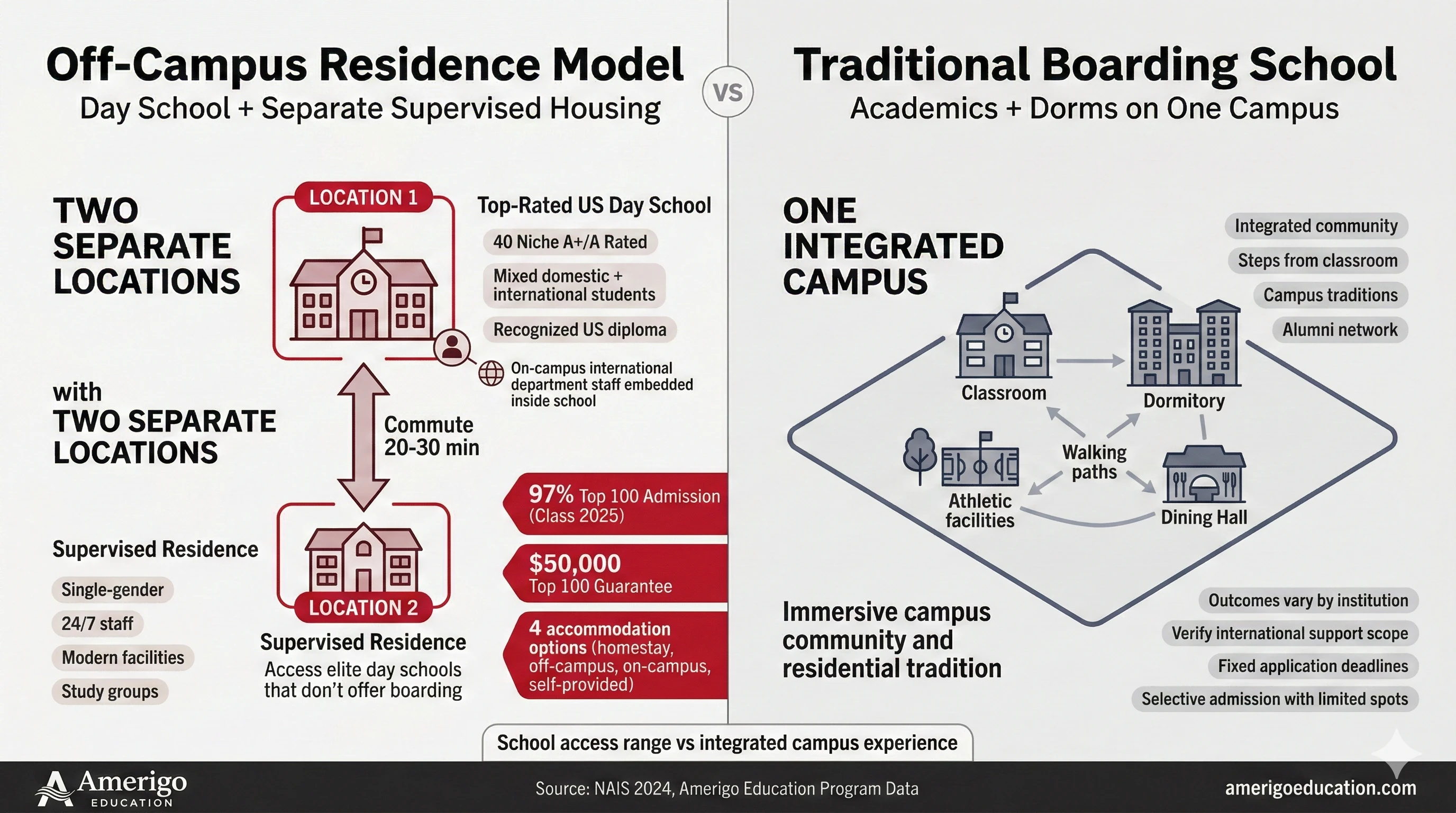
The off-campus residence model partners with established US day schools where international students attend classes alongside domestic American students. Most elite US day schools do not offer on-campus boarding facilities, meaning students seeking residential education through traditional boarding cannot access these particular institutions. The off-campus residence model addresses this by providing housing separately.
Traditional boarding schools operate self-contained campus environments combining classrooms and dormitories. Many are located in suburban or rural settings with strong campus traditions, close-knit communities, and deep alumni networks. Students benefit from the convenience of living steps from classrooms and full immersion in campus life.
Each model offers distinct advantages. The off-campus model expands school options to include day schools in metropolitan areas. Traditional boarding provides an integrated campus experience where academic and social life are closely connected. Families should consider which school environment and location type best serves their student's learning style and social needs.
What Support Model Does Each Program Provide?
The off-campus model embeds full-time staff at each partner school, operating as that school's on-campus international department. Students see familiar staff daily in hallways, during lunch, and after classes without scheduling appointments. This creates dual-layer support: experienced school teachers and counselors plus specialized international student services.
Support includes individualized academic planning for prerequisite courses needed for AP (Advanced Placement) enrollment, in-residence homework help for residential students, academic support at the international department office for homestay students, customized ELL (English Language Learning) courses, subject-specific tutoring, and evening study groups. Monthly family reports keep parents informed with real-time outreach for urgent matters. Native-language staff serve families in China, Vietnam, Korea, Mexico, and Taiwan Region. Life360 or Reach safety technology enables parent location tracking.
Traditional boarding schools provide support through residential advisors, faculty, and counselors serving the entire student body. Many boarding schools have strong counseling departments, experienced faculty who live on campus, and structured study periods. International students typically access the same support systems as domestic students. Families should ask specific boarding schools about dedicated international student services, native-language communication, and family reporting frequency.
8 Questions to Compare Support Models:
- Where are support staff physically located during the school day?
- Does the school have staff specifically trained for international student needs?
- How are parents informed about student progress and how frequently?
- Is native-language communication available for families?
- How does the school handle prerequisite course planning for AP enrollment?
- What academic support exists outside classroom hours?
- What safety technology allows parents to track student location?
- How quickly does staff respond to academic or emotional concerns?
How Do Residential Facilities Compare?
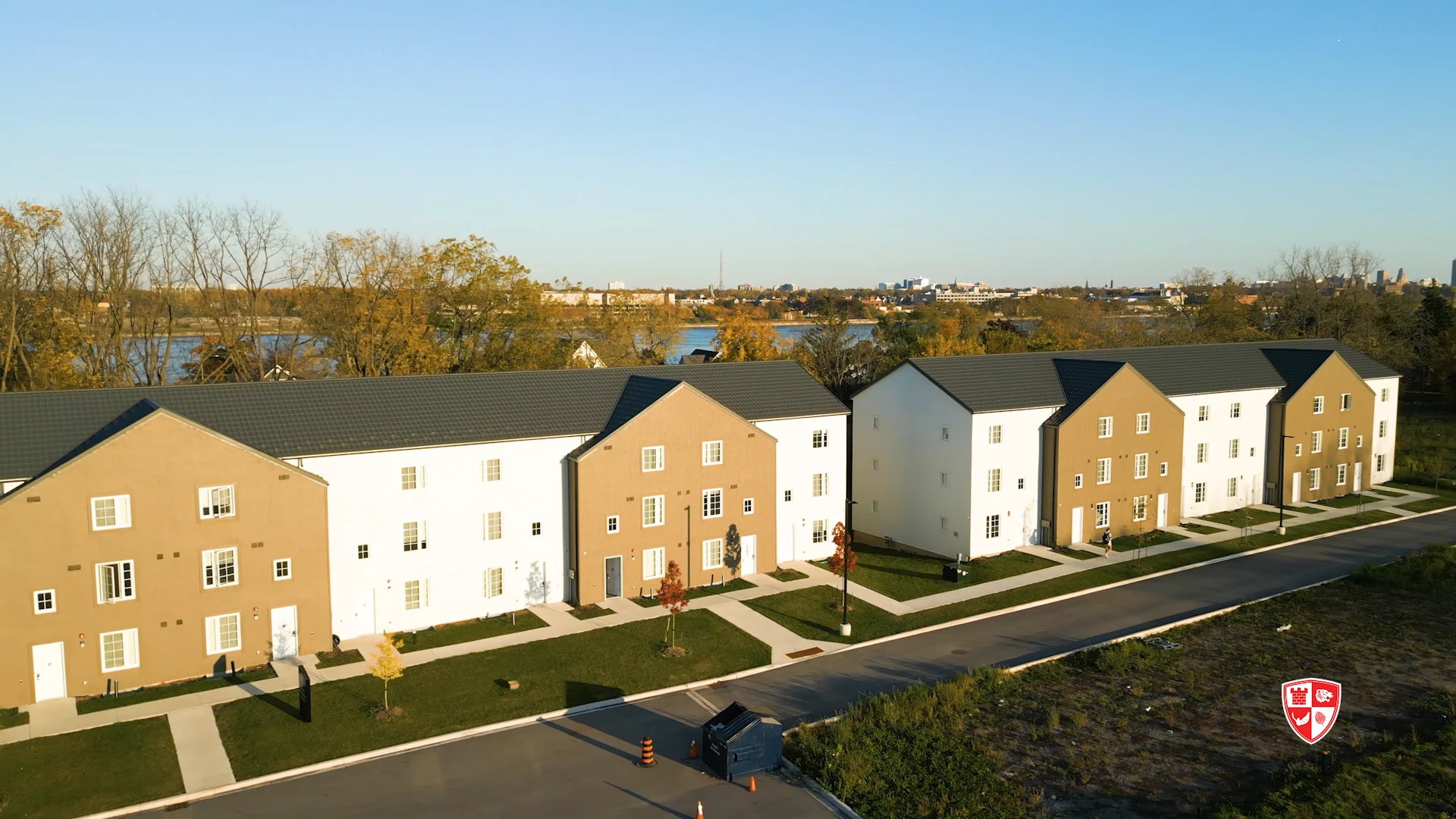
Off-campus residences typically feature modern facilities with contemporary furnishings, dedicated common areas for group study with teacher availability, single-gender arrangements, and 24/7 staff supervision. These residences are located in residential neighborhoods within commuting distance of partner schools, providing structured living environments separate from the school campus.
Traditional boarding school dormitories are located directly on campus, offering the convenience of short walks to classrooms, dining halls, and athletic facilities. Many boarding schools have invested significantly in facility renovations, and campus environments often include extensive grounds, athletic facilities, and social spaces that create a distinct residential community. Some historic campuses carry traditions that build strong school identity and belonging.
The off-campus model's strategic advantage is enabling access to day schools that do not offer boarding. The boarding school model's advantage is integrated campus living where students build community through shared residential experience. Neither model is inherently superior - the right choice depends on whether school access range or campus integration matters more to the family.
Learn more about accommodation options for international students.
How Do University Admission Outcomes Compare?
Verified outcome data for the Class of 2025 through the off-campus model shows 100% university acceptance, 97% admitted to Top 100 US universities, 60% to Top 50, and 25% to Top 30. These outcomes are backed by a $50,000 USD refund guarantee for students meeting requirements (2 consecutive years, 3.2 GPA (Grade Point Average), TOEFL 85+, one AP/IB/Honors course).
English proficiency at entry affects outcomes. Among low-B1 (beginner-intermediate) students, 83% achieved Top 100 admission. Among B1 (intermediate) students, 96% reached Top 100. Students entering with higher English skills see stronger placement rates. Read more about English proficiency progression.
Traditional boarding schools vary widely in university outcomes depending on the specific institution. Many well-established boarding schools have strong college counseling departments and track records of placement at selective universities. Families should request specific outcome data by graduating class and university tier from any boarding school for direct comparison.
5 Questions to Ask About University Outcomes:
- What are your admission rates by university tier for the most recent graduating class?
- Do you publish outcome data broken down by student entry level?
- Do you offer any financial guarantee backing outcome claims?
- How does university counseling differ for international versus domestic students?
- What percentage of international students specifically reach Top 100 universities?
How Do Costs and Pricing Structures Compare?
The off-campus model provides transparent pricing from $40,000 for entry-level programs to $75,000-$110,000+ annually for premium programs. Fees include tuition at the partner school, accommodation management, on-campus support, university counseling, and 24/7 emergency assistance. Visa services are provided through third-party partners and billed separately. Learn more about what is included versus additional costs.
Traditional boarding school tuition typically ranges from $60,000-$80,000+ annually, varying by school reputation and location. These fees generally cover tuition, dormitory, and meals. Some boarding schools may charge additional fees for international student services, ESL support, or specialized counseling. Families should request itemized fee breakdowns for direct comparison.
How Do Application Processes Differ?
The off-campus model emphasizes accessibility: most partner schools offer rolling admissions year-round, do not require recommendation letters at most schools, and accept flexible English testing including Duolingo or Eltis beyond TOEFL and IELTS. Students apply to multiple schools through one process with no extra costs. Visit the application page for details.
Traditional boarding schools typically have fixed application deadlines (often January-February for fall enrollment), require recommendation letters, standardized test scores, and interviews. Admission is often highly selective with limited spots for international students. Each school requires a separate application with individual fees.
6 Application Process Differences:
- Rolling admissions versus fixed deadlines
- Single application for multiple schools versus separate applications per school
- Flexible English testing versus specific test requirements
- No recommendation letters required at most schools versus letters required
- Accessible enrollment versus highly selective admission
- Year-round start options versus fall-only enrollment at most schools
Frequently Asked Questions
What is the main difference between these models?
The off-campus residence model places students at top-rated US day schools while providing separate supervised housing, enabling access to institutions that do not offer boarding. Traditional boarding schools combine academics and dormitory living on a single campus. The core distinction is school access range versus integrated campus experience. Families should evaluate which structure better matches their student's needs.
Which model provides better university outcomes?
Verified Class of 2025 data from the off-campus model shows 97% Top 100 and 60% Top 50 admission, backed by a $50,000 USD refund guarantee. Traditional boarding schools vary widely in outcomes depending on the institution. Families should request specific outcome data by graduating class and university tier from any program for accurate comparison. Financial guarantees indicate confidence in the support model.
Are off-campus residences comparable to boarding school dorms?
Off-campus residences feature modern facilities with contemporary amenities and 24/7 supervision. Traditional boarding school dormitories offer on-campus convenience with direct access to classrooms and campus facilities. Many boarding schools have invested in facility renovations. Each model provides different advantages - modern purpose-built living versus integrated campus community.
How does support differ for international students?
The off-campus model embeds specialized international student staff on campus providing daily accessibility, native-language family communication, and customized ELL courses. Traditional boarding schools provide support through faculty and counselors serving all students. Families should ask boarding schools about dedicated international student services and native-language communication availability.
Can students access the same schools through boarding?
Most elite US day schools do not offer on-campus boarding. The off-campus residence model addresses this by providing housing separately, enabling attendance at these schools. Traditional boarding students attend the boarding school itself. Families should evaluate whether specific school access or campus integration matters more.
How selective is admission to each model?
The off-campus model offers rolling admissions at most partner schools with flexible English testing and no recommendation letters required. Traditional boarding schools often have fixed deadlines, selective admission, and limited international spots. Accessibility differs significantly between models.
Do traditional boarding schools guarantee university admission?
Traditional boarding schools typically do not provide financial guarantees backing admission outcomes. The off-campus model offers a $50,000 USD refund guarantee for students meeting specific requirements. Financial backing demonstrates confidence in the support model's effectiveness.
What are the advantages of traditional boarding schools?
Traditional boarding schools offer integrated campus communities, strong traditions, extensive athletic and extracurricular facilities, close faculty relationships through on-campus living, deep alumni networks, and the independence-building experience of full campus immersion. These strengths appeal to families valuing campus community and residential tradition.
People Also Read
Private US High School vs International School Networks: Complete Comparison Guide for 2026 Understand fundamental differences between American high schools and international school networks, including transcript recognition and cultural immersion.
Study Abroad Accommodation Options: Homestay vs Residence vs On-Campus vs Self-Provided Learn about accommodation types for international high school students and how to select based on student maturity and family priorities.
On-Campus International Department vs External Coordinator Model: Daily Support Access Comparison Compare daily embedded support with external coordination models and see how accessibility differences impact academic performance and family communication.
About the Author
This comparison guide was developed by the program evaluation team at Amerigo Education, with expertise in international student support models and residential education. The team operates the on-campus international department at 40 Niche A+/A rated US and Canadian high schools, combining operational experience with data-driven research to help families make informed program decisions.
Conclusion
The choice between an off-campus residence model and traditional boarding schools depends on what matters most to your family. The off-campus model expands school access to include top-rated day schools that do not offer boarding, while providing specialized international student support. Traditional boarding schools offer integrated campus communities with strong traditions, deep alumni networks, and the independence-building experience of residential campus life.
Both models serve international families seeking quality American education. Programs like Amerigo that publish verified outcome data and offer financial guarantees provide concrete comparison points alongside accommodation structure and support specialization. The questions outlined in this guide help families evaluate either option based on how support is delivered and which school environment best serves their student.
Take the Next Step
Families ready to explore the off-campus support model can contact Amerigo for detailed information about partner schools, daily support structure, and enrollment. To begin the application process, visit the application page - most partner schools offer rolling admissions with flexible English testing.
This article provides program comparison information for educational purposes only. Families should conduct independent research, visit schools when possible, request current data from both program types, and consult with representatives regarding specific circumstances. Contact us with questions.
_converted.webp)