All news
March 11, 2026
Study Abroad 101
International Student US High School Completion Rates
What percentage of international students finish US high school? Completion rates, early departure factors, and how structured support improves outcomes.
International Student US High School Completion Rates
Last Updated: March 2026
A high school completion rate is the proportion of enrolled international students who finish their full program and earn a US diploma. Completion rates differ sharply between program models. According to the Institute of International Education's Open Doors Report (2024), over 1.1 million international students were enrolled across US educational institutions, yet secondary-level retention data remains limited because no single federal database tracks private high school completion by visa type.
Amerigo Education supports 3,500+ international students from 55+ countries across 40 Niche A+/A rated partner schools in the US, Canada, and the UK. The Class of 2025 achieved a 97% Top 100 university admission rate, 60% Top 50 admission, and 25% Top 30 admission - outcomes that depend directly on students completing the full program.
Key Takeaways
- Full program completion drives admissions outcomes: Students who complete Grade 9-12 at the same school present the strongest applications with continuous GPA, AP depth, and teacher recommendations.
- Four factors cause most early departures: Language difficulty, social isolation, family pressure, and academic misplacement account for the majority of program exits.
- Structured programs retain students longer: Programs with on-campus international departments, residential supervision, and monthly family reporting show higher completion rates than self-arranged placements.
- First 90 days are the critical window: Early identification and intervention through daily on-campus interaction during the first semester is the strongest predictor of multi-year retention.
- Class of 2025 outcomes confirm the model: 97% Top 100, 60% Top 50, and 25% Top 30 university admission across 3,500+ students from 55+ countries.
What Are the Top Reasons Students Leave Early?
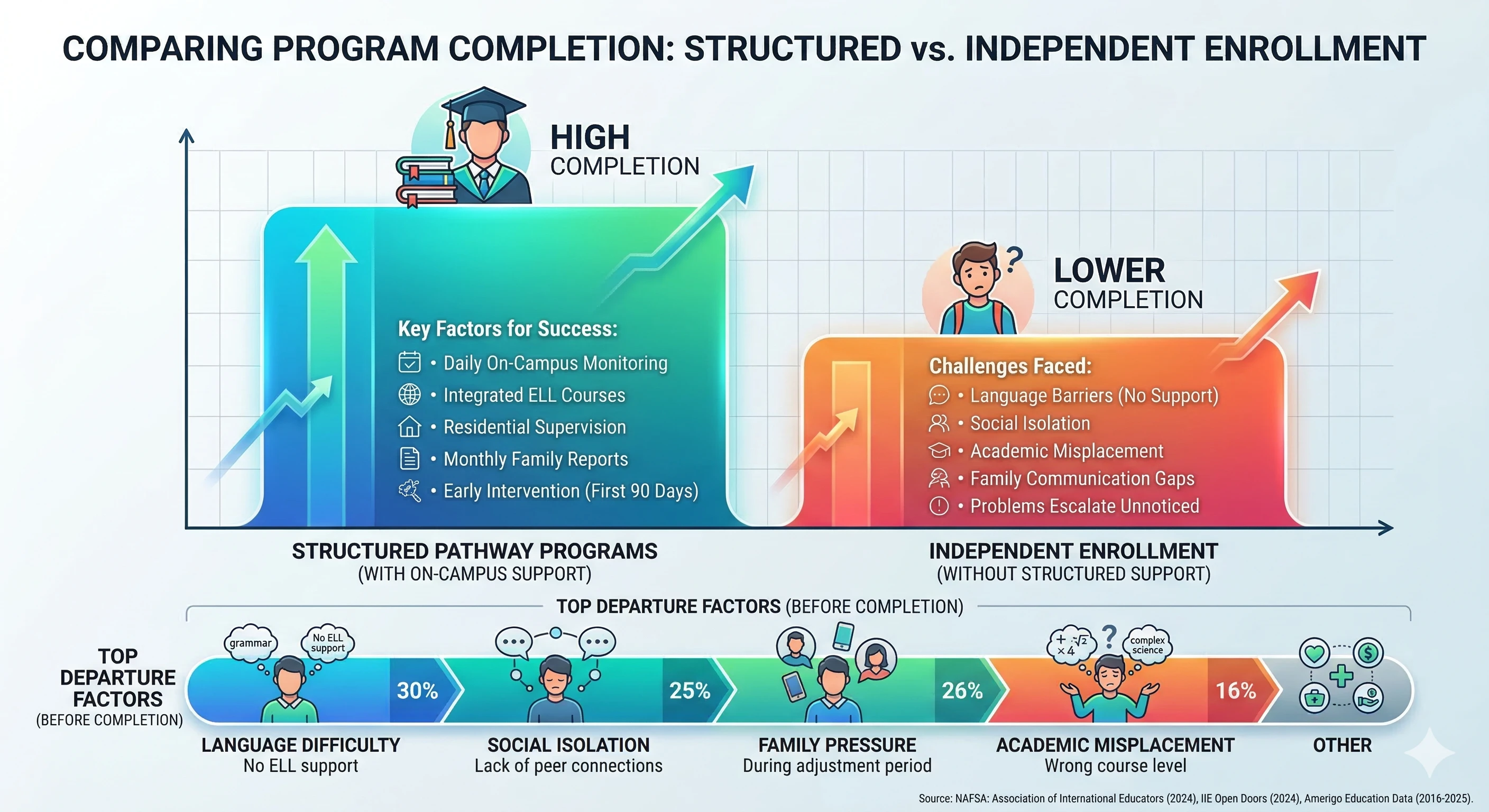
International students leave US high school programs before completion for four primary reasons: language difficulty without ELL coursework, social isolation, family pressure during adjustment, and academic misplacement. These are program design gaps, not fixed personal traits.
According to NAFSA: Association of International Educators (2024), institutional support structures - including proactive welfare monitoring, academic intervention, and parent communication - are the primary drivers of international student retention at the secondary level. The most effective interventions happen during the first 90 days, when students are most vulnerable to homesickness and academic shock. Amerigo Education's on-campus international department model identifies and addresses these challenges daily.
How Do Completion Rates Vary by Program Type?
Completion rates for international students differ significantly by program structure. Self-arranged placements have the lowest completion rates because no intermediary monitors student welfare or intervenes when difficulties arise. Structured pathway programs with dedicated support infrastructure are better positioned to complete the full program.
The multi-year retention rate is the most meaningful metric, measuring what percentage of students who start in Grade 9 or 10 complete through Grade 12 at the same school. Under SEVP (Student and Exchange Visitor Program) regulations, maintaining valid F-1 status requires continuous enrollment and satisfactory academic progress - conditions that structured programs help students meet through daily monitoring.
Amerigo Education's Signature Schools include all features listed in the structured pathway column.
What Makes the First 90 Days Critical?
The first 90 days of enrollment determine whether most international students will complete their program. Students who receive structured support during this period - including ELL coursework, peer connections, and regular welfare check-ins - are significantly more likely to continue through graduation.
During this window, students simultaneously adjust to a new language of instruction, unfamiliar teaching methods, different social norms, and physical distance from family. Programs that assign each student to an on-campus advisor who checks in daily can identify warning signs before they become departure decisions. Amerigo Education provides both homestay, on- and off-campus residence and self-provided accommodation options, with academic support at the school's on-campus international department office for all students.
- Week 1-2: Orientation, campus familiarization, initial ELL assessment, peer introductions
- Week 3-4: First academic feedback cycle; advisors identify students needing course load adjustment
- Week 5-6: Social integration check - students without peer connections receive targeted intervention
- Week 7-8: First monthly progress report sent to families with academic and welfare summary
- Week 9-12: Academic trajectory stabilization; tutoring referrals for students below target GPA
What GPA Do Students Need for US Universities?
GPA requirements for US university admission range from approximately 2.5 at less selective institutions to 3.8 or above at highly selective ones. For Top 100 universities, a GPA of 3.0 or above is typically the floor for competitive consideration. Many Top 50 universities expect 3.5 or above alongside a strong AP course record.
According to UCLA Admissions (2025), competitive UC campuses evaluate GPA in the context of course rigor - a 3.8 GPA in standard courses is weighted differently than a 3.6 GPA with multiple AP courses. Building an AP record requires multi-year enrollment starting in Grade 9 or 10, which is why program completion matters for admissions outcomes. Amerigo Education's university counseling begins in the first year, with individualized academic planning that identifies pre-requisite courses for AP access.
How Does Program Completion Affect Admissions?
Students who complete a full US high school program present admissions officers with a consistent academic record - GPA trajectory, AP course depth, teacher recommendations, and extracurricular activities - all in the format American universities evaluate directly. A student who transfers or departs mid-program loses this continuity, one of the strongest signals admissions committees use to assess readiness.
The Class of 2025 achieved 100% university acceptance among graduating students. Credits may not transfer fully, and transfers after junior year present the greatest challenges for competitive placement. Amerigo Education addresses this by starting university counseling from Grade 9 or 10 and maintaining consistent academic records across the full enrollment period.
- Consistent GPA trajectory visible across multiple years at the same institution
- AP course depth that demonstrates increasing academic rigor over time
- US teacher recommendations from instructors who know the student well
- Extracurricular continuity showing leadership growth and sustained commitment
- Standardized test preparation (SAT/ACT) integrated into the academic plan
What Support Structures Improve Completion?
The support structures that most directly improve international student completion rates are daily academic monitoring through an on-campus international department, ELL coursework integrated into the school schedule, supervised residential environments, monthly family reporting, and university counseling that starts in the first year of enrollment. Programs combining all five consistently produce higher retention.
Amerigo Education provides native-language communication support for families from China, Vietnam, Korea, Mexico, and the Taiwan Region, and more. When updates require immediate attention, families receive real-time outreach beyond the standard monthly reports. Safety technology including Life360 or Reach gives parents location tracking visibility.
How Should Families Evaluate Program Retention?
Families should ask prospective programs five specific questions about retention before enrolling.
The distinction between single-year completion and multi-year retention is important. A program may report high completion for any given academic year while still losing students between years. The metric that matters is what percentage of students who enroll in Grade 9 or 10 are still enrolled at the same school when they graduate.
- What is your multi-year retention rate for students who start in Grade 9 or 10?
- What happens in the first two weeks when a student shows signs of struggle?
- How often do families receive progress reports, and in what language?
- Does the program have an on-campus international department or only a central office?
- What percentage of students who complete the full program gain Top 100 university admission?
Frequently Asked Questions
What are the F-1 visa requirements for US high school?
International students need enrollment at an SEVP (Student and Exchange Visitor Program)-certified school, a valid F-1 student visa, an active I-20 form, SEVIS (Student and Exchange Visitor Information System) I-901 fee payment, and demonstrated English proficiency. Students must maintain full-time enrollment and satisfactory academic progress throughout the program. Financial documentation showing the capacity to fund the full program duration is also required.
What is the 5-month rule for F-1 students?
The 5-month rule allows F-1 students to take an authorized leave of absence of up to five months while maintaining their SEVIS record. This provision primarily applies to university-level students. High school F-1 students are generally required to maintain continuous enrollment throughout the academic year. Families should consult their school's designated school official for specific guidance.
How much financial documentation is needed for an F-1 visa?
No fixed minimum balance is required for an F-1 student visa. Consular officers assess whether documentation shows the capacity to fund tuition, accommodation, living expenses, and travel for the full program. For private US high school programs costing $40,000 to $110,000 or more per year, documentation should demonstrate liquid or accessible assets for the entire enrollment period. Incomplete records are a common cause of delays.
What GPA do international students need for US universities?
GPA requirements vary by institution. Top 100 universities generally expect a minimum 3.0 on a 4.0 scale, while many Top 50 universities expect 3.5 or above. Admissions committees evaluate GPA alongside course rigor, AP coursework, extracurricular activities, and essays. Students who complete a full US high school program with consistent GPA growth are evaluated on the same criteria as domestic applicants.
What percentage of international students drop out of US high school?
No single published dropout rate exists because completion varies significantly by program type, support level, and student profile. Self-arranged placements without institutional support tend to have higher departure rates than structured programs. Students enrolled in pathway programs with ELL support, residential supervision, and academic monitoring are better supported to complete the full program.
What are the top reasons international students leave early?
The most common reasons are language difficulty without adequate ELL support, social isolation during the first semester, family pressure encouraging a return home during adjustment, and academic misplacement at a level that does not match the student's preparation. All four factors can be addressed through structured programs with on-campus international departments providing daily monitoring and early intervention.
Does completing a US high school improve university admission?
Yes. Students who complete a full US high school program present a 4.0-scale GPA, AP exam scores, US teacher recommendations, and extracurricular records in the format admissions officers evaluate directly. The Class of 2025 achieved 97% Top 100 and 60% Top 50 university admission among students who completed the full pathway at Amerigo Education partner schools.
How does on-campus support affect student retention?
Programs with on-campus international departments identify struggling students through daily interaction and intervene before problems escalate. This includes adjusting course loads, providing tutoring, connecting students with counseling, and maintaining regular family communication through monthly reports. Early intervention during the first 90 days is the strongest predictor of long-term program completion.
What happens if a student transfers schools mid-program?
Transferring schools disrupts university applications because admissions officers prefer consistent academic records from a single institution. Credits may not transfer fully, and students lose continuity in teacher recommendations and counselor relationships. Transfers after junior year create the greatest challenges because the student's academic trajectory becomes harder for admissions committees to evaluate.
How do monthly reports help families track student progress?
Monthly progress reports give families visibility into academic performance, social adjustment, and overall welfare. Reports cover grades, attendance, extracurricular participation, and any concerns identified by staff. When updates require immediate attention, families receive real-time outreach. Amerigo Education provides monthly reports for all students, with native-language support for families from China, Vietnam, Korea, Mexico, and the Taiwan Region, and more.
Conclusion
International students who complete structured US high school pathway programs produce the strongest university application profiles because GPA trajectory, AP course depth, and extracurricular continuity are visible to admissions officers across multiple years. The most common early departure factors - language difficulty, social isolation, family pressure, and academic misplacement - are all addressed by programs with ELL coursework, residential supervision, monthly family reporting, and on-campus international department intervention. The Class of 2025 achieved 97% Top 100 university admission, a result that depends entirely on program completion.
Learn More About Program Completion Support
Families ready to understand how structured pathway programs support student completion through graduation can view partner schools and explore program details. Apply now or contact us to speak with an enrollment advisor about multi-year program planning and the support structures that help international students finish what they start.
People Also Read
- How to Calculate the True ROI of High School Study Abroad
- University Admission Results by English Level: How B1 Students Achieve Top 100 Acceptance
About the Author
This guide was written by the Amerigo Education content team, drawing on program data from staff operating the on-campus international department at 40 Niche A+/A rated US and Canadian partner schools. Learn more about Amerigo Education.
Disclaimer: This article provides general information for educational purposes only. Families should conduct independent research, request current program data from providers, and consult with program representatives regarding specific circumstances. Contact us with questions.
_converted.webp)