
All news
March 18, 2026
Study Abroad 101
How US Grades Work: GPA, Credits, and Class Rank Decoded
How do US high school grades, GPA, credits, weighted vs unweighted, and class rank work? Complete grading system explainer for international families in 2026.

How US Grades Work: GPA, Credits, and Class Rank Decoded
Last Updated: March 2026
A US high school grade is a letter - A, B, C, D, or F - assigned to each course a student takes, representing performance on a standardized scale used across nearly all American secondary schools. According to the National Center for Education Statistics (NCES), over 26,000 public and private high schools in the United States use this letter-grade system, making it the dominant academic measurement framework that international families will encounter. The College Board reports that these letter grades convert into a numeric Grade Point Average (GPA) that universities rely on as a primary admissions metric.
Amerigo Education partners with 40 Niche A+/A rated schools across the US, Canada, and UK, supporting 3,500+ students from 55+ countries. The Class of 2025 achieved 97% admission to Top 100 US universities. Each partner school maintains an on-campus international department that helps families from China, Vietnam, Korea, Mexico, the Taiwan Region, and more understand grading systems, track academic progress through monthly reports, and plan coursework that positions students for strong university applications.
Key Takeaways
- Letter grades are the building blocks: US schools assign A (90-100%), B (80-89%), C (70-79%), D (60-69%), or F (below 60%) to every course, with some schools adding plus/minus modifiers like A- or B+.
- GPA is the single summary number: Grade Point Average converts letters to a 0.0-4.0 scale (A=4.0, B=3.0, C=2.0, D=1.0, F=0) and averages them across all courses.
- Weighted GPA rewards harder courses: AP and Honors courses add extra points, allowing GPAs above 4.0 on a weighted scale - a signal to universities that the student chose rigorous coursework.
- Credits track completion, not quality: Each course earns credits (typically 0.5-1.0 per semester), and students need 22-26 total credits to graduate.
- Class rank is relative positioning: A student ranked 10th out of 300 has the 10th highest GPA in their graduating class, giving universities context for how the GPA compares within that specific school.
What Are US Letter Grades?
A US letter grade is a single letter - A, B, C, D, or F - assigned to each course based on the percentage of points a student earns across tests, assignments, projects, and participation during a semester. This system replaces the numeric percentage scales used in many other countries. For a parent accustomed to seeing a score of 87 out of 100 on a report card, the US equivalent would simply read "B+" or "B."
Most US high schools define grade boundaries as follows: A covers 90-100%, B covers 80-89%, C covers 70-79%, D covers 60-69%, and F applies to anything below 60%. Many schools add plus and minus modifiers, creating a finer scale where an A- might cover 90-92% and an A covers 93-96%, with A+ reserved for 97-100%. The exact cutoffs vary slightly between schools, but the general framework remains consistent across the country. A grade of C or above is considered passing, while a D may count for credit but signals weak performance. An F means the student did not pass the course and earns no credit toward graduation.
How Is GPA Calculated?
GPA - Grade Point Average - is a single number that summarizes a student's overall academic performance across all courses. Schools calculate it by converting each letter grade to its point value (A=4.0, B=3.0, C=2.0, D=1.0, F=0), then averaging those values. A student taking five courses who earns two As, two Bs, and one C would have a GPA of 3.2. This number is what universities see first on a transcript.
Schools calculate GPA two ways: per-semester and cumulative. A semester GPA covers only the courses taken during that term, while the cumulative GPA averages every course taken throughout the student's entire high school career. The cumulative GPA is the figure that appears on college applications and is the number universities use for admissions decisions. Some schools weight GPA by credit hours, meaning a course worth 1.0 credits counts more in the average than a course worth 0.5 credits. Monthly progress reports from Amerigo Education help parents track both semester and cumulative GPA so there are no surprises when application season arrives.
- Assign each letter grade its point value (A=4.0, B=3.0, C=2.0, D=1.0, F=0)
- Multiply each grade's point value by the number of credits that course is worth
- Add all the weighted point values together to get total grade points
- Add all the credit hours together to get total credits attempted
- Divide total grade points by total credits attempted - the result is the GPA
- Repeat each semester, then recalculate cumulatively across all semesters
- The cumulative figure is reported on the official transcript sent to universities
What Is Weighted vs Unweighted GPA?
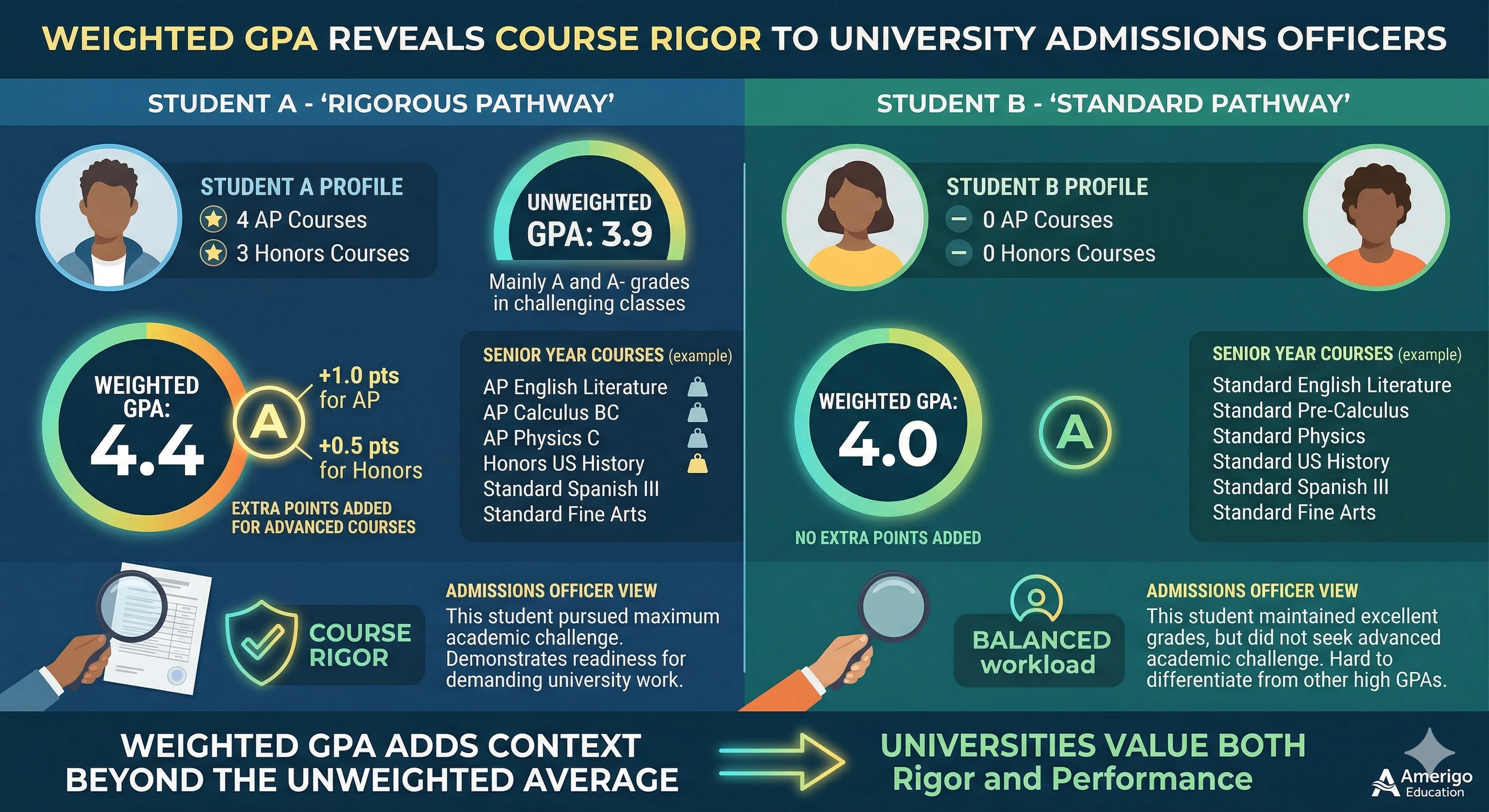
An unweighted GPA uses the standard 4.0 scale for every course regardless of difficulty. A weighted GPA adds extra grade points for advanced courses - typically 1.0 additional point for AP and IB courses, and 0.5 additional points for Honors courses. This means a student earning an A in an AP class receives 5.0 points on the weighted scale instead of 4.0. When a parent sees a GPA of 4.3 on a report, it signals a weighted calculation.
The distinction matters because two students can have very different academic profiles behind the same unweighted GPA. A student with a 3.8 unweighted GPA earned entirely in AP and Honors courses demonstrated greater academic ambition than a student with a 4.0 earned in standard-level courses. Universities understand this difference, which is why many request both weighted and unweighted GPAs on applications. Amerigo Education's academic advisors help students identify the right mix of AP, Honors, and standard courses that builds a strong weighted GPA while keeping workload manageable - including identifying pre-requisite courses needed before AP enrollment.
What Are High School Credits?
A high school credit is a unit that measures course completion, not course quality. Each course a student passes earns a set number of credits - typically 1.0 credit for a full-year course or 0.5 credits for a semester-long course. Credits accumulate over four years, and students need a minimum total - usually between 22 and 26 credits depending on the state and school - to qualify for graduation.
Credits are distributed across required subject areas. A typical graduation requirement might include four credits of English, three of math, three of science, three of social studies, and the remainder filled by electives, physical education, and fine arts. The key point for international families is that credits track whether a student has completed enough courses in each required category - they do not reflect how well the student performed. A student who earns an A and a student who earns a D in the same course both receive the same number of credits, but their GPAs will differ. International students transferring into US high schools go through a credit evaluation process where their previous coursework is mapped to the US credit system.
- English: 4.0 credits required (one course per year for four years)
- Mathematics: 3.0-4.0 credits (typically through Algebra II or higher)
- Science: 3.0 credits (biology, chemistry, and one additional science)
- Social Studies: 3.0 credits (US History, World History, Government/Economics)
- World Language: 2.0 credits (two years of the same language at many schools)
- Physical Education: 1.0-2.0 credits
- Fine Arts: 1.0 credit (art, music, theater, or equivalent)
- Electives: remaining credits filled by student's choice of additional courses
What Does Class Rank Mean?
Class rank is a student's GPA position relative to every other student in the same graduating class. If a school has 250 seniors and a student's cumulative GPA is the 12th highest, that student's class rank is 12 out of 250. Some schools express rank as a percentile - being in the top 5% means the student's GPA is higher than 95% of classmates. This gives universities a way to compare a student's GPA against the specific school's academic environment.
Not all schools report class rank. According to data from the National Association for College Admission Counseling (NACAC), roughly half of US high schools have stopped providing class rank on transcripts, particularly competitive private schools where high-performing students cluster together. When a school does not rank, universities rely on the school profile - a document the school sends with transcripts that describes grading policies, course offerings, and GPA distribution. For international students, class rank can be an advantage when it is reported, because it contextualizes their GPA within the school population.
How Do AP, IB, and Honors Courses Fit In?
AP (Advanced Placement), IB (International Baccalaureate), and Honors courses are more rigorous versions of standard high school subjects. They cover material at a faster pace, in greater depth, and with higher expectations for independent work. Taking these courses signals to universities that a student sought academic challenge rather than choosing the easiest path to a high GPA. The College Board administers AP exams each May, and scores of 3, 4, or 5 on a 1-5 scale can earn college credit at many universities.
For international students, these courses serve a dual purpose. They boost the weighted GPA, and they demonstrate readiness for university-level work in a way that admissions officers recognize immediately. Amerigo Education's academic advisors work with students to build individualized course plans, including identifying pre-requisite courses for AP enrollment, in-school customized ELL (English Language Learner) courses to build language proficiency alongside advanced content, and subject-specific tutoring and evening study groups that help students manage demanding coursework. Students at Amerigo partner schools who maintain a cumulative GPA of 3.2 or higher, score TOEFL 85+, complete at least one AP, IB, or Honors course, and enroll for two consecutive years at a US Signature School qualify for the Top 100 Guarantee - a $50,000 USD refund if admission to a Top 100 US university is not achieved. Grade 12 direct entry is not eligible.
- AP courses follow a standardized College Board curriculum with a national exam in May
- IB courses are part of the International Baccalaureate Diploma Programme, recognized globally
- Honors courses are school-designed advanced sections, typically one level above standard
- AP exam scores of 3-5 can earn college credit, potentially saving a semester of university tuition
- Weighted GPA adds 1.0 for AP/IB and 0.5 for Honors above the standard grade points
- Universities view the number and type of advanced courses alongside GPA when evaluating applications
How Does This Differ From Other Countries?
The US grading system differs structurally from the systems used in most countries that send students to American high schools. In China and Vietnam, grades are reported as percentages or numeric scores out of 100, with different passing thresholds. In the UK A-Level system, grades run from A* through E with a U for ungraded. Korea uses a nine-tier ranking system. None of these translate directly to the US letter-grade and GPA framework without a formal credential evaluation.
This means parents reviewing their child's first US report card will see an unfamiliar format. A Chinese student accustomed to seeing a score of 92 in mathematics will instead see a letter grade of A- or A and a GPA contribution of 3.7 or 4.0. The actual academic standard may be similar, but the reporting looks entirely different. Amerigo Education provides native-language support for families from China, Vietnam, Korea, Mexico, the Taiwan Region, and more, helping parents interpret report cards, understand GPA calculations, and compare their child's US academic standing to familiar home-country benchmarks. University counseling begins as early as Grade 9 or 10, so families have years of context before applications begin.
What Is a Transcript and Why Does It Matter?
A transcript is the official document that records every course a student has taken, the grade earned in each course, the credits received, and the cumulative GPA. High schools issue transcripts directly to universities as part of the college application process. For international students, the US transcript becomes the primary academic record that admissions officers review - it replaces or supplements whatever documentation the student's home-country school provided.
Transcripts also include information about the grading scale the school uses, whether GPA is weighted or unweighted, and sometimes class rank. Universities that receive transcripts from Amerigo Education partner schools also receive a school profile that explains the academic program, course offerings, and student demographics. This context helps admissions officers interpret the grades accurately. For families who may eventually return to their home country or transfer to another school system, the US transcript serves as an internationally recognized academic record that credential evaluation services can translate into equivalent grades for any destination country.
Frequently Asked Questions
What is the GPA scale in US high schools?
The standard US high school GPA scale runs from 0.0 to 4.0 on an unweighted basis. An A earns 4.0 points, a B earns 3.0, a C earns 2.0, a D earns 1.0, and an F earns 0. Schools calculate GPA by averaging the grade points across all courses taken. Weighted scales can extend above 4.0 when students take AP, IB, or Honors courses.
What is the difference between weighted and unweighted GPA?
Unweighted GPA treats all courses equally on a 4.0 scale regardless of difficulty. Weighted GPA adds extra points for advanced courses - typically 1.0 additional point for AP and IB courses and 0.5 additional points for Honors courses. A student earning an A in an AP class receives 5.0 points on the weighted scale instead of 4.0. This rewards students who choose more challenging coursework.
How many credits do students need to graduate?
Most US high schools require between 22 and 26 credits for graduation, though exact requirements vary by state and school. Students typically earn 0.5 to 1.0 credits per course per semester. Credits are distributed across required subject areas including English, math, science, social studies, and electives. Schools publish their specific credit requirements in the student handbook.
Do all US high schools use letter grades?
The vast majority of US high schools use letter grades from A through F, though some schools use percentage-based reporting or standards-based grading at certain levels. Even schools that report percentages typically convert them to letter grades and GPA on transcripts. A small number of independent schools use narrative evaluations, but these are uncommon at the high school level.
What does class rank mean on a transcript?
Class rank indicates where a student's cumulative GPA falls relative to all other students in the same graduating class. A rank of 15 out of 200 means the student has the 15th highest GPA in a class of 200. Not all schools report class rank - according to NACAC data, roughly half of US high schools have moved away from ranking due to concerns about excessive competition.
How do AP courses affect GPA?
AP courses affect GPA through the weighted grading scale. An A in an AP course earns 5.0 grade points instead of 4.0, a B earns 4.0 instead of 3.0, and so on. This means students taking AP courses can achieve a weighted GPA above 4.0. Universities recognize this weighting as evidence that a student pursued more rigorous coursework rather than selecting easier classes to inflate grades.
Is a 3.5 GPA considered good in the US?
A 3.5 unweighted GPA falls between an A-minus and B-plus average and is considered strong by most US standards. According to NCES data, the average high school GPA in the US is approximately 3.0. A 3.5 places a student above average and within the competitive range for many selective universities. Context matters - a 3.5 in AP courses carries more weight than a 3.5 in standard courses.
How do US grades convert to my country's system?
There is no universal conversion formula between US grades and other national systems. A score of 85 out of 100 in China is not automatically equivalent to a B in the US. Credential evaluation services such as WES and ECE provide official conversions when students transfer between systems. Universities that admit international students are experienced in interpreting transcripts from different grading traditions.
Can international students recover from a low GPA?
Yes, because US universities review GPA trends across all four years of high school. A student who starts with a lower GPA in Grade 9 and improves steadily through Grade 12 demonstrates an upward trajectory that admissions officers value. Academic support services - including tutoring, study groups, and individualized planning - help students identify weaknesses early and build stronger performance each semester.
Does Amerigo Education help families track grades?
Amerigo Education provides monthly progress reports to families, covering grades, attendance, and academic standing. The on-campus international department at each partner school monitors student performance and coordinates with teachers when issues arise. Families receive reports with native-language support available in Chinese, Vietnamese, Korean, Spanish, and more, ensuring parents understand their child's academic status regardless of English proficiency.
Conclusion
The US high school grading system converts course performance into letter grades, aggregates those grades into a GPA on a 4.0 scale, tracks completion through credits, and positions students relative to classmates through class rank. Weighted GPA rewards students who take AP, IB, and Honors courses, while the official transcript documents everything universities need to evaluate an applicant's academic record.
Explore Amerigo Education Partner Schools
Families ready to enroll their child in a US, Canadian, or UK high school with built-in academic support, GPA tracking, and university counseling can apply now or contact us to speak with an admissions advisor in your native language. Explore US partner schools, view Canadian options, or learn about partner schools in the UK.
People Also Read
- What GPA Do International Students Need?
- How Many AP Courses Do International Students Need?
- Why US High School Transcripts Give International Students an Advantage
About the Author
This guide was written by the Amerigo Education content team, drawing on program data from staff operating the on-campus international department at Amerigo Education's partner schools across the US, Canada, and UK. Learn more about Amerigo Education.
Disclaimer: This article provides general information for educational purposes only. Families should conduct independent research, request current program data from providers, and consult with program representatives regarding specific circumstances. Contact us with questions.