All news
March 30, 2026
Study Abroad 101
How to Choose Classes at a US High School: Course Selection Guide
How do international students choose classes at a US high school? Guide to course catalogs, required vs elective courses, AP tracks, and building a competitive schedule.

How to Choose Classes at a US High School: Course Selection Guide
Last Updated: March 2026
Course selection is the process by which US high school students choose their classes for each academic year, balancing graduation requirements, personal interests, and university preparation. According to the National Center for Education Statistics, US high schools require students to complete an average of 22 to 26 credits across specific subject areas to graduate, with each yearlong course typically worth one credit. The College Board reports that students who take at least one Advanced Placement course during high school are significantly more likely to complete a four-year college degree, making course-level decisions during high school a direct factor in university outcomes.
Amerigo Education partners with 40 Niche A+/A rated schools across the US, Canada, and UK, supporting 3,500+ students from 55+ countries. The Class of 2025 achieved 97% admission to Top 100 US universities. Each Amerigo Education partner school provides individualized academic planning through the on-campus international department, where academic advisors guide international students through course selection, prerequisite planning, and schedule building from the point of enrollment.
Key Takeaways
- Course catalogs are the starting point: Every US high school publishes a course catalog listing all available classes, prerequisites, credit values, and whether each course is required or elective.
- Required courses are non-negotiable: Students must complete credits in English, math, science, social studies, physical education, and often a foreign language before they can graduate.
- Three course levels exist at most schools: Regular (college prep), honors, and AP courses offer different levels of difficulty, pacing, and GPA weighting.
- ELL courses fit into the schedule without replacing core academics: English Language Learner courses typically occupy an elective slot, preserving the student's access to required subjects.
- Academic rigor matters more than course count: Universities evaluate the difficulty of a student's schedule relative to what the school offers, not just the number of AP courses taken.
What Is a US High School Course Catalog?
A course catalog is the official document each high school publishes listing every class available for enrollment. It is organized by department (English, mathematics, science, social studies, world languages, arts, electives) and includes the course title, a brief description, the number of credits earned, the grade levels eligible to enroll, and any prerequisite courses that must be completed first. Most schools release an updated course catalog each January or February before the next year's registration period begins.
For international students, the course catalog can be unfamiliar because many school systems outside the US do not offer course selection at all. In countries like China, Vietnam, Korea, and the Taiwan Region, students follow a fixed curriculum assigned to their grade level. In the US system, students build their own schedule from the catalog within the constraints of graduation requirements. The academic advisor assigned to each student at Amerigo Education partner schools walks through the catalog during orientation, explaining which courses are mandatory, which are optional, and which require prior coursework to unlock.
What Are Required vs. Elective Courses?
Required courses are classes every student must pass to earn a high school diploma. These are set by state education standards and enforced by each school's graduation requirements. Elective courses are classes students choose freely based on their interests, career goals, or university preparation strategy. A typical US high school schedule includes four to five required courses and two to three electives per year, though this varies by school.
International students arriving from school systems with fixed curricula often underestimate the importance of elective selection. Electives are not filler classes. They appear on the transcript that universities review, and strategic elective choices demonstrate intellectual curiosity, subject depth, or skill development that strengthens a university application. A student interested in engineering who takes computer science and physics electives beyond the required courses sends a clear signal to admissions committees.
- English is required every year of high school, making it the only subject with a four-year continuous requirement at most schools
- Math requirements vary by state, with some requiring courses through Algebra II and others through Pre-Calculus
- Science sequences typically follow Biology, Chemistry, Physics in that order, though some schools allow flexibility
- Social studies requirements often include a US History course and a Government or Civics course
- World language credits may be waived for international students who demonstrate proficiency in a language other than English
- Physical education requirements can sometimes be fulfilled through participation in school sports teams
- Elective credits fill the gap between required courses and the total credits needed for graduation
How Do Course Levels and Tracks Work?
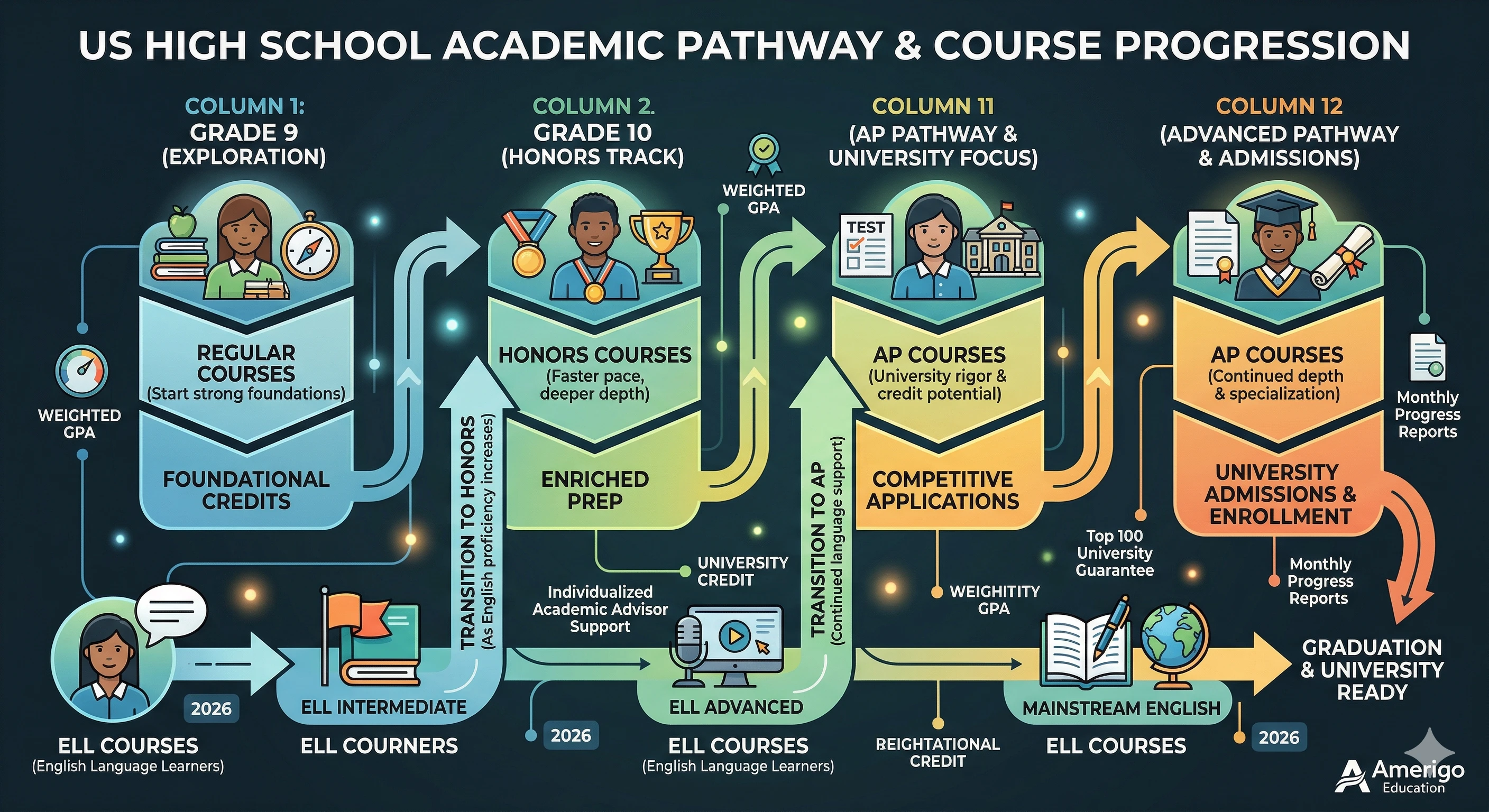
Most US high schools offer courses at three distinct levels: regular (sometimes called college preparatory), honors, and Advanced Placement (AP). The same subject, such as US History, may be available at all three levels, with each version covering the material at a different depth and pace. The course level directly affects the student's GPA because many schools use weighted grading, where honors and AP courses add extra points to the GPA calculation. A student earning a B in an AP course may receive more GPA points than a student earning an A in the regular version of the same subject.
The progression between levels follows a prerequisite structure. A student cannot typically enroll in AP Biology without first completing Honors Biology or, at minimum, regular Biology with a strong grade. This means course selection in Grade 9 and Grade 10 determines which AP courses become available in Grade 11 and Grade 12. Academic advisors at Amerigo Education partner schools map out multi-year course plans during the student's first semester, ensuring that prerequisite courses are completed in time to access advanced options before university applications are submitted.
How Do ELL Courses Fit Into the Schedule?
English Language Learner (ELL) courses are designed for students whose first language is not English and who need structured support to reach academic English proficiency. At most US high schools, ELL courses occupy one or two periods in the student's daily schedule, typically replacing an elective slot rather than a required academic course. This means a student taking ELL still enrolls in math, science, social studies, and other required subjects alongside English-proficient peers.
ELL programs at Amerigo Education partner schools are structured in levels, from beginner through advanced, with students assessed and placed based on their English proficiency at enrollment. As students progress through ELL levels, they transition into mainstream English courses. At some schools, the highest ELL level satisfies the English graduation requirement, while at others, students must complete at least one year of standard English after exiting the ELL program. The on-campus international department coordinates ELL placement with the academic advisor so that ELL course loads do not prevent students from accessing honors or AP courses in their stronger subjects.
- ELL placement is determined by an English proficiency assessment at enrollment, not by the student's age or grade level
- Most schools offer three to five ELL levels, from beginning to transitional
- ELL courses typically count as elective credits, preserving access to required academic courses
- Students in higher ELL levels may take sheltered content courses (core subjects taught with language support) at some schools
- Exiting ELL status requires meeting a proficiency threshold on a standardized assessment
- SAT and ACT preparation support is available alongside ELL courses at Amerigo Education partner schools
- Academic advisors adjust course selections each semester as the student's English proficiency improves
- Students with strong math or science skills can take honors or AP courses in those subjects while still enrolled in ELL for English
How Should Students Build a Balanced Schedule?
A balanced schedule combines academic rigor with a workload the student can sustain over an entire semester without academic or personal burnout. The most competitive university applicants are not students who loaded every period with AP courses. They are students who took the most challenging courses available in their areas of strength while maintaining grades that reflect genuine mastery. A schedule with three AP courses and strong grades is more competitive than a schedule with six AP courses and mediocre grades.
International students face an additional balancing factor: language adjustment. A student still developing English proficiency should not take AP English Literature in the same semester as AP US History, both of which require extensive reading and writing in English. Instead, a stronger approach pairs one reading-intensive course with courses that rely more on quantitative skills, such as AP Calculus or AP Physics. Families receive monthly progress reports from Amerigo Education partner schools, allowing parents and advisors to adjust the course load if early semester performance indicates the schedule needs rebalancing.
- Start with all required courses for the student's grade level to ensure graduation progress
- Add honors or AP courses in the student's strongest one or two subjects
- Keep regular-level courses in subjects where the student is still building skills
- Include ELL courses if needed, using an elective slot
- Select at least one elective that aligns with the student's university application interests
- Avoid scheduling two or more reading-intensive AP courses in the same semester for students still developing English fluency
- Confirm that prerequisite courses for desired Grade 11-12 AP courses are included in the Grade 9-10 plan
- Leave room for SAT/ACT prep and extracurricular activities, which universities weigh alongside coursework
What Academic Planning Support Does Amerigo Provide?
Amerigo Education partner schools assign each international student an academic advisor within the on-campus international department who manages course selection from enrollment through graduation. This advisor reviews the student's academic history, evaluates transferred credits, assesses English proficiency, and builds a multi-year course plan aligned with both graduation requirements and university admissions goals. The advisor adjusts the plan each semester based on the student's academic performance and evolving interests.
This individualized planning is particularly important for students targeting the Top 100 Guarantee, which requires a cumulative GPA of 3.2 or higher, a TOEFL score of 85 or higher, and completion of at least one AP, IB, or Honors course across two consecutive years of enrollment at a US Signature partner school. The $50,000 USD refund guarantee means course selection directly affects a student's eligibility. Academic advisors ensure students meet these benchmarks by mapping prerequisite courses, scheduling AP or Honors options at the right time, and intervening with tutoring support when grades indicate risk. Accommodation options include homestay, on- and off-campus supervised residences, and self-provided housing, with native-language support available for families from China, Vietnam, Korea, Mexico, the Taiwan Region, and more.
- Academic transcript evaluation and credit transfer assessment during enrollment
- English proficiency assessment and ELL level placement
- Multi-year course plan mapping required credits, honors/AP progression, and elective strategy
- Semester-by-semester schedule adjustments based on academic performance
- SAT and ACT preparation integrated into the academic calendar
- Monthly progress reports sent to families covering grades, attendance, and advisor observations
- University counseling that connects course selection to target school admissions requirements
- Tutoring and academic intervention when course performance drops below target benchmarks (additional costs may apply)
Frequently Asked Questions
What is a course catalog at a US high school?
A course catalog is a document published by each high school that lists every class available for enrollment, organized by subject area. It includes course descriptions, credit values, grade-level eligibility, prerequisites, and whether the course is required or elective. International students receive the course catalog during registration and use it with their academic advisor to build a schedule that meets graduation requirements.
How many classes do students take per semester?
Most US high school students take six to eight classes per semester, depending on the school's schedule format. Schools using a traditional schedule run seven or eight periods per day year-round. Schools on a block schedule run four classes per day, with each class meeting for longer sessions and completing in one semester. International students typically fill all available periods, with ELL courses replacing an elective slot if needed.
What is the difference between honors and AP?
Honors courses are advanced versions of standard subjects taught at a faster pace with deeper content, weighted higher in GPA calculations. AP (Advanced Placement) courses follow a standardized College Board curriculum and culminate in a national exam each May. Scoring 3 or higher on the AP exam can earn college credit at many universities. Honors courses are typically available starting in Grade 9, while most AP courses require completion of prerequisite honors courses first.
Can international students take AP courses?
Yes, international students can take AP courses if they meet the prerequisite requirements set by the school. Most AP courses require completion of the honors-level version of that subject first. Students with strong English proficiency and solid academic records may be placed into AP courses earlier. The Top 100 Guarantee at Amerigo Education US Signature partner schools requires completion of at least one AP, IB, or Honors course.
Do ELL courses count toward graduation credits?
ELL course policies vary by school. At many schools, ELL courses count as elective credits toward graduation but do not replace required English credits. Some schools allow advanced ELL levels to fulfill the English requirement. Students should confirm with their academic advisor how ELL credits apply at their specific school. Amerigo Education partner schools integrate ELL courses into the student's schedule without reducing access to core academic courses.
What happens if I fail a required course?
If a student fails a required course, they must retake it to earn the credit needed for graduation. Schools offer retake options through summer school, online credit recovery programs, or repeating the course the following year. The failed grade may remain on the transcript alongside the new grade, depending on school policy. Academic advisors at Amerigo Education partner schools monitor student progress through monthly reports and intervene with tutoring before a failing grade becomes final.
What is a study hall or free period?
A study hall is a scheduled period during the school day when a student has no class and uses the time for independent study, homework, or meeting with teachers for extra help. A free period serves a similar function but may allow students to leave campus at schools with open-campus policies. Most high schools limit study halls to upperclassmen who have completed enough credits ahead of schedule. International students on F-1 visas must maintain full-time enrollment status.
How do credits from my home country transfer?
US high schools evaluate international transcripts to determine which courses transfer as credits toward graduation requirements. Math and science courses typically transfer more directly than humanities courses, where language and curriculum differences may require re-evaluation. The on-campus international department at Amerigo Education partner schools manages credit evaluation during the enrollment process to ensure students receive appropriate credit for prior coursework.
Should I take the hardest schedule possible?
Universities want to see academic rigor, but a schedule that leads to poor grades defeats the purpose. A strong approach is to take honors or AP courses in subjects where the student has demonstrated strength and standard-level courses in weaker areas. A student earning As and Bs in a moderately rigorous schedule is more competitive than a student earning Cs in an all-AP schedule. Academic advisors help students find the right balance between rigor and manageable workload.
When does course selection happen each year?
Course selection for the following academic year typically happens in February or March. Schools distribute course catalogs, hold informational sessions, and schedule meetings between students and academic advisors. Students submit course request forms ranking their preferred classes, and the school builds the master schedule over summer. New international students arriving mid-year or for fall entry work with their advisor during orientation to select courses based on available sections.
Conclusion
Course selection at a US high school determines the academic transcript that universities evaluate, making it one of the most consequential decisions an international student makes each year. Understanding the course catalog, balancing required and elective courses, progressing through honors and AP tracks at the right pace, and integrating ELL support without sacrificing core academics requires deliberate planning that starts at enrollment and adjusts each semester.
Build Your Academic Plan
Families ready to start academic planning can apply now through a single application covering 40 partner schools, or contact us for guidance on course offerings, ELL support, and AP availability at specific school locations. Explore US partner schools, view Canadian options, or learn about Brentwood School in the UK.
People Also Read
- How Many AP Courses Do International Students Need for Top US Universities in 2026?
- What GPA Do International Students Need for Top US Universities?
- What Is Advanced Placement Credit? Complete Guide 2026
About the Author
This guide was written by the Amerigo Education content team, drawing on program data from staff operating the on-campus international department at Amerigo Education's partner schools across the US, Canada, and UK. Learn more about Amerigo Education.
Disclaimer: This article provides general information for educational purposes only. Families should conduct independent research, request current program data from providers, and consult with program representatives regarding specific circumstances. Contact us with questions.