All news
March 13, 2026
Study Abroad 101
How International Transcripts Transfer to US High Schools
How international academic transcripts are evaluated, converted to US credits, and matched to grade-level placements at American high schools for 2026.

How International Transcripts Transfer to US High Schools
Last Updated: March 2026
An international transcript transfer is the process by which a US high school evaluates foreign academic records and converts them into American credits, grade placements, and GPA equivalencies. According to the Institute of International Education, international secondary enrollment in the US has grown steadily since 2020. How these records are evaluated determines course access, AP eligibility, graduation timelines, and the strength of a student's university application profile.
Amerigo Education operates on-campus international departments at 40 Niche A+/A rated partner schools across the US and Canada, supporting 3,500+ students from 55+ countries. The Class of 2025 achieved 97% Top 100 university admission. Amerigo's enrollment teams coordinate with school registrars to evaluate international transcripts, determine course equivalencies, and place students into appropriate academic tracks from enrollment onward. At Signature campuses, Amerigo's team also facilitates sending transfer transcripts directly to US universities, making the college application process more convenient for students.
Key Takeaways
- Transcript evaluation determines grade placement: US high schools convert international grades to a 4.0 GPA scale using school-specific or third-party evaluation methods.
- Math and science transfer most consistently: These subjects share standardized content globally, while social studies and English literature require the most adaptation.
- Credit shortfalls are common for late-entry students: Students entering in Grade 10 or 11 may need to complete US-specific requirements alongside regular coursework.
- No universal GPA conversion exists: Each school applies its own methodology, making pre-enrollment evaluation essential for accurate grade placement.
- Structured programs reduce transfer friction: Amerigo Education's 40 partner schools have established evaluation processes for transcripts from 55+ countries.
How Are International Transcripts Evaluated?
US high schools evaluate international transcripts through direct institutional review or third-party credential evaluation services. The school registrar examines course titles, grades, credit hours, and the home country's grading scale to assign US equivalencies. Schools with established international student populations typically maintain internal conversion charts for common sending countries. The evaluation determines both grade-level placement and eligibility for advanced coursework including AP courses.
The evaluation process varies by school and country of origin. Some schools require certified translations while others accept translations from the sending school with an official seal. Schools with on-campus international departments, including Amerigo Education partner schools, manage evaluation internally with staff experienced in reading transcripts from China, Vietnam, Korea, Mexico, the Taiwan Region, and more.
What Courses Transfer to US High Schools?
Mathematics, laboratory sciences, and foreign languages transfer most consistently because their content overlaps across national curricula. English, US History, US Government, and state-specific requirements rarely transfer from international schools and must be completed in the US. Physical education and health education requirements also vary by state. Schools evaluate each course individually against their graduation requirements to determine which credits count toward the US diploma.
Students transferring from IB programs, British A-Level systems, or national curricula with strong math and science components may receive credit for advanced content. However, even strong students may need to complete courses like American Literature, US History, or state civics requirements that have no international equivalent. Amerigo Education's individualized academic planning identifies these gaps during enrollment so students begin required courses immediately rather than discovering shortfalls in Grade 11 or 12.
- Mathematics (Algebra, Geometry, Calculus) - high consistency across countries with direct credit transfer
- Laboratory Sciences (Biology, Chemistry, Physics) - content aligns globally with minor lab methodology differences
- Foreign Languages - credit typically granted if documentation shows proficiency level and contact hours
- Fine Arts and Music - usually accepted with portfolio or performance documentation
- Computer Science and Technology - generally accepted if course descriptions match US standards
- Social Studies (non-US topics) - may count as elective credit but not toward US History or Government
- English Language Arts - rarely transfers directly due to literature curriculum and writing methodology differences
- Physical Education - requirements vary by state and must often be completed locally regardless of prior credit
How Is International GPA Converted?
There is no single universal formula for converting international grades to the US 4.0 GPA scale. Each high school or evaluation service applies its own methodology based on the sending country's grading system. A student with a 16 out of 20 in France, a 7 out of 10 in Mexico, or a B2 grade in China may receive different US GPA equivalencies depending on which conversion table the receiving school uses. This variability makes pre-enrollment evaluation essential.
Common conversion approaches include linear scaling, percentile mapping, and grade distribution analysis. Some schools weight international grades conservatively to account for differences in grading culture. A student scoring 85 percent in a system where 90 percent is rare may receive a lower US GPA than the same percentage would suggest. Amerigo Education partner schools use conversion methods calibrated to each sending country's grading norms. Monthly progress reports track the converted GPA so families see exactly where their student stands each semester.
What Documents Are Needed for Transfer?
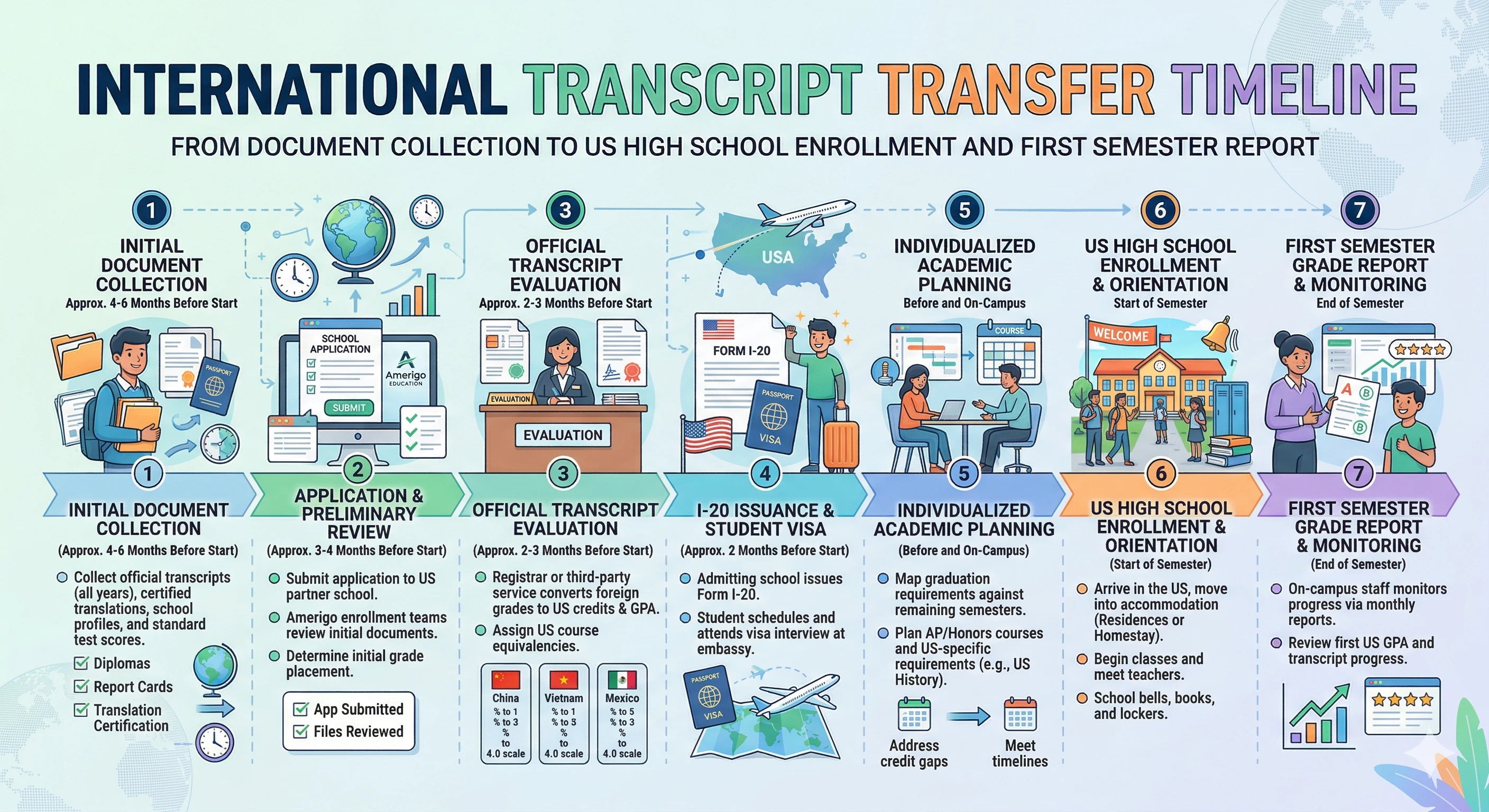
International students transferring to a US high school need official transcripts from all previous schools, certified English translations, a school profile or curriculum description, and proof of current enrollment or completion status. Under SEVP regulations, the admitting school must issue a Form I-20 based on verified academic records before the student can apply for an F-1 visa. Additional documents may include standardized test scores and teacher recommendations depending on the school.
Document preparation should begin three to four months before the intended start date. Official transcripts must carry the sending school's seal or stamp and be sent directly to the receiving school or credential evaluation service. Some countries require apostille certification for educational documents. Amerigo Education's enrollment process includes a document checklist tailored to each student's country of origin, with guidance on obtaining certified translations and meeting school-specific deadlines for each partner school.
- Official transcripts from all secondary schools attended, with grades for each completed term
- Certified English translations of all academic records by an approved translator
- School profile or curriculum description explaining the grading system and course content
- Proof of enrollment status or graduation from the previous school
- Standardized English test scores (TOEFL, IELTS, Duolingo English Test, or Eltis)
- Copy of passport biographical page for visa documentation
- Form I-20 eligibility documentation including financial capacity statements
- Teacher or counselor recommendation letters if required by the receiving school
What Challenges Do Transfer Students Face?
The most common challenge is credit gaps. Students entering a US high school after completing two or three years abroad may find that certain courses do not transfer, requiring additional classes to meet graduation requirements. Grade-level mismatches also occur when the sending country's academic calendar or curriculum pacing does not align with the US system. Language barriers compound these challenges for students still developing English proficiency.
Students entering in Grade 10 or 11 face compressed timelines to meet both graduation requirements and university preparation benchmarks. A student entering in Grade 11 may need to complete US History, take the SAT or ACT, build AP coursework, and develop extracurricular depth within two years. Amerigo Education addresses these timeline pressures through individualized academic planning that maps every remaining requirement against available semesters. Students live in homestay placements, on- and off-campus supervised residences, or self-provided accommodation, with on-campus international department staff monitoring progress through monthly reports and adjusting course loads as needed.
How Does Transcript Quality Affect University?
The quality of a student's US high school transcript directly determines university admission competitiveness. Universities evaluate GPA, course rigor measured by AP and Honors courses taken, grade trends, and the school's academic profile. A student who transfers international credits effectively and builds a strong US transcript with ascending grades and advanced courses presents a more compelling application than one with unexplained gaps or inconsistent grading.
University admissions officers review transcripts in the context of what was available at the student's school. Students at Amerigo Education partner schools have access to 20 or more AP courses, which demonstrates maximum course rigor when reflected on the transcript. Amerigo's Top 100 Guarantee, available at Signature partner schools, requires a cumulative GPA of 3.2 or higher and completion of at least one AP, IB, or Honors course. The guarantee provides up to $50,000 USD refund if the student does not receive a Top 100 university admission after meeting all requirements including two consecutive years of enrollment and a TOEFL score of 85 or above.
- GPA trajectory matters more than absolute GPA - ascending grades demonstrate growth and adaptation
- AP and Honors course selection signals academic ambition to university admissions officers
- Credit transfer gaps that appear as missing semesters require explanation in the application
- A school profile from a recognized institution adds credibility to the grades on the transcript
- Consistent grading across all semesters shows sustained effort and academic stability
- Course descriptions from international schools help universities understand non-standard curricula
Frequently Asked Questions
Do US high schools accept transcripts from any country?
Most US high schools accept transcripts from any country provided they are accompanied by certified English translations and verifiable school seals. The evaluation process varies by school. Schools with on-campus international departments typically have more experience processing records from diverse educational systems than those without established international enrollment.
How long does transcript evaluation take?
Transcript evaluation timelines range from two to eight weeks depending on the method used. Direct school registrar evaluation typically takes two to four weeks. Third-party credential evaluation services require four to eight weeks plus additional time for document shipping. Starting the process at least four months before the intended enrollment date provides sufficient buffer for delays or resubmission requests.
Can students skip grades based on international credits?
Grade skipping based on international credits is rare in the US system. Schools more commonly award course credits while maintaining age-appropriate grade placement. A student who completed advanced mathematics abroad might receive credit for Algebra II and begin with Pre-Calculus but would remain in their age-appropriate grade for other subjects.
What happens if courses do not have US equivalents?
Courses without direct US equivalents are typically classified as elective credits, counting toward total graduation credits but not toward specific subject requirements. A student who completed a country-specific civics course would receive elective credit rather than US Government credit and would still need to complete the US-specific requirement separately.
Do students need to retake courses after transfer?
Students do not retake courses that have been accepted for transfer credit. However, if a course is not accepted or only partially credited, the student may need to take an additional course in that subject area. This is most common with English Language Arts and US History which have curriculum-specific requirements. Amerigo Education's academic planning identifies these requirements during enrollment to prevent surprises in later grades.
How does transcript format affect evaluation?
Transcript format affects evaluation accuracy. Records including course descriptions, credit hours, and grading scale explanations are evaluated more quickly than those with grades alone. Schools using unfamiliar systems should provide a school profile explaining the scale. Official seals and direct transmission increase credibility.
Can students transfer mid-year to a US high school?
Mid-year transfers are possible at many US high schools though course availability may be limited for spring. Students transferring mid-year must have transcripts evaluated before enrollment and may need to complete partial credits for courses in progress at their previous school. Rolling admissions at most Amerigo Education Signature partner schools allow mid-year entry when spots are available.
Does Amerigo help with transcript evaluation?
Yes. Amerigo Education's enrollment teams coordinate transcript evaluation between families, sending schools, and partner school registrars. This includes guidance on obtaining certified translations, submitting documents in the required format, and following up on evaluation progress. The on-campus international department at each partner school has experience evaluating records from 55+ countries.
What grading scales do US high schools use?
US high schools use a 4.0 GPA scale where A equals 4.0, B equals 3.0, C equals 2.0, D equals 1.0, and F equals 0. Weighted GPA adds 0.5 to 1.0 points for AP and Honors courses, allowing weighted GPAs to exceed 4.0. Individual course grades are typically reported as letter grades or percentages. Cumulative GPA is calculated across all completed semesters and included on the official transcript.
How do transcript issues affect university admission?
Transcript inconsistencies, missing semesters, or unexplained grade drops can raise questions during university admission review. Admissions officers look for clear academic progression across all four years. Students whose international credits were properly transferred and documented present stronger applications. A counselor who can explain the transfer context in a recommendation letter addresses remaining questions.
Conclusion
International transcript transfer requires document preparation, credit evaluation, and strategic course planning to ensure grades translate effectively into the US system. Students who begin the process early and enroll in programs with established evaluation processes avoid credit gaps and maintain competitive GPAs. The Class of 2025 data - 97% Top 100 university admission across 3,500+ students from 55+ countries - demonstrates that structured transcript management produces measurable university outcomes.
Start Your Transcript Transfer Process
Families preparing to transfer international transcripts to a US high school can explore Amerigo Education's 40 partner schools across the US and Canada. Apply now to begin the enrollment and transcript evaluation process, or contact us to discuss grade-level placement and course planning for your student.
People Also Read
- Why US High School Transcripts Give International Students a University Admission Advantage
- What Grade Should International Students Start US High School?
About the Author
This guide was written by the Amerigo Education content team, drawing on program data from staff operating the on-campus international department at 40 Niche A+/A rated US and Canadian partner schools. Learn more about Amerigo Education.
Disclaimer: This article provides general information for educational purposes only. Families should conduct independent research, request current program data from providers, and consult with program representatives regarding specific circumstances. Contact us with questions.