All news
March 24, 2026
Study Abroad 101
How International Students Navigate US Healthcare: A Guide for Families
How do international high school students see a doctor, fill prescriptions, or visit the ER in the US? Complete healthcare navigation guide for families with students abroad.
How International Students Navigate US Healthcare: A Guide for Families
Last Updated: March 2026
A healthcare navigation gap is the disconnect between the medical system a family knows at home and the unfamiliar procedures they encounter in a foreign country. According to the CDC's National Center for Health Statistics, the US healthcare system operates through a network of private providers, insurance-based payment, and facility types that differ from government-run systems in most other countries. For families sending a minor child to study in the US, understanding how doctor visits, prescriptions, and emergency rooms actually work - before a health issue arises - reduces stress and prevents costly mistakes.
Amerigo Education supports 3,500+ students from 55+ countries across 40 Niche A+/A rated partner schools in the US, Canada, and UK. On-campus international department staff assist students with healthcare coordination, including scheduling appointments, explaining insurance processes, and providing 24/7 emergency assistance. This guide covers the practical experience of using US healthcare as an international high school student - not insurance plan requirements, which are addressed in separate resources.
Key Takeaways
- The school nurse is the first point of contact: For any health concern during the school day, students visit the school nurse, who assesses symptoms and determines whether a doctor visit, urgent care trip, or rest is needed.
- Three levels of care serve different needs: Primary care physicians handle routine visits and ongoing conditions, urgent care clinics treat same-day non-emergencies, and emergency rooms handle life-threatening situations.
- Students must carry their insurance card at all times: Every medical visit, pharmacy pickup, and emergency room check-in requires the insurance card, along with a photo ID and emergency contact information.
- Prescriptions work differently in the US: Many medications available over the counter in other countries require a US doctor's prescription, and pharmacies fill prescriptions electronically rather than accepting handwritten notes from foreign providers.
- On-campus staff coordinate medical logistics: Amerigo Education's on-campus international department staff help schedule appointments, arrange transportation, and communicate with families through monthly progress reports and native-language support for families from China, Vietnam, Korea, Mexico, the Taiwan Region, and more.
How Does the US Healthcare System Work?
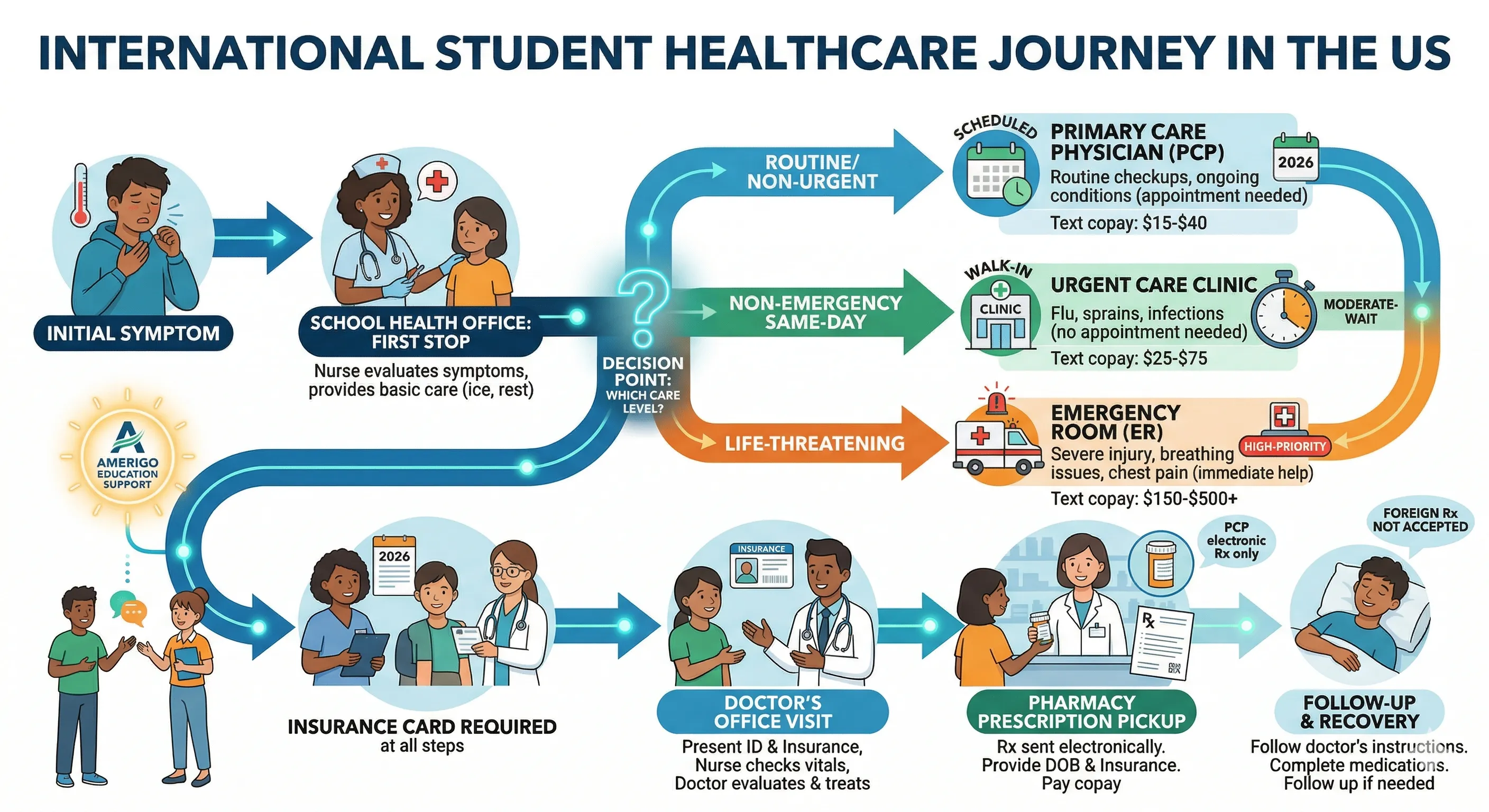
The US healthcare system is structured around three main care levels that serve different medical needs. A primary care physician (PCP) handles routine checkups, ongoing health conditions, and non-urgent concerns by appointment. Urgent care clinics accept walk-in patients for same-day treatment of conditions like flu, minor sprains, and infections. Emergency rooms (ERs) treat life-threatening situations around the clock. International families often find this tiered structure unfamiliar, especially when their home country uses a single-entry public system.
Understanding which facility to visit prevents unnecessary ER trips that can result in bills exceeding several thousand dollars even with insurance. A student with a sore throat and fever needs a PCP appointment or urgent care visit, not an emergency room. A student experiencing chest pain or a severe allergic reaction needs the ER immediately. On-campus international department staff at Amerigo Education partner schools help students and families determine the correct level of care when a health situation arises, removing the guesswork that leads to either delayed treatment or unnecessary expense.
What Happens at a Doctor's Appointment?
A typical US doctor visit begins at the front desk, where the student presents their insurance card and photo ID. Staff may ask the student to complete intake forms covering medical history, current medications, allergies, and the reason for the visit. The student then waits in a reception area until a nurse calls them back, checks vital signs - blood pressure, temperature, heart rate - and asks preliminary questions before the doctor enters. The entire visit typically lasts 15 to 30 minutes.
For international students, the school nurse often initiates the process by identifying a condition that needs physician evaluation and recommending a specific PCP. Residential staff or homestay families typically provide transportation to and from the appointment. The doctor may write a prescription, order lab tests, or refer the student to a specialist. At checkout, the student pays their copay - a fixed amount set by their insurance plan, usually between fifteen and fifty dollars. The insurance company handles the remaining charges directly with the provider's billing office.
- Present insurance card and photo ID at the front desk
- Complete or update intake forms covering medical history and allergies
- Wait in the reception area until called by a nurse
- Nurse checks vital signs and asks preliminary health questions
- Doctor examines the student and discusses symptoms
- Doctor prescribes treatment, orders tests, or refers to a specialist
- Pay the copay at checkout before leaving the office
- Pick up any prescribed medication at a pharmacy using the insurance card
How Do US Pharmacies and Prescriptions Work?
US pharmacies operate inside retail chains like CVS and Walgreens or within grocery stores and big-box retailers. When a doctor prescribes medication, they send the prescription electronically to the pharmacy the student selects. The student visits the pharmacy, provides their name and date of birth, presents their insurance card, and pays the medication copay. The pharmacist provides printed instructions covering dosage, timing, side effects, and drug interactions along with the medication itself.
International families should know that the US classifies medications differently than most other countries. Drugs available over the counter in parts of Asia, Europe, and Latin America may require a US prescription. Students who take regular medications should bring documentation listing the generic drug name, dosage, and prescribing doctor so a US physician can prescribe an equivalent. The insurance plan's formulary - a list of covered medications - determines the copay amount. Generic versions of brand-name drugs typically carry lower copays. Students should never share prescription medications with peers, as this violates US law.
When Should a Student Visit the ER?
Emergency rooms are designed for conditions where delayed treatment could result in permanent harm or death. A student should go to the ER for difficulty breathing, chest pain, severe allergic reactions with swelling or throat closure, head injuries involving loss of consciousness, broken bones with visible deformity, uncontrolled bleeding, or seizures. The ER operates 24 hours a day, 7 days a week, and treats patients based on severity rather than arrival order through a process called triage.
Students arriving at the ER should bring their insurance card, a photo ID or passport, a copy of their I-20 form, and emergency contact information including their parents' phone number and the school's contact line. Under US federal law (EMTALA), emergency rooms must evaluate and stabilize any patient regardless of insurance status or ability to pay. However, ER visits generate significantly higher charges than PCP or urgent care visits. Amerigo Education's 24/7 emergency assistance line allows students and residential staff to reach support coordinators who can guide them through the process and notify families in real time.
- Call 911 for immediately life-threatening situations - ambulance response is typically under 10 minutes
- Bring insurance card, photo ID or passport, I-20 copy, and emergency contact list
- Inform the triage nurse of any allergies, current medications, and medical history
- On-campus staff or homestay families should accompany minor students to the ER
- Contact Amerigo Education's 24/7 emergency assistance line for coordination support
- Keep all ER paperwork, discharge instructions, and prescribed follow-up information
- Follow up with the student's PCP within the timeframe the ER doctor specifies
What Role Does the School Nurse Play?
The school nurse is the first healthcare contact for international students during the school day. School nurses assess symptoms, administer basic treatments like ice packs, bandages, and approved over-the-counter medication, and determine whether the student needs to see a doctor. For conditions like headaches, minor stomach issues, or low-grade fevers, the nurse may recommend rest in the health office before returning to class. For anything requiring diagnosis or prescription treatment, the nurse refers the student to their PCP or urgent care.
School nurses also maintain student health records, track immunization compliance, and manage ongoing conditions like asthma or diabetes during school hours. Parents should ensure the school has current medical information on file, including allergies, medications, and signed consent forms authorizing treatment. According to the National Association of School Nurses, school nurses serve as the bridge between the school environment and the broader healthcare system, making them a critical resource for international students unfamiliar with US medical procedures.
- Student reports to the school health office when feeling unwell during the school day
- Nurse assesses symptoms and checks vital signs
- Minor issues are treated on-site with rest, ice, or approved OTC medication
- Conditions needing further evaluation result in a referral to PCP or urgent care
- Nurse contacts on-campus international department staff or homestay family for pickup and transportation
- Health office maintains records of visits and communicates patterns to families through the school's reporting system
What About Dental, Vision, and Mental Health?
Dental and vision care operate separately from medical care in the US, with different insurance plans, different providers, and different appointment processes. A student needing a dental cleaning visits a dentist's office, not their PCP. A student needing glasses or contact lenses visits an optometrist. These visits require confirming that the student's insurance includes dental and vision coverage, as standard medical insurance typically excludes both. Families should verify dental and vision benefits before the student arrives in the US.
Mental health services are available through multiple channels. School counselors address academic stress, homesickness, and social adjustment during the school day. Community mental health providers and private therapists offer ongoing counseling, often partially covered by student insurance plans. Telehealth platforms allow students to access counseling by video in their preferred language without leaving campus. On-campus international department staff at Amerigo Education partner schools monitor student wellbeing as part of monthly progress reports and can connect students with appropriate mental health resources when signs of distress appear.
How Do Families Stay Informed From Abroad?
Families thousands of miles away need reliable communication about their child's health status without being present at appointments. Amerigo Education provides monthly progress reports that include wellbeing observations alongside academic data, giving parents regular insight into their student's physical and emotional health. Native-language support for families from China, Vietnam, Korea, Mexico, the Taiwan Region, and more ensures medical information is communicated clearly regardless of the parents' English level.
Parents should complete all medical consent forms during enrollment so that authorized adults - residential staff, homestay parents, or designated school personnel - can approve treatment when parents are unreachable across time zones. Students should carry their insurance card, emergency contact information, and a list of allergies and current medications at all times. Accommodation options - homestay, on- and off-campus supervised residences, and self-provided housing - each involve different adults coordinating healthcare logistics, so families should understand who accompanies their child to medical appointments under their specific arrangement.
- Complete all medical consent forms during enrollment before the student arrives
- Confirm the student's insurance card is in their possession and they know how to use it
- Provide the school with a current list of the student's allergies, medications, and medical conditions
- Designate an emergency contact reachable during US business hours in case parents are unavailable
- Review monthly progress reports for any health or wellbeing observations from on-campus staff
- Discuss with the student what each care level (PCP, urgent care, ER) is for before the school year begins
- Keep a copy of the student's passport, visa, I-20, and insurance policy accessible digitally
- Ask on-campus staff about telehealth options available for routine consultations
Frequently Asked Questions
What should my child bring to a doctor's appointment in the US?
Students should bring their health insurance card, a photo ID or passport, and any relevant medical records or allergy documentation. If the student takes prescription medications, bring a list with dosages and prescribing doctor information. Having the school's emergency contact number and a signed parental consent form on file ensures the appointment proceeds without delays related to guardian authorization.
How does the US pharmacy system work for international students?
US pharmacies like CVS and Walgreens fill prescriptions sent electronically by licensed US doctors. The student presents their insurance card at pickup, pays the copay, and receives printed medication instructions. Some medications available over the counter in other countries require a US prescription, so students should not assume they can purchase familiar medications without a doctor visit first.
When should an international student go to the emergency room?
Emergency rooms are for life-threatening situations such as difficulty breathing, chest pain, severe allergic reactions, head injuries with loss of consciousness, broken bones with visible deformity, or uncontrolled bleeding. For non-life-threatening conditions like minor sprains, flu symptoms, or mild infections, urgent care clinics provide faster and less expensive treatment. On-campus staff help students determine the right level of care.
What is the difference between a copay and a deductible?
A copay is a fixed dollar amount paid at each medical visit, typically between fifteen and fifty dollars depending on the plan. A deductible is the total amount a student must pay out of pocket before insurance begins covering a larger share of costs. After meeting the deductible, insurance pays a percentage of remaining charges. Families should review their specific policy to understand both amounts.
Can my child see a doctor who speaks our language?
Many US medical practices employ bilingual staff or offer interpreter services by phone or video. On-campus international department staff can help locate providers who speak Chinese, Vietnamese, Korean, Spanish, or other languages common among international student families. Under federal law, healthcare facilities receiving government funding must provide language assistance at no cost to the patient.
Do international students need parental consent for medical care?
Minor students generally require parental or guardian consent for medical treatment in the US. Most programs collect signed medical consent forms during enrollment so authorized adults can approve treatment when parents are in another country. Emergency situations are an exception - US law permits doctors to treat minors without consent when delaying treatment would endanger the patient's life or health.
Are dental and vision visits covered by student health insurance?
Dental and vision care are typically covered under separate insurance plans in the US, not under standard medical insurance. Some international student policies include basic dental and vision coverage, while others require additional riders. Families should confirm these benefits before the student arrives. Routine cleanings, eye exams, and glasses may require separate appointments with providers outside the PCP network.
What happens if my child gets sick on a weekend or holiday?
Urgent care clinics operate on weekends and some holidays, accepting walk-in patients for same-day non-emergency treatment. Telehealth services allow students to consult a doctor by phone or video without leaving their residence. Amerigo Education provides 24/7 emergency assistance, so residential staff or homestay coordinators can help students access appropriate care outside normal school hours.
How do US prescription medications compare to those in other countries?
Some medications sold over the counter in other countries require a US prescription, and brand names often differ internationally. Students taking regular medications should bring documentation of current prescriptions including the generic drug name and dosage so a US doctor can prescribe an equivalent. Controlled substances like certain ADHD or anxiety medications require specific US prescriptions and cannot be transferred from foreign doctors.
Is mental health counseling available for international students?
Most US high schools provide access to school counselors who address academic stress, homesickness, and social adjustment. Community mental health resources and private therapists are also available, often partially covered by student insurance. On-campus staff monitor student wellbeing through monthly progress reports and can refer students to counseling services. Telehealth counseling options allow students to speak with a therapist in their preferred language.
Conclusion
International students access US healthcare through a tiered system of school nurses, primary care physicians, urgent care clinics, and emergency rooms, each serving different medical needs at different cost levels. Families who understand these distinctions before the school year begins - and ensure consent forms, insurance cards, and medical records are in place - give their student the preparation to handle health situations calmly and correctly.
Get Healthcare Support for Your Student
Families seeking a program with built-in healthcare coordination can explore US partner schools, view Canadian options, or learn about Brentwood School in the UK. Apply now to begin enrollment, or contact us to discuss how on-campus international department staff support your student's health and wellbeing throughout the school year.
People Also Read
- Medical Insurance for F1 Students
- Health Insurance for F1 Students
- Is America Still Safe for International Students in 2026: What Parents Need to Know
About the Author
This guide was written by the Amerigo Education content team, drawing on program data from staff operating the on-campus international department at Amerigo Education's partner schools across the US, Canada, and UK. Learn more about Amerigo Education.
Disclaimer: This article provides general information for educational purposes only. It does not constitute medical advice. Families should consult with healthcare providers, review their specific insurance policy, and contact program representatives regarding individual circumstances. Contact us with questions.