All news
February 21, 2026
Study Abroad 101
Can International Students Attend Public High School in the USA?
F-1 visa holders can attend US public high school for 12 months max and must pay $10,000-$15,000/year. Full 2026 guide to rules, costs, and alternatives.
Can International Students Attend Public High School in the USA?
Last Updated: March 2026
A US public high school for international students is a government-funded secondary school where F-1 visa holders may enroll for a maximum of 12 months under Section 214(m) of the Immigration and Nationality Act. Students must reimburse the school district for the full unsubsidized per-pupil cost, averaging $13,700 per year according to the National Center for Education Statistics. The 12-month limit is a lifetime cap, not a per-year allowance.
Amerigo Education places approximately 1,000 students annually across 40 Niche A+/A rated partner schools in the US and Canada. The Class of 2025 achieved a 97% Top 100 university admission rate. For families targeting competitive US universities, understanding the difference between public and private high school options on an F-1 visa shapes every decision - from enrollment duration to support services and academic outcomes.
Key Takeaways
- 12-month federal cap: F-1 visa holders may attend a US public high school for a maximum of one academic year - a lifetime limit that cannot be renewed or reset.
- Reimbursement required: F-1 students must pay the district's unsubsidized per-pupil cost, typically $10,000-$15,000 per year, with the national average at $13,700.
- No time limit at private schools: Private high schools carry no F-1 enrollment cap, allowing two-to-four-year programs with full university preparation.
- 97% Top 100 admission rate: The Class of 2025 at Amerigo Education partner schools achieved 97% admission to Top 100 US universities with 100% overall acceptance.
- Multiple English tests accepted: Amerigo Signature Schools accept TOEFL, IELTS, Duolingo English Test, and Eltis - giving families flexible options for demonstrating proficiency.
What Are the F-1 Rules for US Public High Schools?
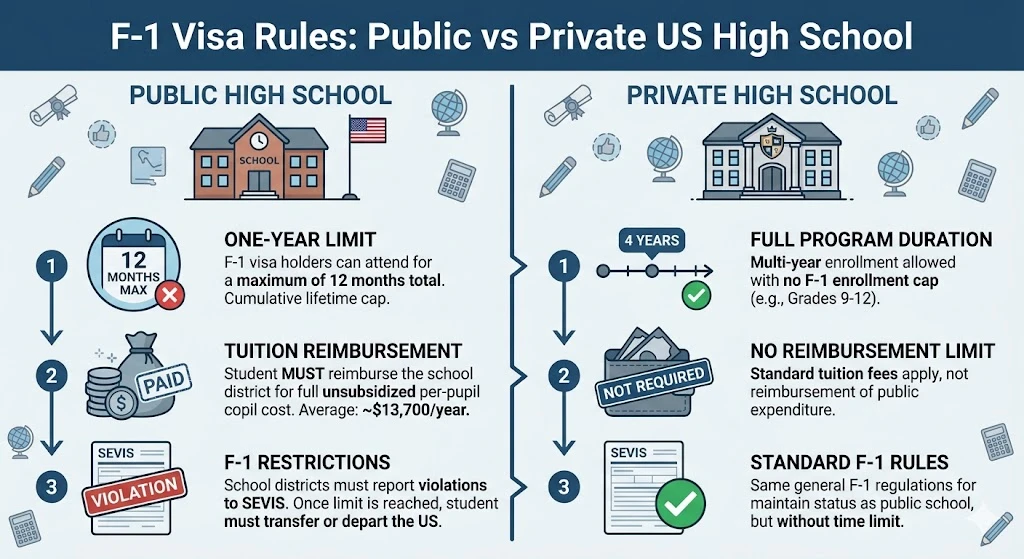
International students on an F-1 visa can attend a US public high school, but federal law places strict limits on duration and cost. Under Section 214(m) of the Immigration and Nationality Act, F-1 students at public secondary schools (grades 9-12) may enroll for a maximum of 12 months total across their entire lifetime in the US. This is a cumulative cap that applies once and cannot be reset.
In addition to the 12-month ceiling, F-1 students at public high schools must reimburse the school district for the unsubsidized per-pupil cost of education. According to the National Center for Education Statistics, the average annual per-pupil expenditure at US public schools is approximately $13,700, though this varies significantly by state and district. Once the 12-month period ends, the student must transfer to a private school, change visa status, or depart the US. School districts report violations to SEVIS, the Student and Exchange Visitor Information System managed by the Department of Homeland Security.
How Do Public and Private High Schools Compare?
The key difference for international students is that public high schools limit F-1 enrollment to 12 months with mandatory reimbursement, while private high schools allow multi-year enrollment with no time cap. Public schools offer authentic immersion, diverse demographics, and broad extracurricular access. The trade-off is the 12-month ceiling, which means students who want a two-to-four-year program will need to plan for a private school pathway from the start.
For students planning to attend US high school for two, three, or four years, a private school is the only viable path on an F-1 visa. Private schools with dedicated international programs provide academic advising, ELL coursework, and university counseling that public schools rarely offer. Amerigo Education's on-campus international department model places support staff directly inside partner schools, giving students daily access to academic planning and English development resources.
*Amerigo Education's Signature Schools include all features listed in the private school column.
**Amerigo's Foundation Program allows students to enroll at a public school for one year and receive conditional admission to a partner university, including university counseling support.
What Does a US Public High School Experience Include?
Public high school in the US enrolls about 90% of all American secondary students according to NCES data, and the experience reflects that breadth. Classes range from 25 to 35 students, extracurricular offerings are extensive, and most public schools follow the standard US curriculum with AP courses available at larger schools. The social environment is typically more informal than high schools in Asia or Europe.
What public schools generally do not offer is a dedicated international student support structure. Most districts assign international students to a general ESL program if one exists, but individualized academic planning, university counseling, monthly progress reports, and 24/7 emergency support are not standard features. Amerigo Education provides this through its on-campus international department at each Signature private partner school, providing the structured academic and personal support that public schools lack.
- Class size: 25-35 students per classroom in most public high schools
- Curriculum: Standard US curriculum with AP courses at larger schools
- Extracurriculars: Broad offerings in sports, arts, clubs, and community service
- ESL support: General programs where available - not individualized
- University counseling: Generic guidance shared across hundreds of students
- International support staff: Rarely available in public school districts
- Monthly family reports: Not offered at public schools
- Social environment: Diverse student body with informal classroom culture
How Do International Students Apply to US High Schools?
Every F-1 student needs a Form I-20, issued by the SEVP-certified school they plan to attend. This document creates the SEVIS record, which is activated when the student pays the SEVIS I-901 fee (currently $350) and registers. The I-20 must come from a Student and Exchange Visitor Program-certified institution. Both private international pathway schools and most public high schools with international enrollment hold SEVP certification.
For English proficiency, the accepted tests vary by school and program. At Amerigo Signature Schools, most applications receive a decision within 2-4 weeks, and students can apply to multiple partner schools through a single application at no extra cost. For families considering the F-1 visa process in detail, the steps from application to arrival typically run 3-6 months.
- Apply to a SEVP-certified school - submit transcripts, English test scores, and application materials
- Receive a Form I-20 - the school issues this enrollment document after acceptance
- Register in SEVIS - pay the I-901 fee ($350) and activate your student record
- Apply for an F-1 student visa - schedule an interview at a US embassy or consulate
- Prepare travel documents - confirm passport validity, financial documentation, and enrollment dates
- Complete pre-departure orientation - review school policies, arrival logistics, and housing details
- Attend classes at your designated school - maintain full-time enrollment to keep F-1 status
Amerigo Education's third-party visa consulting partner provides interview coaching, document review, and application guidance. Visa services are billed separately from program fees.
What Are the Pathway Options for International Students?
For students seeking a two-to-four-year private school pathway, Amerigo Education operates through 40 Niche A+/A rated partner schools across the US and Canada. Amerigo offers three primary accommodation models: homestay placement, which provides cultural immersion at a more affordable price point with academic support at the school's on-campus international department office; and on and off-campus residences located 20-30 minutes from partner schools, which are single-gender, staffed 24/7, and include dedicated study areas. A third option - self-provided accommodation - is available for students who have family or relatives near the school and prefer to arrange their own housing independently.
Amerigo Education's support model includes customized ELL coursework to accelerate English development, AP course planning from the first semester, and university counseling that begins in Grade 9 or 10. Students also receive monthly progress reports, native-language communication support for families from China, Vietnam, Korea, Mexico, and Taiwan Region, and 24/7 emergency assistance through Life360 or Reach safety technology.
Amerigo's Top 100 Guarantee backs these outcomes with a $50,000 USD refund for eligible students at US Signature Schools. The guarantee requires two consecutive years of enrollment, a cumulative GPA of 3.2 or higher, a TOEFL score of 85 or above, and completion of at least one AP, IB, or Honors course. Grade 12 direct entry students are not eligible.
How Much Does Public vs Private High School Cost?
Public high school costs F-1 students the district's unsubsidized per-pupil rate, typically $10,000-$15,000 per year, for a maximum of 12 months. Private high school programs range from $40,000 per year at entry level to $75,000-$110,000+ per year for Signature-level programs. The private school cost includes tuition, accommodation, academic support, and university counseling. Visa services are handled through third-party partners and billed separately.
Families evaluating total costs should consider what each price point is included or covered. Amerigo Education's program fees cover tuition, accommodation (homestay or off-campus residence), on-campus international department support, and structured university preparation over multiple years.
Frequently Asked Questions
Can a foreign child go to public school in the USA?
Yes. Under federal law, all children in the United States have a right to access public K-12 education regardless of immigration status. For international students on F-1 visas, high school attendance carries additional restrictions: F-1 holders may attend public secondary schools (grades 9-12) for a maximum of 12 months total. This is a lifetime cap. F-1 students must also reimburse the school district for the unsubsidized per-pupil cost of education, typically $10,000 to $15,000 per year.
Is public high school free for international students?
No. Public high school is not free for international students on F-1 visas. Federal law requires F-1 students attending public secondary schools to reimburse the school district for the full unsubsidized per-pupil cost. The national average is approximately $13,700 per year according to the National Center for Education Statistics, though actual costs vary significantly by state and district. Private pathway programs charge higher fees but include accommodation, academic support, and university counseling.
Do public high schools accept international students?
Most SEVP-certified public high schools can accept F-1 students for up to 12 months. However, many districts do not actively recruit international students and offer little international-specific programming or support. For students seeking dedicated English language development, AP course planning, and university counseling, a private high school program with structured international support is typically the stronger choice. Amerigo Education's partner schools provide this support through an on-campus international department.
What is the best US high school for international students?
The best US high school depends on academic goals, English proficiency level, preferred location, and budget. Strong indicators include Niche A+ or A ratings, dedicated international support staff, AP course availability, and published university admission outcomes. Amerigo Education's 40 partner schools are all Niche A+/A rated. Each campus page on the school directory details specific programs and outcomes for that location, helping families compare options side by side.
How can a foreigner go to high school in the US?
The standard process involves five steps: apply to a SEVP-certified school, receive a Form I-20, register in SEVIS and pay the I-901 fee of $350, apply for an F-1 student visa at a US embassy or consulate, and attend the school specified on the I-20. Amerigo Education's F-1 visa guide covers each stage in detail, from document preparation through arrival and orientation.
What should international students expect at a US high school?
The US high school experience varies significantly depending on whether a student attends a public or private school. At public high schools, students experience a more informal classroom culture, with class sizes averaging 25 to 35 students, broad extracurricular options, and general ESL support where available, but limited international-specific services. At private high schools with a dedicated international program, such as Amerigo Education partner schools, students receive structured orientation, academic advising, customized ELL coursework, monthly progress reports, and peer connection programs. Both settings emphasize participation, project-based learning, and extracurricular involvement, but the level of support for international students differs considerably.
What are the new rules for international students in 2026?
The most significant regulatory development for 2025-2026 is increased SEVIS oversight and reporting requirements. All F-1 students must maintain full-time enrollment and comply with the 12-month public school limit. Amerigo Education's F-1 visa changes guide for 2025-2026 covers these updates specifically for high school-age students and their families, including reporting timelines and compliance requirements.
How do I choose a US high school as an international student?
Choosing a US high school involves evaluating school quality ratings such as Niche scores, available international support infrastructure, AP course offerings, accommodation options, geographic location, and documented university counseling outcomes. Amerigo Education's school selection guide helps families compare these factors across 40 Niche A+/A rated partner schools in the US and Canada.
Can international students attend US high school without TOEFL?
Yes. Many private international programs accept IELTS Academic, Duolingo English Test, and Eltis as TOEFL alternatives. Amerigo Signature Schools specifically accept Eltis and Duolingo, which are generally considered more accessible and affordable for younger test-takers. The minimum score required varies by school and program tier, so families should confirm current requirements with their admissions contact before applying.
What grade should an international student start US high school?
Most international students start between Grade 9 and Grade 11. Starting in Grade 9 or 10 allows the most time for AP coursework, extracurricular development, and university preparation. Students entering directly into Grade 12 are not eligible for Amerigo's Top 100 Guarantee. A detailed breakdown of optimal entry timing appears in the complete grade timing guide.
Conclusion
International students can attend US public high schools on an F-1 visa for a maximum of 12 months and must reimburse the school district an average of $13,700 per year. After that limit, students must transfer to a private school or leave the country. Private high schools carry no F-1 time limit, with costs ranging from $40,000/year at entry level to $75,000-$110,000+/year for premium programs. The Class of 2025 achieved 97% admission to Top 100 universities, backed by a $50,000 USD Top 100 Guarantee for eligible students.
Ready to Explore Your Options?
Amerigo Education, founded in 2016 and backed by Avathon Capital, operates 40 Niche A+/A rated partner schools across the US and Canada. Whether your student is considering a short-term public school experience or a multi-year private school pathway, the right choice starts with understanding the rules, the costs, and the outcomes. Contact us or apply now to speak with an enrollment advisor about the best fit for your family.
People Also Read
- Boarding School vs Day School for International Students: Complete Comparison Guide 2026
- What Grade Should International Students Start US High School? Complete Timing Guide 2026
- How to Get Student Visa for US: Complete Guide 2025-2026
About the Author
This guide was written by the Amerigo Education content team, drawing on program data from staff operating the on-campus international department at 40 Niche A+/A rated US and Canadian partner schools. Learn more about Amerigo Education.
Disclaimer: This article provides general information for educational purposes only. Families should conduct independent research, request current program data, and consult with program representatives regarding specific circumstances. Contact us with questions.