All news
May 13, 2026
Study Abroad 101
Most Common F-1 Visa Denial Reasons for High School Applicants in 2026
Most common F-1 visa denial reasons for high school students 2026: Section 214(b), financial documentation errors, non-immigrant intent, and reapplication steps.

Most Common F-1 Visa Denial Reasons for High School Applicants in 2026
Last Updated: May 2026
F-1 visa denial for international high school students most often results from a failure to satisfy the requirements of Section 214(b) of the US Immigration and Nationality Act - the provision that requires every visa applicant to demonstrate they do not intend to immigrate permanently. According to SEVP, all F-1 (student visa for academic programs) applicants must demonstrate both the ability to fund their program and the intention to return home after completing their studies. Understanding why denials happen is the most effective preparation for a successful interview.
Amerigo Education partners with 40 Niche A+/A rated schools across the US, Canada, and the UK, supporting 3,500+ students from 55+ countries. The Class of 2025 achieved 97% admission to Top 100 US universities. For families navigating the F-1 application process, Amerigo's pre-departure support and optional visa assistance through ZF Visa - available for US program enrollment only - provide structured preparation from document review through interview readiness.
This guide covers the most common F-1 denial reasons for high school applicants in 2026, explains what each denial category means in practice, and outlines the steps families can take to improve approval outcomes before and after a visa interview.
Key Takeaways
- 214(b) denials: The majority of F-1 denials cite Section 214(b) of the INA - failure to demonstrate non-immigrant intent or sufficient financial resources.
- Financial documentation: Bank statements must cover the full program cost for the entire planned enrollment period - not just the first year.
- Non-immigrant intent: Applicants must demonstrate clear reasons to return home after completing studies; vague or unconvincing answers are a leading cause of denial.
- Document consistency: Any inconsistency between the I-20 form, financial documents, and interview answers increases denial risk significantly.
- Reapplication is possible: An F-1 denial is not permanent; applicants can reapply with stronger documentation and more thorough interview preparation.
What Is Section 214(b) and Why Does It Cause Denials?
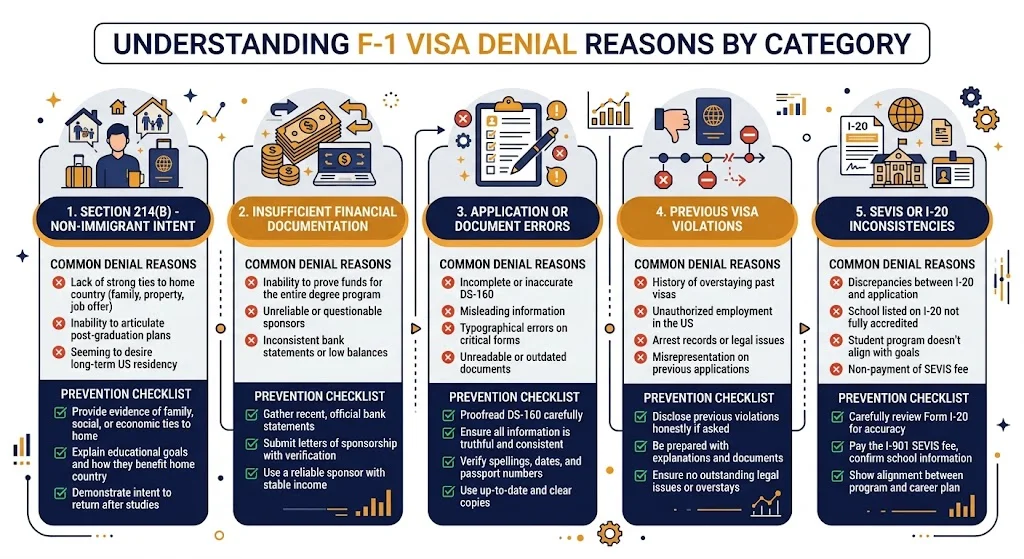
Section 214(b) of the US Immigration and Nationality Act (INA) places the burden of proof on the visa applicant to demonstrate they are not an intending immigrant. Every person applying for an F-1 student visa for academic programs is presumed to be an intending immigrant until they demonstrate otherwise. Consular officers evaluate this presumption primarily through financial evidence and the strength of the applicant's ties to their home country.
For high school applicants aged 14-18, the ties evaluated are not personal employment or property - they are family ties and a clear understanding of why the student is pursuing a US high school program and returning home afterward. SEVIS (Student and Exchange Visitor Information System) status, program documentation, and financial records are the primary documents consular officers review during a 3-5 minute interview.
According to IIE Open Doors (2025), the US remains the top destination for international high school students, which means consular officers at key issuing posts in Asia, Latin America, and Europe process significant volumes of F-1 high school applications each year. Preparation quality directly affects interview outcomes.
- Presumed immigrant intent: Applicants start with zero benefit of the doubt - they must actively demonstrate non-immigrant intent.
- Short interview window: Most F-1 interviews for high school students last 3-5 minutes; every answer must be direct and clear.
- Financial sufficiency: Insufficient bank statements are the second most common reason for 214(b) denial after intent-related concerns.
- Home country ties: For minors, family ties - parents, siblings, extended family - are the primary ties the consular officer evaluates.
What Financial Documents Cause F-1 Denials?
Financial document errors are among the most preventable causes of F-1 denial. Bank statements must demonstrate funds sufficient to cover the complete planned program cost - not just the first year. If a student is applying for a two-year program under the Top 100 Guarantee pathway, the financial documentation should reflect funds for both years. Statements that cover only one year of a multi-year program are frequently cited as grounds for financial insufficiency under Section 214(b).
The documentation must also be recent - typically issued within 90 days of the interview appointment. Savings accounts, fixed-term deposits, and investment accounts may all be submitted, but the issuing bank must be a regulated financial institution in the student's home country. Undocumented cash assets cannot be presented as proof of financial ability.
According to NACAC (2024), families who work with counselors experienced in F-1 documentation prepare bank statement packages that are more complete and consistently referenced during the interview, reducing the risk of financial-based denial. The on-campus international department at each Amerigo US Signature School coordinates with families on documentation requirements specific to each consulate.
How Does Non-Immigrant Intent Affect F-1 Approval?
Non-immigrant intent is the single most common basis for F-1 denial. The consular officer is evaluating whether the student has strong enough ties to their home country to guarantee return after completing the high school program. For minor applicants, those ties are typically family-based. A student who cannot clearly articulate why they will return home after graduation - or who expresses ambiguous plans about staying in the US - is at higher risk of a 214(b) finding.
Parents who are present at the interview (permitted at many posts for minor applicants) must also be able to answer clearly and consistently with the student's stated plans. Inconsistency between parent and student answers is a significant denial risk that families do not always anticipate.
Students who have family members with US permanent residency or citizenship should be prepared to explain their own intent to return home clearly - consular officers may view such connections as evidence of immigrant intent unless countered by credible evidence of home-country ties.
According to NAIS (2025), students at private US high schools who begin visa application preparation with structured counselor support achieve stronger documentation outcomes than those who prepare without guidance. Amerigo's university guaranteed admission counseling team works alongside pre-departure staff to ensure students can articulate their US high school program goals and post-graduation return plans clearly.
What Application Errors Lead to F-1 Denial?
Application and document errors are avoidable but frequently cited in denial cases. The DS-160 (Online Nonimmigrant Visa Application) must be completed accurately, with answers that match the I-20 issued by the partner school. Any discrepancy between the program name, school address, or program dates on the DS-160 and the I-20 form raises questions that consular officers will flag in the interview.
The I-20 form is issued by the partner school after enrollment is confirmed and the SEVIS fee has been paid to SEVP. Families must confirm the I-20 information is correct before the interview appointment - errors in the student's name, date of birth, or program dates on the I-20 require the school's DSO (Designated School Official) to issue a corrected form, which adds processing time and delays the interview.
Optional F-1 application support through ZF Visa - available for Amerigo US program enrollment only - provides families with structured guidance through the DS-160 and document preparation stages. ZF Visa is not available for UK Student Visa applications at Brentwood School Essex or Berkhamsted School.
Can a Denied F-1 Application Be Reapplied?
An F-1 visa denial is not permanent. Applicants can reapply at any time without a mandatory waiting period, though most experienced advisors recommend waiting until the circumstances that caused the denial can be meaningfully addressed. Reapplying with the same documentation as the original application is unlikely to produce a different result.
Effective reapplication strategies include strengthening financial documentation, clarifying non-immigrant intent with additional supporting evidence of home-country ties, and preparing more thoroughly for the interview's likely questions. A consular officer reviewing a reapplication will see the record of the prior denial and the stated reason - applicants must be prepared to address that reason directly.
According to SEVP, maintaining a valid I-20 and current SEVIS record is required throughout the F-1 application and enrollment process. If the school's enrollment year begins while the reapplication is in progress, families should contact the school's DSO to request a deferred start date and an updated I-20 before the SEVIS record expires. Families can explore Amerigo's partner school options to identify the best Signature School match before the reapplication is filed.
How Does Amerigo Support F-1 Visa Preparation?
Amerigo's pre-departure support for US Signature School students includes a 1:1 academic director call focused on transcript review and course planning, and a separate pre-departure orientation session covering arrival logistics, health documentation, and interview preparation - run by campus coordinators. These two events are distinct: the academic director call covers academic matters, and the orientation session covers practical logistics including what to expect at the consulate.
ZF Visa, Amerigo's optional third-party F-1 visa assistance partner, provides document review, DS-160 guidance, and interview preparation for an additional fee. ZF Visa assistance is available for US program enrollment only and is never used for UK Student Visa applications. Families who prefer to complete the F-1 application independently can do so using the I-20 issued by the partner school and guidance from the school's DSO.
After arrival in the US, students receive monthly progress reports, school activity calendars and event announcements through StudyStudyGo, Amerigo's parent communication platform launching Fall 2026, which keeps families informed throughout the enrollment period.
Frequently Asked Questions
What is the most common reason F-1 visas are denied?
The most common reason is Section 214(b) of the US Immigration and Nationality Act - failure to demonstrate non-immigrant intent or financial sufficiency. Consular officers must be convinced that the student will return home after completing their program. For high school applicants, intent is evaluated through family ties, clear post-graduation plans, and the credibility of the student's interview answers. Financial insufficiency is the second most frequently cited reason.
How can students demonstrate non-immigrant intent at the F-1 interview?
Students should clearly state why they are pursuing a US high school program, what they plan to study, and what they will do after completing high school - specifically, their plan to return home for university or family reasons. Family ties in the home country are the primary evidence for minor applicants. Parents who accompany minor applicants must give answers consistent with the student's stated plans.
What financial proof is required for F-1 high school approval?
Bank statements covering the full cost of the planned enrollment period are required. For a two-year program, statements must reflect funds for both years, not just year one. Statements must be recent (typically within 90 days), issued by a regulated financial institution, and in the student's family name or with documentation of the relationship if a third party is sponsoring the program.
What is Section 214(b) of the INA?
Section 214(b) of the Immigration and Nationality Act is the provision that presumes every non-immigrant visa applicant to be an intending immigrant until proven otherwise. The applicant carries the full burden of demonstrating non-immigrant intent and financial ability. Most F-1 denial letters cite Section 214(b) without specifying the exact concern - applicants must assess their own interview to determine which aspect to strengthen before reapplying.
Does a SEVIS record problem cause F-1 denial?
SEVIS (Student and Exchange Visitor Information System) record inconsistencies - such as mismatches between the I-20 and the DS-160, or an unpaid SEVIS fee - can cause delays or denial at the interview. The SEVIS fee of $350 must be paid to SEVP before the visa interview and confirmed with the DS-160 receipt. Families should confirm the SEVIS record is active and accurate with the school's DSO before scheduling the consulate appointment.
Can a student reapply after F-1 denial?
Yes. F-1 denial is not permanent and applicants may reapply at any time. However, reapplying without addressing the denial reason is unlikely to succeed. The consular officer reviewing a reapplication will see the prior denial. Effective reapplication requires stronger financial documentation, clearer evidence of non-immigrant intent, or corrected application materials - depending on the specific reason for the original denial.
How long should families wait before reapplying after F-1 denial?
There is no mandatory waiting period before F-1 reapplication. The practical consideration is whether the circumstances that caused the denial can be meaningfully improved before the new appointment. If the denial was financial, obtaining updated bank statements and additional financial evidence may take 2-4 weeks. If the denial was intent-related, additional preparation time for the interview is the most valuable investment.
Does ZF Visa help with denied F-1 applications?
ZF Visa, Amerigo's optional third-party F-1 visa assistance partner, provides document review, DS-160 guidance, and interview preparation services. ZF Visa support is available for US program enrollment only. Families who received a prior denial and are reapplying may find document review support particularly helpful in identifying what to strengthen before the new interview. ZF Visa does not guarantee visa approval.
What role does the I-20 form play in F-1 approval?
The I-20 is the Certificate of Eligibility for Nonimmigrant Student Status, issued by the partner school after enrollment is confirmed. Every piece of information on the I-20 - student name, date of birth, program dates, and school details - must match the DS-160 and interview answers exactly. Discrepancies between the I-20 and other documents are a common application error that consular officers flag. The I-20 is issued after the enrollment deposit and SEVIS fee are paid.
How does Amerigo prepare families for the F-1 visa process?
Amerigo's pre-departure support includes a 1:1 academic director call covering course planning and a separate pre-departure orientation session covering arrival logistics and preparation steps - run by campus coordinators. Optional F-1 visa assistance is available through ZF Visa for US program enrollment only. The school's DSO issues the I-20 after enrollment is confirmed and coordinates any corrections needed before the visa appointment.
Conclusion
The most common F-1 visa denial reasons for high school applicants in 2026 are Section 214(b) findings related to non-immigrant intent, insufficient financial documentation, and application errors. All three categories are addressable through thorough preparation before the interview. Families pursuing US Signature School enrollment through Amerigo should begin visa preparation as soon as the I-20 is issued.
Prepare Your F-1 Application With Confidence
To learn more about studying in America at an Amerigo partner school, contact us to speak with a program advisor about visa preparation, or apply now to begin the enrollment process.
People Also Read
- What Documents Are Required for F-1 Visa Interview? Complete Checklist 2026
- When Should I Apply for F-1 Visa? Complete Timeline Guide 2026
- F-1 Visa Changes 2026: What International High School Students Need to Know
About the Author
This guide was written by the Amerigo Education content team, drawing on program data from staff operating the on-campus international department at 40 Niche A+/A rated US, Canadian, and UK partner schools. Learn more about Amerigo Education.
Disclaimer: This article provides general information for educational purposes only. Families should conduct independent research, request current program data from providers, and consult with program representatives regarding specific circumstances. Contact us with questions.